
Releases
Every version of VeilVoice, what changed in it, and where to get it.
The same notes as CHANGELOG.md.
Every release, newest first. Open one to read what changed in it; its files are at the end of the notes. The notes are CHANGELOG.md, which is where they are written.
Check a download the signature, the hashes, and the files inside the archive, from the command line or the window
Every archive below is signed, and every release publishes the two files that let you check it: SHA256SUMS, a list of hashes, and SHA256SUMS.asc, the detached OpenPGP signature over that list. From v0.1.15 there is a third, CONTENTS.sha256, which is itself covered by SHA256SUMS and lists every file inside each archive, so the binary you are about to run can be checked and not merely the zip it arrived in.
The signing key's fingerprint is:
8101 FB3B B28D 02FB 239E 0CDF 9CC1 C7E7 A9B5 833AComparing that against the copy in README.md and the copy on the front page is the one step no program can do for you, because a program that came out of the download cannot vouch for the download.
The chain, end to end. Every check below is one link in this, and each link is only worth anything if the one above it held:
SHA256SUMS.ascis a detached OpenPGP signature, made with the key above, overSHA256SUMS. Verifying it is what ties everything under it to a person rather than to whoever served you the files. Skip it and the hash list is numbers of unknown origin, and comparing your file against numbers of unknown origin proves nothing at all.SHA256SUMSholds the hash of each archive and the hash ofCONTENTS.sha256, so the contents list is signed as well, by being covered by the list the signature is over.CONTENTS.sha256holds the hash of every file inside each archive:veilvoice,veilvoice-gui, and everything shipped beside them.
So the hash of the binary you are about to run traces back, link by link, to that one signature. Checking the archive stops at step 2 and tells you the zip was published; going on to step 3 tells you the program was, which is the question somebody actually has. Releases before v0.1.15 publish no CONTENTS.sha256 and stop at step 2, and every command here says so at the time rather than quietly checking less.
With VeilVoice itself, no GnuPG required
The verifier is part of veilvoice: it is not a separate download, and it carries the signing key compiled in, so it needs no GnuPG, no keyring and no network.
The whole check, in one command
veilvoice verifyRun it in the folder you downloaded to. It finds the release, checks the OpenPGP signature over SHA256SUMS, checks every archive against that list, checks CONTENTS.sha256 against it as well, and then checks every file you extracted against CONTENTS.sha256. Each step runs only if the one before it passed. Entirely offline.
The same, pointed at a folder
veilvoice verify auto ~/DownloadsA named directory is checked and nothing else is searched. A path that is not there is refused by name rather than answered with a verdict about somewhere else.
The signature over the hash list, on its own
veilvoice verify sums SHA256SUMS SHA256SUMS.ascThis is the step everything else rests on. SHA256SUMS is a list of numbers; SHA256SUMS.asc is the detached OpenPGP signature over it. Until that signature checks out against the signing key, the list is just numbers somebody sent you.
One file, against the signed list
veilvoice verify file veilvoice-v0.1.22-linux-x86_64.tar.gz --sums SHA256SUMS --sig SHA256SUMS.ascThe signature is verified first, and the file is compared against the list only after that passes. A pass means the download is INTACT: byte for byte the file that was published, signed by the VeilVoice key.
One file, with no hash list at all
veilvoice verify file veilvoice-v0.1.22-linux-x86_64.tar.gz --sha256 THE_HASH_YOU_WERE_GIVENFor when you have a hash rather than a signed list. What a match proves depends entirely on where that hash came from, and only you know that, so the tool says so instead of guessing. If it came from somebody else's independent build of the same tag, a match means the release is REPRODUCIBLE, which is the stronger claim.
Just the hash, verifying nothing
veilvoice verify hash veilvoice-v0.1.22-linux-x86_64.tar.gzPrints the SHA-256 and checks nothing, for when you want to compare it against something yourself.
The same check through your own GnuPG
veilvoice verify gnupgThe one thing no program can do for itself: the tool telling you a download is genuine came out of that download. This runs the gpg on your machine over the same signature, says it added the public key and how to remove it again, and prints the commands so you can run them yourself.
The key it is checking against
veilvoice verify keyPrints the signing key compiled into the program, and its fingerprint. Compare it against the fingerprint at the top of this section, against README.md, and against the website. It is the one step nothing can do for you.
What a pass actually proves
veilvoice verify --explainINTACT and REPRODUCIBLE are different claims, and this is the difference written out in full.
The same thing, with your own GnuPG and nothing of ours
Three commands, in the folder you downloaded to. This is what veilvoice verify gnupg runs and prints, and it is worth typing yourself: the second opinion is the whole point.
gpg --import veilvoice-signing-key.asc
gpg --verify SHA256SUMS.asc SHA256SUMS
sha256sum -c SHA256SUMS --ignore-missing
gpg --verify answers whether the hash list is the one that was signed with the key above. sha256sum -c answers whether your files match that list. Both have to pass, and in that order: a hash list nobody checked the signature of proves nothing at all. On macOS and the BSDs the last command is shasum -a 256 -c SHA256SUMS or sha256 -c SHA256SUMS; the first two are the same everywhere.
In the desktop application
veilvoice-gui runs the same code with the same key, so the answer is the same one; only the typing is different.
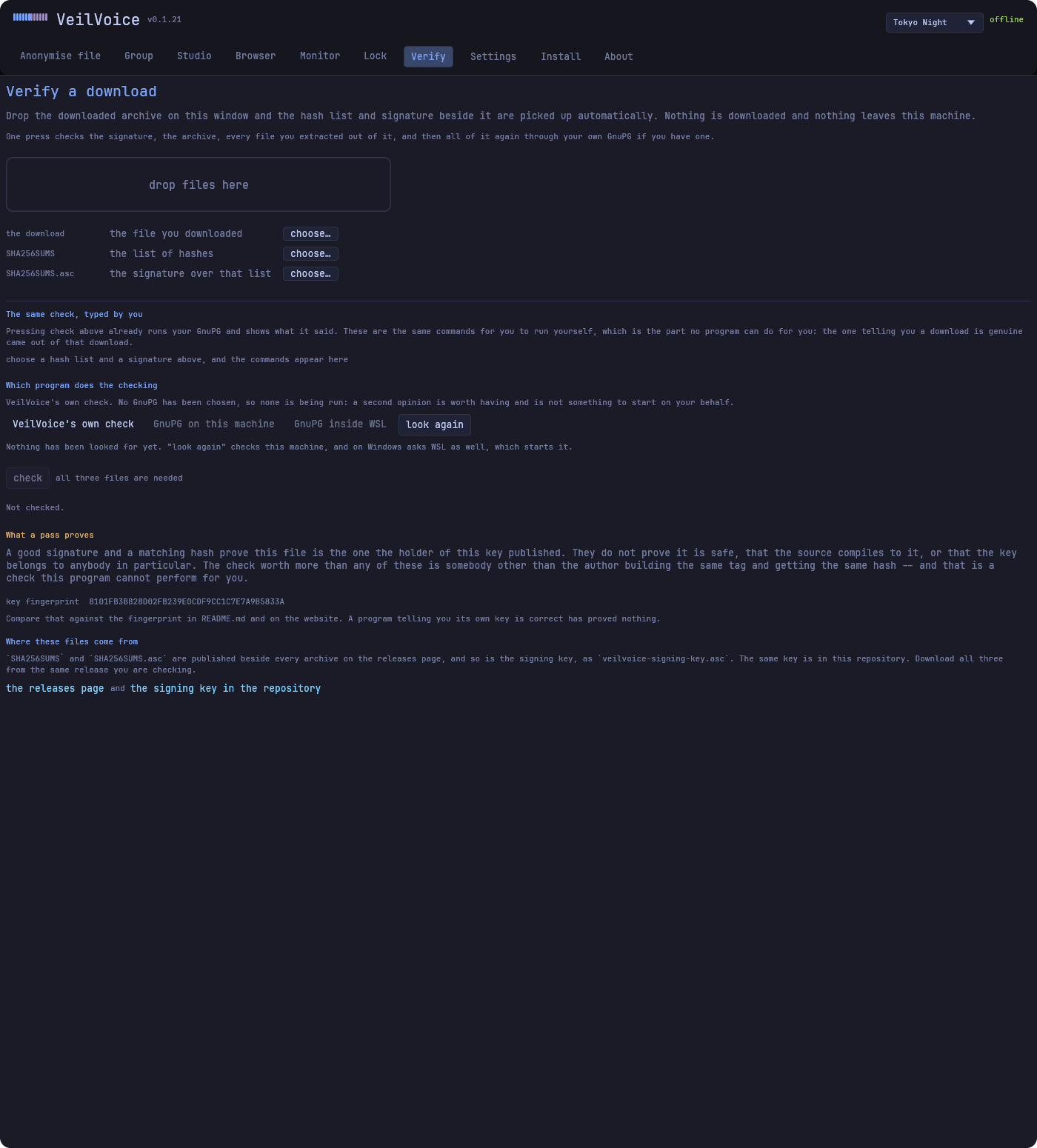
- Open Verify in the desktop application. Three slots are shown before you drop anything, because verifying needs three files and an interface that discovers that after the drop teaches people it is fiddly.
- Drop the archive you downloaded, the
SHA256SUMSand theSHA256SUMS.ascon the window. A drop fills whichever slot the file's name says it is, in any order. - Press the button once. It checks the signature over the hash list, then the archive against that list, then every file extracted out of the archive against the signed contents list, and then runs the GnuPG on this machine over the same signature.
- Read the three answers, which are drawn separately on purpose so a pass on one is never mistaken for a pass on another. A release published before v0.1.15 carries no contents list and simply has no such row. A GnuPG that will not run on this machine is drawn quietly: that is a fact about the computer and says nothing about the download.
Checking the source rather than the download
What a build needs on this machine
veilvoice verify depsWhat is required to build VeilVoice here and which of it is already present. --install offers the missing pieces one at a time with the exact command shown before each question.
Build it, and compare against the published hashes
veilvoice verify reproduce . --sums SHA256SUMS --sig SHA256SUMS.ascA signature says who made a file. Only a build says what it is made of. This compiles the workspace here and compares what came out against the published hashes for this platform, with the signature verified before any hash from the list is read. A difference is a finding, not an accusation: both hashes are printed and the exit status is deliberately not the one that means tampering.
What each answer is worth
- INTACT means your file is byte for byte the one that was published: not truncated, not corrupted in transit, not swapped by whoever served it to you. The hash came from the signed list.
- REPRODUCIBLE is the stronger claim and needs a hash from somewhere else: somebody else's independent build of the same tagged source. It says the published binary corresponds to the published source, which a signature alone cannot.
- A GnuPG that will not run is a fact about your computer. It is not a failed check and nothing here treats it as one.
Full instructions per platform, including Windows and the BSDs, are in docs/INSTALL.md(https://github.com/tilas01/veilvoice/blob/main/docs/INSTALL.md).
The documentation every guide, on GitHub and on this site, and in the archive you just downloaded
Each of these is a file in docs/. Every release archive carries the whole folder, so once you have unpacked one you have all of it offline. The first link is the file as it is written; the second, where there is one, is the same ground covered as a page of this site.
| Document | What it covers | On this site |
|---|---|---|
USER_GUIDE.md | The whole application, screen by screen | guide |
GUIDE_CLI.md | Every command line command, with worked examples | — |
GUIDE_GUI.md | The desktop application on its own | — |
GUIDE_VERIFY.md | Checking a download, at length | verify |
INSTALL.md | Installing and verifying, per operating system | download |
FAQ.md | The questions people actually ask | faq |
WHITEPAPER.md | What the veiling does and why it cannot be undone | crypto |
REPRODUCIBLE_BUILDS.md | Building it yourself and comparing | — |
SELF_SIGNING.md | The code-signing certificate, and importing it | — |
PACKAGING.md | The deb, the RPM, the AUR recipe and the rest | — |
USING_THE_CRATES.md | Using VeilVoice as a library | — |
AUDIT.md | Every defect found and fixed, in order | — |
SECURITY.md | Reporting a vulnerability, and what counts as one | — |
CONTRIBUTING.md | Building it, the standing rules, and the house style | — |
WEBSITE.md | Both editions of this site, and what generates each page | — |
The generated reference for every crate and every source file is under the reference, and the same pages are in the wiki.
v0.1.22 VeilVoice was split into twenty-seven separate libraries.
Files
- Windows, 64-bit veilvoice-v0.1.22-windows-x86_64.zip
- macOS, Apple silicon veilvoice-v0.1.22-macos-arm64.tar.gz
- macOS, Intel veilvoice-v0.1.22-macos-x86_64.tar.gz
- Linux, 64-bit veilvoice-v0.1.22-linux-x86_64.tar.gz
- Linux, ARM 64-bit veilvoice-v0.1.22-linux-arm64.tar.gz
- Raspberry Pi OS, 32-bit (command line only) veilvoice-v0.1.22-linux-armv7-pi.tar.gz
- Linux, 64-bit, static (command line only) veilvoice-v0.1.22-linux-x86_64-musl-static.tar.gz
- Linux, ARM 64-bit, static (command line only) veilvoice-v0.1.22-linux-arm64-musl-static.tar.gz
- FreeBSD, 64-bit (command line only) veilvoice-v0.1.22-freebsd-x86_64.tar.gz
- OpenBSD, 64-bit (command line only) veilvoice-v0.1.22-openbsd-x86_64.tar.gz
- NetBSD, 64-bit (command line only) veilvoice-v0.1.22-netbsd-x86_64.tar.gz
- SHA256SUMS the hash of every file above
- CONTENTS.sha256 the hash of every file inside those archives
- SHA256SUMS.asc the signature over that list
- veilvoice-signing-key.asc the public key it was signed with
These links are worked out from the version number rather than fetched, so this page builds with no network. A release that did not build for a platform answers with a not-found; the release page is the definitive list.
Release notes everything that changed in v0.1.22, in full
Twenty-seven crates became thirteen
- VeilVoice was split into twenty-seven separate libraries. Seven of them were under seven hundred lines and four were used by exactly one thing. Every one of those splits is a published surface, a manifest, a README, a page of the reference and a row in every list of what this project is made of, and somebody deciding what to depend on had to read twenty-seven descriptions to find the two they wanted.
- The line is drawn at what a person would realistically take on its own. The six that watch what else the machine is doing are one library now. The two that raise an alarm and the safety catch that acts on one are another. The download verifier absorbed both of its halves, the video renderer absorbed the graphics probe that exists to answer one question for it, the decoy passphrase joined the cryptography it is part of, the update check joined the installer, and saved profiles joined the settings.
- Nothing was deleted and nothing behaves differently. Every module kept its name, its documentation and its tests, and the whole suite passed before and after. If you were using one of these as a library, the code is in the same shape at a shorter path.
- Found while doing it: the documentation generator wrote pages for what exists and never removed pages for what does not, because nothing had ever been removed before. It would have left 218 pages describing crates that are no longer there. It takes them away now, and says how many.
A link to this site now shows a picture, and search engines are told they may read it
- Every page told a link preview to use
assets/banner.png. That tag is read by crawlers, not by browsers, and a crawler does not work out what a relative address means. So every link to this site, posted anywhere, had always shown no picture. Nothing looked wrong: the tag was there and the file exists. - The address is absolute now, and every page also says which address is its own, which stops the same page being counted twice. Two pages had no preview tags at all and now have them, and the no-JavaScript page's preview title no longer reads
VeilVoice · no-JavaScript edition. - None of it is typed any more. It is built from what each page already says, by one piece of code every generator calls, so a new page cannot arrive without it.
- The site also had no
robots.txtand no sitemap, so the only way in was a link from somewhere else. Both are there now, and the sitemap is produced by walking the site: all 398 pages, updated whenever one is added or removed.
The banner moves on the no-JavaScript page too
- That edition showed the still picture while the main site animated the same banner. It shows the animation now, which is the same file the main site already serves to anyone with scripts off.
- Anyone who has asked their system for less movement still gets the still, and that choice is made by the markup rather than by a script, so it works on a page that runs none.
Links into a page land on the thing they name
- The site's header stays at the top of the screen as you scroll, so anything a link jumps to needs to be pushed down clear of it. The amount it was pushed down by was a single number, and the header is five different heights depending on the page and the width of the window. At the commonest desktop width the heading you had asked for ended up behind the bar, so the section looked as though it started halfway through a sentence.
- Worse for two whole pages: the rule only covered sections and the larger headings, so every entry on the releases page and every entry on the roadmap got no push at all and landed a full header height underneath.
- Driven in a browser, 425 of the 430 links into a page on this site landed in the wrong place. The edition of the site that runs no scripts had none of this, because it has no bar that follows you down, and it is the standard the rest of the site is now held to.
- The header is measured instead of guessed, and re-measured when the window changes shape or a font arrives late. The landing is held for a second afterwards, because pictures and fonts below the fold can still move the page under you, and it lets go the moment you scroll. Where you landed is outlined briefly so it is obvious which heading you asked for, and if you have asked your system for less movement the outline simply sits there rather than fading.
- Jumping a long way down the page no longer takes a second and a half to get there. The page glides when the distance is a screen or two, which is what tells you that you went down rather than sideways, and goes straight there when it is further, which is what a link into a page is for.
- Seventeen images on the site did not say how big they were, so everything below them moved down when they arrived. That is why a section you had just landed on could be somewhere else a moment later. They all say now, and a check refuses an image that does not.
- The back button, the middle button and copying a link all behave exactly as before: nothing about the navigation itself was taken over.
The list of crates on the front page was short by fifteen
- The website's front page shows the README, and the README lists what this project is made of twice. Both lists, and a third in the library documentation, had stopped being added to. They showed twelve and thirteen crates; there are twenty-seven.
- The missing ones are not plumbing: the two halves of the download verifier, the failsafe, the video renderer and the workspace store are all things the rest of the documentation describes at length.
- All three lists are complete, and a check now reads the workspace and the three lists on every build, so the next crate cannot be added without them.
The website no longer opens on a ticked-looking box
- The first thing the site shows is the notice a reader has to accept, and the first checkbox in it opened already wearing its focus ring, as if somebody had just tabbed onto it. Nobody had. The script moved focus to that checkbox when the dialog opened, and focus moved by a script is drawn the same way as focus moved by a keyboard, in every engine.
- Focus now lands on the dialog itself, which is where a modal's focus belongs: a screen reader announces its title from there, the first Tab reaches the first control, and the trap that keeps focus inside the notice still holds. Nothing looks pressed until the reader presses it.
- Checked by the website's own suite, which reads the script and the stylesheet and fails if either goes back.
The numbers this project states about itself are written by the tool that measures them
- The README, the front page and one row of the audit state how many tests this tree has, how many crates, how many website suites and how many functional lines of Rust. Ten sentences in all, and every one of them was typed by hand and compared against the tree by the website suite.
- The comparison was doing its job. The typing was not: every change to any Rust file moves the line count, so a commit that changed code and not those ten places failed a check that had nothing to do with what the commit was for. It happened four times in a single round.
- The generator that already takes those numbers now writes the sentences from them too, using the same patterns the suite checks with, so the tool that writes a claim and the check that reads it cannot disagree about where the claim is. The check is unchanged and still runs.
- Nothing a reader sees is different, and that is the point: the numbers were right before and are right now without anybody having to remember them.
A size calculation that could wrap on 32-bit machines
- Records in the encrypted store are padded to a fixed set of sizes so that how big a file is says as little as possible about what is in it. Working out that size multiplies the record's length by eight.
- On the 32-bit builds, a record over about half a gigabyte would have wrapped that sum around. Nothing was at risk: the next line caught it and reported a failure, and the store only ever holds settings and measurements a few kilobytes in size. But it was the wrong way to write it.
- The arithmetic is checked now, and refuses cleanly instead of wrapping.
Two places that asked the system to find a program, rather than saying where it was
- Naming a program without its full path means the system searches for it, and whatever it finds first is what runs. VeilVoice already says full paths everywhere it starts something, and a test enforces that, but the test only reads one file.
- Listing your graphics hardware on Linux, and looking up where an installed tool lives, were both still asking the system to search. Both now say exactly where they expect to find what they are running, and the graphics code has its own copy of the test that keeps it that way.
- The reproducible-build check still searches for your Rust toolchain and git, deliberately: it is checking a build against the tools you have, so finding yours is the point.
A one in 65,536 chance that the voice scrambler settled into a fixed rhythm
- VeilVoice re-draws the seed behind its voice scrambling at an interval, and draws that interval's range fresh at every launch, so the rhythm is a property of your session rather than of the program. Two numbers are drawn to set the range.
- About one launch in 65,536, the two came out identical, and the range had no width. That means a fixed interval, which is precisely what drawing the range is meant to avoid. Nothing looked wrong: the settings were valid and a panel showing them would have shown two matching numbers.
- A drawn range is now always at least one frame wide, widened around the numbers that were drawn so a slow rhythm stays slow.
- It turned up as a test failing once after passing eleven times the same day, and two hundred repeats afterwards did not bring it back. The arithmetic is a separate function now, so the case can be handed to it directly rather than waited for.
The metadata cleaner, put through the same test
- The part that reads a sound file somebody else made, and the part that replaces its metadata, were changed a line at a time the same way. Of 58 changes worth trying, four went unnoticed.
- One let the reader look one byte past the end of a file whose last section has an odd length and no padding, which is what a cut-off recording looks like.
- The other three were in the bland tags this writes in place of the ones it removes. Removing metadata is itself a signal, so plausible ordinary tags go in instead, and that only works if they are shaped like the ones any other program writes. Nothing had ever read back what it writes, so three ways of getting that shape wrong all passed.
- All four are fixed and the whole thing was run again: nothing survives now. These two files are covered by the weekly check from here on.
Eighty-one changes to the encryption code that every test accepted
- One way to find out whether tests are worth anything is to change the code a line at a time and see whether any of them complains. Run over the app lock, the vault, the chunked store and the reversible encodings, that found 674 changes worth trying and 81 that the whole suite let through.
- Forty-four were the same gap. The encodings were only ever checked by encoding something and decoding it back, which tests the pair rather than the encoder: any change the decoder still reverses passes. Each of the thirty-one encodings now has its exact output written down for one fixed input, so a change to what they emit has to be deliberate.
- Three were in the app lock and none of them harmless. Two locks sharing half their identity could have compared as the same lock. A tamper warning could have been cleared without the passphrase. The limit on how long the lock makes somebody wait was checked against the setting that defines it, so changing fifteen minutes to seventy-five seconds passed every check.
- Two were not missing tests but dead code: a condition that could only act where the next line already acts, and a branch that cannot be reached at all. Both are gone.
- Four rounds of writing tests and re-measuring took 81 down to 15, and each of those 15 is now recorded with the reason no test could ever catch it: some compute exactly the same answer as the original, and some depend on the machine rather than on the code.
- This runs every week from now on, and compares itself against that recorded list. Anything new fails the build and is named.
Fifteen gigabytes of build output that was living inside the repository
- The tool that counts how many tests this project has does it by running them. It sent that build to a folder under the user's profile on Windows, which is right, and through a fallback nobody had thought about it sent it to a folder inside the repository on every other system.
- So every machine that is not Windows had a second complete copy of the build sitting in the source tree, rebuilt from scratch each time the numbers were regenerated. Nothing reported it: the rule that hides build output from version control hides it at any depth, which is correct and also means this never appeared in any status, any diff, or any clean.
- It was found because something else broke. A long test run ran out of disk, several steps removed from the cause.
- The build now goes where builds go, and a check fails if build output ever appears anywhere in the repository except the one place at the root. It names the folder and how large it has grown.
The undefined-behaviour checker can now look at the cryptography
- VeilVoice keeps every key and passphrase in a type that locks its pages out of swap, so the operating system cannot write them to disk. That lock is made with a system call the interpreter used to check for undefined behaviour cannot make, so the first key any test created stopped the check dead, and the part of the program that does the encrypting was the one part that could not be checked this way at all.
- The lock is now skipped when running under that interpreter, which is the same thing that already happens on a machine with no budget for it or a platform without the call. The program reports honestly that the pages are not locked, and nothing about what it stores or wipes changes. Ordinary runs are untouched and still lock.
- The checker then read the reversible encodings, the authenticated encryption, the protected-memory type itself, the chunked store, the file shredder and the private-file helper, and found nothing wrong in any of them.
- Two tests keep it that way: one fails if the lock is ever taken outside the one place that knows about this, and one proves a secret holds and wipes the same bytes whether the lock happened or not.
Code that nothing reached, taken out, and a check so it cannot come back
- Five public items were compiled into every binary on every platform, documented, published into the generated reference and the wiki, and called by nothing: not by the programs, not by a test, not by anything. Each had been superseded by a path that does the same job, and none of them was wrong, which is why nobody had noticed.
- One of them was costing something. An accessor for the last vault audit kept alive a private field, and that field was filled by a copy of the audit result made every time the vault was opened, for a value no line of code ever read. The accessor, the field and the copy are all gone.
- The compiler cannot report this. Its dead-code warning stops at the edge of a library, because a public item might be called by a program the compiler cannot see, and an accessor that reads a private field keeps that field looking used while it does.
- So a check now asks it: every public item has to be named somewhere other than the line that declares it. An item used only by its tests passes, which is a normal thing for a reader kept beside a writer. An item used by nothing fails the build, naming the file and the line. It runs in CI and before every commit, and it was proved able to fail before it was trusted.
The audit, round thirty-three: the whole tree read again
- The round after 0.1.21, run against the brief written before it began: every class of defect the earlier rounds established and every check the repository runs, asked of each file. What it found is written up in
docs/AUDIT.md; what changed because of it is below. - Licences, sources and duplicate versions are checked now.
cargo auditanswers whether anything in the graph has an advisory against it and nothing asked the other three questions: whether every licence can ship under GPL-3.0-or-later, whether every crate comes from crates.io, and whether one crate is compiled at two versions.deny.tomlanswers them,cargo denyruns in CI beside the advisory check, and the two policy files are checked against each other so their advisory exceptions cannot drift apart. - Five checks that ran only when somebody ran them are in CI. The guard for a state file written one place and read from another, the per-program guides, the questions page, the app-manifest self-test and the local site host were all in
tools/verify.pyand none was in a workflow, so each caught drift only when somebody remembered to look. - The seven coverage-guided fuzz targets run weekly, two minutes each from the committed corpus, in a workflow of their own that can also be dispatched before a release. They had only ever run by hand.
- The hybrid key exchange's documentation said both public keys went into the combiner. The recipient's X25519 key does; the recipient's ML-KEM key does not, and does not need to, because FIPS 203 binds it through the shared secret itself. The doc comment now says exactly what is bound, why the omission is not a weakness, and why the transcript is not changed: every key and container already made would change with it, for no gain.
- The command line's offline claim was proved again on the built binary, four ways, and each guard was shown to fail when given something to catch.
Undefined-behaviour checking, run here for the first time
- The whole workspace forbids unsafe code, so anything an interpreter found would belong to a dependency rather than to VeilVoice. It found nothing, in the three crates it got through: the release-signature and contents readers, the WAV and metadata crate, and the speaker plan and its edits.
- Said precisely, because the alternative is a claim that sounds larger than it is: four tests in the metadata crate could not run, because they write tags to a real file and the interpreter's filesystem stands in the way. No undefined behaviour and no unsupported operation was reported for them, and they pass in seconds outside it, so the tag writer is uncovered rather than broken. The engine and the cryptography were not reached at all, and that is said rather than left to be assumed.
A promise about allocation, kept
- The frame-pacing code carried a note saying it allocates nothing once a frame, and then took its median with a sort that takes a scratch buffer for a slice that long. Nothing looked wrong and nothing was slow; what was wrong is that a sentence in this repository was not true about the code fourteen lines beneath it.
- It now selects the middle element in place instead, which allocates nothing and is all a median needs.
The tests now stand at the edge of every boundary in the cryptography
- Mutation testing over the four files that matter most, which changes the code a line at a time and asks whether any test objects: 127 changes, 91 objected to, 21 that do not compile, and fifteen that the whole suite accepted.
- Five were boundaries in the parser that reads a file somebody sends you: the length tests and both checks on what a header claims to carry. Each is now tested from both sides, at exactly the length in question rather than near it.
- Four were the ceilings that stop a file from choosing how much memory this program allocates. Each now accepts its own value and refuses one past it, and a header asking for zero lanes is refused on its own rather than only in company.
- Three were the randomness adapter, and that is the one worth saying plainly. Replacing it with something that returns a constant, or that claims success without writing a byte, passed every test this project had. A key drawn from a buffer left untouched is a key somebody else already knows. It is now asked, in both forms, whether bytes actually arrive.
- Run again afterwards, which is what makes it a result: 104 objected to, 21 that do not compile, and two left, both of them the same line.
- That line cannot be killed and the reason is now written where it lives: a ceiling on parallelism that the memory ceiling always reaches first. It stays, because a guard that is only redundant today is not a guard to delete, and the next person who changes it and sees nothing happen will find the answer in the comment rather than concluding the line is dead.
The command it prints and the command it runs cannot drift apart
veilvoice conversationprints anffmpegcommand for you to run yourself, under a line saying VeilVoice never runs it for you. The window runs a different one, because it feeds the pictures in by a list rather than by a numbered pattern. Everything after the inputs was the same decision made separately in three places, with only the frame size compared across two of them.- They agreed, and now they have to: a test compares the codec, the quality, the scale filter, the pixel format and the audio settings across all three, so an instruction this program gives cannot quietly stop being the thing this program does.
Dependencies, reviewed one by one
- egui and eframe 0.36, and this one is a security change as much as an upgrade: 0.36 rasterises text without
ttf-parser, so that crate has left the dependency graph and its advisory leaves the exception list with it. Two accepted advisories remain where there were three. The port was real work: the application now draws into a root panel rather than taking the context, the OpenGL choices moved to where the OpenGL backend is configured, panels and styles are set differently, a dropped file reports its path through a trait, and every headless test had to learn that a frame's texture uploads must be accounted for. 1611 tests pass on it. symphonia0.6, the decoder for everything that is not a WAV. The 0.6 API changed how a stream is probed, how a decoder is made and how decoded audio is read; the port keeps one interleaved buffer across packets rather than one per packet, and every audio test passes on it.- The GitHub Actions the workflows use, nine of them, to their current majors.
- The cryptographic line is held, on purpose, and the reason is written where it will be read.
sha2,hkdf,chacha20poly1305,argon2,x25519-dalek,ml-kem,rand,rand_core,rand_chachaandgetrandomall have a newer major.pgp, which verifies release signatures, pins the generation this project uses, and taking the newer one would compile two copies of every primitive into both binaries. None of the newer versions fixes a vulnerability. The line moves together the daypgpmoves, or the day the signature check stops needing it, which is roadmap item 149 on the roadmap: a reader for exactly what a detached signature over a text file is, with nothing else in it. Dependabot is told not to reopen the same ten pull requests every week. - Every compatible update in the lock file taken.
The meters can sit above a call or a stream
- The live monitor had two places to be and both were inside the VeilVoice window. On a call or while streaming, that window is behind the thing you are talking into, so the only picture of what your microphone is doing was covered exactly when it mattered.
- A third choice: a small window of its own, kept above other windows. Off the task bar, draggable, resizable, showing the same two levels and the same sentence about what a level is not. It is not the default, because a window that puts itself above everything is something to ask for rather than to be given.
- Closing it brings the strip back rather than turning the meters off. Its close button belongs to the window manager, so pressing it means "not in my way", and reading that as "never show me my microphone again" would take the meters away from under a call without being asked.
- Where a platform will not give a second window, it falls back to the floating card, which is the same thing inside the window.
- Offered where the session starts, not only in Settings: while the voice is being veiled, a keep the meters on top button sits beside the live indicator. That is the moment somebody is about to put a call in front of this window, and a setting they have to go looking for afterwards is one they find after the call.
The window draws at the display's rate
- The animations ran at twenty frames a second, by design: a constant in the mark, a fifty-millisecond cadence for anything busy, and sixteen for veiling. On a display faster than sixty that is judder, and the sixteen was wrong even at sixty, because a display at sixty shows a frame every 16.67 ms and a request for one "within sixteen" misses the frame it wanted and lands on the next. Thirty a second, asked for as sixty.
- The fix is not a bigger number. While anything is moving, the window asks for the next frame now and lets the screen space it: a window that waits for the display cannot draw faster than the display shows, so this is one frame per refresh and no more, at whatever rate the screen runs.
- That is also what makes the display measurable. Nothing in the libraries this window is built on will say what the refresh rate is, so it is measured: frames paced that way are the display's own, and the middle value of the last thirty-two is a figure a single slow frame cannot move.
- Settings can lower it, to 30, 60, 90, 120, 144, 165 or 240, which is a choice to make for a battery rather than for smoothness.
- A live readout in the header when you turn it on, and the About tab now carries what the window is aiming at, what the display measured, the rate as drawn and how many frames arrived late.
- It says when it is struggling. A frame more than half again later than it should have been is counted late; two seconds of that shows a notice once, naming the rate, the target and what the window is drawing with, because software rendering and a slow GPU are different problems. One bad second is not enough, since every launch costs one.
- Idle is unchanged: a window with nothing moving asks for no frames and draws none.
The lock button and the theme picker agree on a height
- The manual lock button in the header did not line up with the picker beside it. Measured properly, in a frame laid out the way the header lays it out: the two share a centre exactly and the picker is one pixel taller, because each control worked its own height out from padding and nothing said the two should match.
- The button now takes its height from the picker's own rectangle rather than from a number written down twice, so they cannot drift apart at a font size or on a platform nobody here has tried. Two tests hold it, one of which proves the other can fail.
- No screenshot can show this: the captures photograph a window with no app lock set, and the button is only drawn when there is one.
Two roadmap items on the roadmap
- Roadmap item 148, the window drawing at the display's rate and saying so: the animations ran at twenty frames a second by design, and what to build instead is specified in full.
- Roadmap item 149, the signature check that needs only a signature check, which is what unblocks the cryptographic line above.
The site can be claimed in Search Console
- The ownership tag Google asks for sits in the head of every page, so the site can be verified and indexed. It is a string with no behaviour: nothing is loaded, sent or run because of it.
The Studio is in the documentation, and so is the reason for it
- The companion list recommended Audacity as being "useful for recording a file and for trimming one before veiling it". The first half stopped being true when the Recording Studio landed, and it was worse than merely out of date: it pointed a reader at exactly the thing the Studio exists to avoid.
- A recording made in another program is a plaintext file on your disk. Open an editor, record an interview, save it, veil the result, delete the original: the original was on the disk the whole time, and on flash storage deleting it does not reliably take it back. The encryption that happens afterwards cannot reach backwards to cover it.
- So the Studio never writes one. The samples go from the audio callback into memory the operating system has been asked to keep out of the page file, the WAV is assembled inside that protected memory, and what leaves is already sealed. There is deliberately no route in the code that would produce a plain copy, because a route that existed would eventually be taken.
- Audacity is still recommended, for what it is actually for here: editing a file you already have. The install guide said the same thing twice and now says this instead.
- The questions page gains the question a reader actually arrives with, which is whether it can record at all. It says what it captures (any input the system offers, chosen by name, so a microphone or a virtual cable carrying the computer's own audio, up to eight at once for a room), and what it keeps (uncompressed PCM at whatever rate the device is really running, nothing resampled, no lossy codec).
- It does not claim to be an editor, or to be better than one. There is no cutting, fading or arranging, and the page says so rather than implying otherwise. No comparison with any other program has been benchmarked, so none is made.
A doc comment that had moved to the wrong function
- Factoring one loop out of three copies left a documentation block behind, and the next function down inherited it. The function that looks for GnuPG was documented as "the route to Audacity differs per platform"; the function that installs Audacity was documented as nothing at all.
- The generated wiki repeated it, which is the part worth recording. Every check passed, because every check compares the generated pages to the source, and the source said this.
- This is the second time in one release that an insertion has taken a block from the item below it, after the missing feature gate earlier. A test now reads the module and fails if a probe or an offer carries no documentation, which is the mechanical half of the mistake and the half a losing item always shows.
The same notes are in CHANGELOG.md, where they are written, and at the top of this release on GitHub.
v0.1.21 Every screenshot the same size, and in the face they were meant to be in
Files
- Windows, 64-bit veilvoice-v0.1.21-windows-x86_64.zip
- macOS, Apple silicon veilvoice-v0.1.21-macos-arm64.tar.gz
- macOS, Intel veilvoice-v0.1.21-macos-x86_64.tar.gz
- Linux, 64-bit veilvoice-v0.1.21-linux-x86_64.tar.gz
- Linux, ARM 64-bit veilvoice-v0.1.21-linux-arm64.tar.gz
- Raspberry Pi OS, 32-bit (command line only) veilvoice-v0.1.21-linux-armv7-pi.tar.gz
- Linux, 64-bit, static (command line only) veilvoice-v0.1.21-linux-x86_64-musl-static.tar.gz
- Linux, ARM 64-bit, static (command line only) veilvoice-v0.1.21-linux-arm64-musl-static.tar.gz
- FreeBSD, 64-bit (command line only) veilvoice-v0.1.21-freebsd-x86_64.tar.gz
- OpenBSD, 64-bit (command line only) veilvoice-v0.1.21-openbsd-x86_64.tar.gz
- NetBSD, 64-bit (command line only) veilvoice-v0.1.21-netbsd-x86_64.tar.gz
- SHA256SUMS the hash of every file above
- CONTENTS.sha256 the hash of every file inside those archives
- SHA256SUMS.asc the signature over that list
- veilvoice-signing-key.asc the public key it was signed with
These links are worked out from the version number rather than fetched, so this page builds with no network. A release that did not build for a platform answers with a not-found; the release page is the definitive list.
Release notes everything that changed in v0.1.21, in full
Every screenshot the same size, and in the face they were meant to be in
- The captures were trimmed to each tab's own content, with a floor. That gave eight pictures 1000 tall, one 1095 and one 1315, which is right for one picture and wrong for the grid the README and the website show them in: the row holding the group tab sat lower than the rows either side of it.
- One height now, and it is the tallest one's content, measured across the set on every run rather than written down. It is the only shared height that crops nothing: trimming to the shortest would cut the group panel off, and scaling would make the text in one picture a different size from the next. The cost is real and is paid on purpose: the short tabs carry background below their content. Empty space in a picture reads as the window having room; a stepped grid reads as a mistake.
- The captures are in JetBrains Mono, and that is now proved rather than hoped. The window prefers it and falls back to the built-in monospace when it is absent, which is right for somebody running the program and wrong for a capture: half a set in the wrong face looks subtly off and nothing about the run says so.
veilvoice-gui --typefaceanswers which face the window would draw with, without opening one, and the capture script asks first and refuses to photograph anything if the answer is the fallback, naming the package for each platform. - All ten retaken, so they show what this release actually contains.
- More room between them on the website: 40px across and 48px down, more vertically because each picture has a caption under it and a matching row gap put the next picture as close to a caption as the caption is to its own picture. The README's grid is a table GitHub renders and strips styles from, so there the equal heights are the whole of the fix.
ffmpeg joins the companion list, and the render points at it
- The Setup tab lists the software VeilVoice works with, says who makes each and under what licence, and installs one on an explicit yes.
ffmpegwas not in it, which is the whole of this: a render told youffmpegwas missing and the tab that installs things had never heard of the name, so the message pointed at nothing. - It is there now, first in the list, with what it is for, what still works without it, and the install command for this system:
wingeton Windows, Homebrew on macOS, and whichever package manager is actually on PATH elsewhere. Every message about a missingffmpegnow names the tab, and a test fails if one stops doing so. - Both front ends read the same table, so
veilvoice companionsgained the entry at the same time and cannot disagree with the window about what exists. - The loop that asks each package manager in turn existed twice and would have become three copies. It is written once, which is the point at which copies start disagreeing about which managers this project recognises.
- "Look again" no longer freezes the window. It ran a command per companion inside the frame it was drawing, which on a machine with several of them is the window going white. The search moved to a worker and the button says it is working while it runs.
- Nothing here downloads anything. An install runs the package manager the machine already has, so the claim that VeilVoice ships no network client is unchanged and still checked three ways on every commit.
The video has a picture in it (roadmap item 139, finished)
- A render produced veiled audio over a black rectangle. It now produces the same picture the preview page shows: a circle per speaker in their colour, whoever is talking lit, the level under each name, the waveform and a playhead. One layout function draws both, so the two cannot drift into being pictures of different recordings.
- The frames are drawn here, as pixels. A canvas with rectangles, antialiased circles and a PNG writer, and a five-by-seven monospace face of ninety-five glyphs written out in the file. The drawing is SVG and no build of
ffmpegcan be assumed to read SVG; converting it would have meant an SVG rasteriser, which is exactly the large library this project spends a page explaining why it will not carry. One dependency,miniz_oxide, for the deflate that PNG is made of, and it was already in this tree underflate2. - A picture is written when the picture changes, not once per frame of video. The playhead moves a pixel at a time rather than a frame at a time, so ten minutes at thirty frames writes hundreds of files instead of eighteen thousand. The saving is measured and reported rather than asserted, and a short recording holds nothing, which is correct: the playhead crosses the whole waveform however long the recording is.
- That is why the ffmpeg command is a concat list with a duration per picture. Held frames handed to the numbered-sequence reader would play an hour of conversation in the few seconds its distinct pictures cover, which is a video that is wrong rather than one that refuses to encode.
- Names the face cannot draw are named. Printable ASCII only, so a name in another alphabet comes out as open boxes, and the render says which names before somebody watches an hour of video to find out. The preview page does not have this limit, because it is markup and uses the reader's own fonts.
- Video is the one output off by default, because it is the one that needs a tool VeilVoice does not ship. Without
ffmpegthe pictures and the list are still written and the exact command is handed over.
A score for what a recording gives away about who was speaking
- Beside the voice controls in the Group tab there is now a percentage. A hundred means the finished recording says nothing about which of the people in it was talking. It falls as the group grows in "a voice each" mode: two people is 70 per cent, four is 40, eight is 10. One voice for everybody is a hundred at any size.
- It is not a measure of how well a voice is disguised. That is the engine's and it does not get weaker because somebody else joined the call: eight people are each hidden exactly as well as one. It is not cryptography either, and the module, the guide and the interface all say so rather than letting an information count be read as a claim about strength.
- What it counts is the other leak, the one that does grow with the group: how much of the conversation's shape a listener gets free. Eight tellable-apart voices let anybody count the participants, follow who said what, and align two recordings of the same group by voice.
log2(classes)bits per turn, measured against the widest the engine goes. - Two speakers whose voices are too close to separate count as one. So crowding the table makes a recording give less away while making it harder to follow. That runs backwards from the obvious reading, so it is shown on its own line rather than folded into the score, and a test pins it down.
- Fixed while building it: a solo recording was reported as "crowded", because the closest-pair measure answers 1.0 when there is nothing to compare and that is below the separation floor. One voice has nothing to be confused with.
A level under every speaker's name (roadmap item 139, the first of its two halves)
- The preview page lit whoever had the turn and said nothing more. A lit circle cannot say whether that person is mid-sentence or mid-pause, and those look identical for as long as the turn lasts, so under each name there is now a bar that moves with the sound.
- Drawn from the same envelope as the waveform beneath it, so the two cannot disagree: one array, two things drawn from it, and the page is animated from the numbers it drew rather than from a second copy.
- It is the mix, given to whoever is speaking, and the guide says so. A render produces one mixed track, so there is no separate signal per person to measure. That is the same thing while one person talks; where two turns overlap both show the same bar, which is what a listener hears and is not a claim that each was that loud.
- Somebody whose turn it is not shows nothing, rather than a small amount. A bar moving for a person who is not speaking would be the one thing on the picture actively saying something untrue.
- The track is always drawn and only the filled part moves, so the layout does not shift under the reader every time somebody stops talking.
- What is left is drawing the frames. The video file is still veiled audio over a black picture. That needs a rasteriser and a font, neither of which is a small addition, and the roadmap row says what they are and why a full SVG rasteriser is the wrong way to get them.
Dependabot, configured, and a check that keeps it true
- There was no
.github/dependabot.yml. Nothing had ever raised a version update or an alert against this tree. There is one now: the Cargo workspace,fuzz/separately (it is outside the workspace, so an entry on the root does not reach it), and the actions the workflows run, which hold a token that can publish signed artefacts and are monitored on the same terms as the code. - The configuration is checked rather than remembered.
tools/audit/dependabot.pyreads it against the tree and fails on a manifest no entry covers, or an entry naming a directory that has gone. It runs in CI beside the check that every dependency says what it is for, which is the other half of the same question: saying what a dependency is for does not make anything watch it. - Two ecosystems, and the file says why there are only two. The website's JavaScript and the site tests use Node's own built-in modules and nothing else, and every script under
tools/andassets/is standard-library Python, so apackage.jsonor aGemfilehere would declare no dependencies and would be one more file to keep true.Cargo.tomlis this project's package manifest, and there are 28 of them.
One demonstration, the command line first and the window under it
- The demonstration was in three parts in the order: the command line typed out, the window's screens, the command line one job at a time. The two halves of the same thing had the other thing wedged between them, so a reader who wanted to know what the commands are read about them, looked at pictures of a window, and then read about the commands again.
- It is one section now. Both command-line parts are together and first, and the window is below them. The command line goes first because it is the half that can be shown rather than depicted: those are recordings of the real programs replayed at typing speed, and every byte in them is what the program wrote. Somebody who reaches the photographs has already watched it run.
- Nothing else about the page moved, and nothing went behind a button.
The terminal drawings share one width
- Each drawing was exactly as wide as its own longest line, which gave eleven pictures at five widths: 651, 800, 817, 825 and 834. The README stacks all eleven vertically and the website shows the same set, so what a reader saw was a column of terminal windows whose edges did not line up.
- They share one width now, measured across the set on every run, so a command whose help grows moves all of them together instead of becoming the one exception. Height still varies, because height is the content: a longer help screen is a taller picture, which is the axis a page can afford.
- These draw a terminal window, and a terminal window does not shrink to fit whichever command printed the least. The shared width is the widest one's content, which is the only shared width that re-wraps nothing.
- Checked rather than asserted: the ten window captures are all 1400 by 1537 and the eleven drawings are all 834 wide, and both are produced by tools that measure the set rather than by a number written down somewhere.
The tag a release publishes now names the commit it built
- The release workflow ends by creating a GitHub release for a tag. Creating a release for a tag that does not exist yet makes GitHub create the tag, and with no target it creates it at the default branch rather than at the commit the run compiled.
- Both of the last two releases were tagged that way. v0.1.21's tag landed on a tree whose
Cargo.tomlstill said 0.1.20; v0.1.20's landed thirteen minutes ahead of what it published, on a commit that does not compile on nine of the twelve targets. - This goes to the whole of what a release claims. Every binary is built twice in different directories and compared byte for byte, the hashes are signed, and the reproducible-builds guide tells a reader to check out the tag and rebuild. That is all machinery for one sentence, and the sentence is false when the tag names a different tree: the reader who does the work gets different bytes and correctly concludes the release does not reproduce.
- Nothing was tampered with, and the binaries are what the run built. What was wrong was the pointer, and it is one line: the release step names the commit now, and
tools/audit/publishing.pyfails a build if it stops doing so or starts naming something else.
A release published saying it had no release notes
- v0.1.21's notes on GitHub read, in full, that no changelog section could be found for it. The workflow matches
## v<version>as a whole line, the entry had been written with a date after it and novin front, and the match failed, so seven hundred lines of notes were dropped. - It then published anyway. That is the defect rather than the heading: a note saying the notes are missing is not a smaller version of the notes, it is a release whose contents nobody can tell.
- The heading is the shape every other entry uses. The workflow refuses to publish without a section now, and because that refusal only fires after twelve jobs have built and compared every binary, the same question is asked first where it costs nothing:
tools/release/version.py --checkrequires the changelog to carry a heading the workflow's reader can find, and says which heading is actually there when it is the wrong shape. - Two readers of one file disagreeing is why this survived. The website's releases page is built from the same headings and tolerates both forms, so every local check passed while the one that mattered found nothing.
The feature nine release jobs turn off, that nothing built
veilvoice-audio's live capture is an optional feature, off on nine of the twelve targets a release builds:cpalhas no backend for the BSDs, cannot be linked into a static musl binary, and has no cross-architecture ALSA to build against. Those nine build the command line with default features off.- Nothing in CI built that. Every
cargoline took the default features, so a module whose#[cfg(feature = "live")]had gone missing compiled on all three platforms, passed every check twice over two days, and then failed nine release jobs at once. The attribute had been taken by aplaybackdeclaration inserted directly above it, because an attribute attaches to the item that follows it. - The gate is back, and the gap it fell through is closed:
tools/audit/features.pyreads the build arguments out of the release workflow and compiles each selection, in CI beside the release build. Reading the workflow rather than copying its arguments is what makes a target added to that matrix built on every push without anybody remembering, and the tool refuses to pass if it can read fewer than two selections, so a workflow rewritten into a shape it cannot parse fails rather than checking nothing. - The existing platform guard could not have caught this. It varies the operating system; this varies the features, and a guard covering one axis reads as covering the other.
Several microphones at once, veiled and metered each (roadmap item 147)
veilvoice_audio::roomopens one input per guest, veils each with its own engine, seed and destination voice, and mixes the results into the one output a call or a recorder hears. One microphone carrying four people is one signal, and whatever it is turned into, everybody in it is turned into the same thing.- The cost is a number rather than a promise. The output callback runs every guest's engine before it returns, so they share one deadline of a few milliseconds and the cost is the sum.
RoomStats::loadis that sum measured against that deadline. At 1.0 the engines have used the whole block and what follows is dropouts. The guest limit is a bound on the arithmetic, not a claim about any machine. - The mix is summed and clipped, and never limited. Two people talking at once is two signals added, which can pass full scale; a render fixes that afterwards with one factor and a live path cannot see the rest of the conversation. So the peak before clipping is reported, the blocks that clipped are counted, and there is deliberately no limiter: a limiter is a dynamics processor, it changes the voice, and this program's whole claim is about what changes a voice.
- Each guest has their own ring, so a microphone whose clock runs fast drops that guest's samples rather than everybody's, and a slow one starves and is padded. A rate mismatch is not absorbed: it is refused before anything opens, which is the fix in this same release.
- A recorder per guest, veiled or unveiled, and one for the mix. Roadmap item 131's warning about the unveiled side applies once per guest.
- The Studio drives it. Ticking "several microphones, a guest each" in the Studio turns the input picker into a guest list: a name and a microphone per person, up to eight. Starting it opens all of them, and each guest is veiled into a voice of their own, from the same table a group render hands out and in the same order.
- Two bars per guest, what went into their microphone and what their engine produced from it, with the mix under them and the load beside them. A room drawn as one pair of bars cannot say which microphone is dead, which is the reading somebody actually needs. The load is said as a percentage of the block every engine shares, and past 80 per cent it says what to do about it.
- A take stores every guest separately, beside the mix. One name, and the recordings under it are the mix, called "(everybody)", and one or two per guest called after them. The choice of which side to keep is the one the single microphone already has and applies to every guest at once, so an unveiled room is eight recordings of eight real voices and says so before it starts.
- The Studio holds one session or the other and never both, as one field rather than two: two of them would be two streams on one output with every guest's voice arriving twice, and a field that has to be remembered is a field that gets forgotten.
- Two guests on one microphone is refused by name before anything opens. One microphone carrying two people is one signal, so veiling it would give both of them the same voice, which is what a microphone each was for. Two guests on the default device are the same refusal:
Noneis a device, not an absence. - Every recording of a take is named in one function, checked by a test that reads this module. A take now produces up to seventeen recordings from three loops, and a suffix added in two of them would leave an entry that is somebody's real voice looking exactly like the veiled one beside it.
A microphone and an output that never compared their rates
- The live path built the engine and the ring between its callbacks from the output device's sample rate, and the input stream from the microphone's, and never checked that the two were the same number.
- Where they are not, and a laptop with a 44.1 kHz microphone and 48 kHz speakers is an ordinary machine, the ring starves continuously and the veiled voice comes out about a semitone and a half sharp and stuttering.
- Invisible twice over: the starvation reads as "this machine is too slow", and the pitch is meant to change, because this is a voice de-identifier.
- Both devices are now put on one rate: the one they already share, the output's if the microphone will take it, or the microphone's if the output will. If neither will move, it refuses and names both rates and what to do, rather than running them together and quietly shifting the voice.
- The output's rate is preferred, because it is what the person hears through and what anything on a virtual cable expects.
- Nothing here resamples, and adding a resampler to paper over a mismatch would be a quality and latency decision taken to avoid saying something.
The Studio has a failsafe of its own, and a running take says what it keeps
- Both are clauses of roadmap item 145 that nothing had built, found by reading that row rather than treating it as a sum of the roadmap items under it.
- A device that goes stops the Studio, not the recording. Since the last change the Studio knows when the device a take is being recorded from has stopped existing; knowing was as far as it went, and the take carried on recording silence until somebody looked at the screen. It now stores what was captured and stops.
- It does not discard, retry or switch device. Not discard, because everything up to the fault is a real recording of something somebody said. Not retry or switch, because the person chose that microphone and moving a recording onto another one is this program deciding that for them, which on most machines means a laptop's built-in microphone.
- Only a device that has gone. Anything else the platform reports is shown and left alone: an underrun is not a reason to end somebody's recording.
- Separate from the application's safety catch, which is about other programs taking the microphone. This one is about this tab.
- A running take now says which voice it is keeping. The choice is made on a form that disappears when recording starts, so a take of somebody's real voice looked exactly like one that is not for the whole of the recording. It is beside the clock, in yellow when the microphone is being kept.
- Roadmap item 145 is still planned, and its row now says what it is waiting for rather than reading as a sum of the roadmap items under it: group mode recording every guest with the same guarantees, which is roadmap item 147.
A BSD reader was told to run a command their system does not have
veilvoice verify --scriptwrites a shell script that checks the signature and the hashes with the reader's own GnuPG. It knew two systems, Linux and macOS, and every mapping onto it ended in a catch-all meaning Linux, so a reader on FreeBSD, OpenBSD or NetBSD was handedsha256sum -c.- The same release's other script, the one that reproduces the build, has always given the BSDs
sha256 -cand has a test forbiddingsha256sumthere. Two scripts in one release, disagreeing about the reader's machine. - The cause was a copy: both modules answered the same question and one of them was not kept current. The copy is gone. There is one public
System::hash_check_command, the verification script asks it, and the two catch-all matches are now one exhaustive function that will not compile if a system is added to one enumeration and not the other. - The guard is that no system's script may contain another system's hash command, which fails on exactly the fall-through this was.
Checking a download, written up per system
veilvoice verifyon its own is the same command everywhere: it hashes and checks the signature itself, and needs no GnuPG, no network and none of the system's own tools. A BSD reader has nothing to translate, which is why the guide now says so first.- The second opinion is where systems differ, and the guide carries a table of which script each system gets and what it runs. The table is checked against the program in the test suite, so a command in the documentation that the program no longer prints fails a build.
- Installing GnuPG on OpenBSD and NetBSD is the one thing left unsaid. This project has not run those package managers and does not print commands it has not run; FreeBSD's spelling is named because
install/install.shalready uses it.
Two bars per speaker, while a group render runs
- As the render walks the file, each person gets what went into the turn just finished and what the engine produced from it, with how far through their turns the render is. One bar answers "is something being written" and not "is this person being veiled", which is the question somebody rendering an interview is asking.
- Drawn with the shared meter the live path uses, so it is the same bar rather than a second one that would drift from it, and the limit is printed under them in the same words.
- The render reports through a small structure of atomics: nothing allocates, nothing locks, and the render threads write to it while the window reads it every frame. A watched render and an unwatched one produce byte-identical audio, which is a test rather than a claim.
- A progress made for fewer speakers than the plan holds drops what it cannot keep rather than failing the render. A bar with nowhere to go is not worth a refused render.
- This is the half of roadmap item 133 that could be built from what was here. The other half, several guests on several microphones at once, is now roadmap item 147: the live path opens one input and everything downstream assumes one.
The audio path says when something interfered with it
- A device unplugged or swapped mid-session, and anything else the platform reports about either stream, is now shown where the person is looking. Both error callbacks used to be
eprintln!and nothing else: on Windows the desktop application is built with no console at all, so a microphone taken away in the middle of a call was completely silent and a recording carried on being made of nothing. - The report is the platform's own words, with the device-is-gone case named separately because it does not come back on its own.
- Detected by the platform telling us rather than by polling a device list. A list read once a second is a guess between reads, and enumerating devices from another thread on Windows is what F-163 and F-165 were.
- While a take is running, a program other than VeilVoice taking the microphone is named on the tab and again with the stored take. That program heard the real voice whatever was going to the cable. Independent of the safety catch's posture: that setting is about closing other programs, and somebody who turned it off did not ask to be told less about their own recording.
- The command line shows the same thing as
INTERRUPTEDon the meter line, andveilvoice recordrepeats it when the take is sealed, because the meter line is gone by the time somebody decides whether to keep what was recorded. - The limit is stated beside the warning rather than after it: this is what VeilVoice's own path noticed, and it cannot vouch for a microphone that was already being intercepted before this opened it.
- The roadmap item asked for the samples reaching the recorder to be checked against the engine's output. They cannot differ, because the recorder is fed from inside the output callback from the same slice the engine has just written into, so the check would be a buffer compared with itself. That is a property worth keeping rather than measuring, and a test now reads the source for it: two sinks, two writes, each from the one place its samples exist.
A check that failed once now says what it disagreed about
- The recorded-session check failed once on a loaded machine and passed on the twenty-two runs after it. It has not been reproduced and is not claimed to be fixed.
- What it said was that the transcript "is not what the program prints now", and nothing else. It now prints the differing lines, diffed on the same normalised text it compares, so the next occurrence explains itself instead of being re-run until it passes.
Two roadmap rows corrected rather than built around
- Roadmap item 132's opening sentence described a check that would compare a buffer with itself, and the row now says what was actually missing.
- Roadmap item 133 asked for two live bars per speaker in group mode, and neither word survives reading the code: group mode is a panel for a recording that already exists and never opens a device, and the live path opens one input, so there is no per-guest live signal in this tree to draw. The row now says that this is two things: bars drawn during a render, which the plan already has the information for, and a multi-input capture path, which is the actual work. It stays planned.
Optimisation stops being a pass and becomes how this is written
- The practices roadmap item 125's reading established are now in
CLAUDE.mdas the standing way this project is written, and three of the four are enforced by a build rather than by somebody remembering. - No audio callback allocates, blocks or prints. A callback runs on the operating system's audio thread with a deadline of a few milliseconds; allocating takes a lock in the allocator, blocking on a mutex hands the thread away, and printing takes the lock on standard output. Each of the three callbacks already carried a comment saying its buffers are sized once. A test now reads the callbacks themselves and fails naming the line and what it would cost.
- Every dependency says what it is for, on the line that declares it, checked in CI. A dependency is code this project ships and does not review, build time on every machine that compiles this, and one more thing that has to work on the BSDs and the 32-bit targets. If there is no sentence to write, that is the answer.
- Writing those sentences found three dependencies no line of code referred to:
sha2inveilvoice-verify,hexin its tests andhex-literalin the crypto crate's. All three had been compiled by every build on every platform for as long as they had been there. They are gone.
Live scramble is the Studio now, not a tab beside it
- Veiling as it runs has stopped being a separate tab. The Studio is where it happens, and the tab is the voice above and the take below: devices, engine settings, meters, performance figures and the preview button on top, the vault and the take under them.
- The voice half works with the vault shut. Veiling a call has never needed a recording vault, and requiring one would be a worse program.
- Both screens always ran the same engine through the same session, which is what made two of them wrong rather than merely redundant. The Studio recorded with whichever devices the other tab happened to be set to, and nothing on its screen said so. Worse, each tab started a session of its own: veiling on one and recording on the other opened the same microphone twice.
- There is one starter now, and a test that reads the desktop crate's source and fails if a second one appears.
- Ending a take leaves the veiling running. Somebody who has just stopped recording has not asked to be heard in their own voice again. stop, in the voice half, ends the veiling, and it stores a take still running rather than discarding it.
- Starting and ending a take each restart the audio, because a recorder cannot be attached to a stream that has already started. That costs a short gap in the outgoing voice, and it is said on screen and in the guide rather than hidden.
veilvoice-gui --tab livestill opens a window. It opens the Studio, because the name is in shortcuts and scripts written before the tab moved and the honest destination is the tab that does the job today.- The monitor strip works during a take, which it did not before: it read the live tab's session, and a Studio recording was a different one, so the strip went blank over a recording that was running.
A recording was written with the rate it asked for, not the rate it got
record::starttakes the sample rate for the WAV header, and its own documentation says that has to be the rate the device agreed to. Both callers passedconfig.sample_rate, which is the rate the engine was configured for and is 48 kHz by default, and the session then overwrites that field with what the hardware actually gave. On a machine whose output runs at 44.1 kHz the take was written 48 kHz over 44.1 kHz samples: about nine per cent fast and a semitone and a half sharp, on top of the veiling.- Fixed by construction rather than by care.
LiveSession::start_recordingbuilds the recorders itself, after the device has answered, and hands them back: it takes aKeepingsaying which sides to keep and returns aKeptholding them. The caller has no rate to get wrong. - The property roadmap item 131 asked for survives:
Keeping's fields are named at the call site, so no caller reaches a recording of somebody's real voice without writing the wordplainnext to it. - A test reads the workspace and fails if a recorder is built anywhere outside the crate that knows the rate.
The Studio can keep the real voice, and asks before it does
- "What to keep": the veiled voice, both, or the microphone unveiled. Before the start button rather than after it, because a recording of somebody's real voice is not a thing to discover having made.
- The veiled voice is what is selected. The choice is not remembered between runs and locking the window puts it back, for the reason group mode is not remembered: a mode somebody forgets is on eventually records what they did not mean to record.
- Anything that keeps the microphone says what that costs in the same words the plaintext path uses. It is sealed in the vault exactly as strongly as a veiled take, and it is still a recording anybody who opens the vault can hear who was speaking in.
- Keeping both gives two takes, and the unveiled one's name ends in "(unveiled)". The name is the only thing telling them apart, which the panel says where the choice is made.
- The microphone is copied into its recorder from inside the input callback, after the downmix and before anything else sees it, through a buffer sized once at startup so nothing allocates in a realtime path. It is a separate argument to
start_recordingrather than a flag on the existing one, so no caller can reach it without naming it, and every path that was not asked for it passes nothing. veilvoice recordon the command line keeps the veiled voice only and is unchanged. This is a Studio decision, made where the vault that receives it is.- The panel that runs during a take drains both recorders every frame and takes the clock from whichever is running. Draining one of two would have made the second take quietly short, which is the failure the dropped-sample count exists to report; and reading the clock from the veiled recorder alone would have shown 0:00 for the whole of a microphone-only take.
A guard for it, rather than a third one at a time
- No test in the desktop crate may open a device, a dialog or a window. The guard walks that crate's test code and fails naming any line that reaches one, with a single exception by test name for the one place that enumerates devices on purpose.
- Proved both ways: it passes on the tree as it stands, and planting one line that enumerates a device makes it fail naming the file, the line and the test.
- Its own first false positive is recorded too.
dialog.rs's guard searches the source forrfd::FileDialog, and the string it searches for is not an opened dialog, so a match inside a string literal is skipped.
Windows, a second time, and the same mistake in a new place
- A test written for the new setup card asked the machine how many audio devices it has, twice, to check the answer was stable. The desktop crate's test binary already enumerates real devices once, deliberately, in one place; a second enumerator beside it killed the process on Windows with an access violation, exactly as the last one did.
- Gone rather than made conditional. It was checking that a call the machine answers does not fail, which is a fact about the machine. What is worth checking is that the card asks the machine rather than carrying a number, and a test reads the card's source for that. "One enumeration, in one place" is now written where the counting function is.
Every platform is green again, and the crash is understood
test / windows-latestwas dying with an access violation after every test it printed had passed. A step that reran the desktop crate's tests on one thread named the culprit on its first run: a test that played a recording and then locked the window, on the stated assumption that a build machine has no audio device. The Windows runner has one. A stream started and tearing it down took the whole test binary with it.- A test whose correctness depends on the machine not having a sound card is not testing the thing it names. It reads
close's own source now, the way its sibling readsplay's, and no test in the crate opens a device. - That step was there to identify the defect and is gone, as it said it would be. All thirteen jobs pass: the offline proof runs all four of its steps for the first time, and macOS and Windows are green.
A fifth setup card, and every number on it read from the machine
- First run ends on "What this machine says": where recordings will go and how much room is free there, how many devices there are to record from and play to, and what the window will ask the graphics driver for.
- Every figure is read at the moment the card is drawn. None of it is a default written into the program: a setup screen that asserts how much room there is, or that the graphics will be fine, is guessing on somebody else's hardware and sounding certain about it.
- The free space is said as an hour of veiled audio rather than as a number of bytes, because that is the question somebody about to record actually has.
- Where the machine will not answer, the card says so instead of printing a figure nobody measured. A system that does not say where an application keeps its files is told plainly what that costs, which is that nothing is kept between runs.
- Nothing on the card has to be answered, and like the four before it there is a way past it.
- The guard that proves no card is a gate read a fixed four thousand characters after each function's name, which is a length rather than a body. A card longer than that reported no way past it, and a shorter one was checked against the card after it as well. It ends where the function does now.
Acceleration is a switch now, and the About tab shows both halves
- The window has always asked the platform for a hardware context and accepted a software one, which is why it opens in a virtual machine, over a remote desktop and on a server with no card. That was not settable.
- One tick in Settings turns the asking off. It is for the case the request cannot cover: a driver that accepts and then draws badly, which is a hybrid-graphics laptop handing over the wrong adapter or a black window on a broken OpenGL path. Nothing can detect that, because from inside the process it looks like success, so it is a switch rather than a measurement and the panel says so.
- It never becomes a demand.
Requiredrefuses to open where no hardware context exists, and a privacy tool that will not run is not more private. - The About tab shows what was asked for beside what the driver actually gave. Either line alone answers half of "why is this slow".
Portable first, and the About tab says exactly where things are
- A folder called
veilvoice-databeside the program makes the settings, the vaults, the policies, the palettes and the app lock live in it. A copy on a memory stick now stays a copy on a stick. Remove the folder and it goes back to the platform's own configuration directory; neither switch moves anything that is already there. - Opted into rather than detected. "Beside the program if that is writable" would have moved an ordinary installation's state the day somebody unpacked it somewhere writable, and the symptom would have been an empty vault.
- The About tab lists the exact folders in use, worked out on the machine rather than written down, with a line saying which of the two arrangements is in force. The app lock's file names are not among them: they are derived rather than fixed, on purpose, and printing them in a window would hand that back to anybody standing behind the reader.
- A test reads the crate's own source for every place it keeps something and fails naming any the tab does not show, so a location added tomorrow cannot quietly stop being reported.
- Installing a portable copy now asks what should happen to that folder, and the button waits for the answer. There is no default because the two right answers point in opposite directions: carrying over is right when moving onto your own machine, and leaving is right when installing on somebody else's. Carried means copied, never moved, and nothing already at the destination is replaced.
The build was red, and the offline proof had never run
- The
offline-runtimejob proves the front page's claim four ways. Its third step ran the command line inside an empty network namespace withunshare -rn, which asks for an unprivileged user namespace, and Ubuntu 24.04 refuses those by default. It failed on its first run and on every run since, and because a failed step ends a job, the two steps after it never ran: the syscall trace and the window's socket families. The job existed, looked like it proved four things, and proved one. - The namespace is now taken whichever way the kernel allows, with the program dropped back to the ordinary account inside it, and the step fails saying the claim is unproved rather than passing quietly if neither way works.
- The fourth step, never reached, had one quotation mark too many on its last line and would have failed the job the first time it ran.
- The desktop tests were opening a real file panel. On macOS that panics outright, and on Windows the dialog thread outlived the harness and took the process down with an access violation after every test had passed. Both platforms were red. A file panel is not opened where there is no window to open it on, and on macOS an ask from any thread but the main one now reads as a cancel rather than crashing the application.
- Three counts said on the front page and in the README had drifted from the tree: the tests, the functional lines and the defects. They are checked against it, and now agree with it.
Decoy vaults, and a real vault that is not found by its name
- The Browser can now fill the vault folder with decoys: vaults whose contents never existed, sealed under a key made and dropped inside the call that writes them. Nobody holds that key, so there is nothing to find, to leak, or to be compelled to hand over, and cracking one yields bytes that parse as nothing.
make_decoyandShape::ofhad been written, documented and tested since 0.1.20 and were reached by nothing. This is the half that was missing.- How many is worked out from the room actually free where the vaults live, read from the operating system rather than guessed: one twentieth of it, up to a stated ceiling of thirty-two. Where the system will not say how much is free, the panel says that instead of showing an invented figure as though it had been measured.
- The real vault used to sit at a fixed name,
studio, which would have made every decoy beside it pointless: the one directory calledstudiois the one worth attacking. Vaults now live in directories with opaque names and the real one is found by trying each in turn until one opens, which only the pair of passphrases does. A vault written the old way is moved down into a directory of its own on the next unlock, index last, so an interrupted move finishes on the following one rather than splitting the vault in two. - A wrong pair of passphrases finds nothing and makes nothing. Creating a fresh vault there would show somebody who mistyped an empty vault, which reads exactly like their recordings having been lost.
- A decoy's index is padded to the length the real one measured. Without it, every decoy in the folder would be the one with the smallest index file, and the sizes were the thing this was meant to make identical.
- The limit is stated where the button is: this raises the cost of a search. It does not hide the real vault from somebody watching you open it, from something already running inside the computer, or from a backup taken before the decoys were made.
The pictures of the window showed nine tabs, and there are eleven
- Both the README's table and the website's "what it looks like" grid were hand-written lists. The Studio and the Browser shipped in 0.1.20 and appeared in neither, so the whole section quietly described a different application from the one released. Both now show all eleven, and a test reads the tab keys out of the window's own source and fails if either page is missing one.
- The count was already checked and the list was not, which is why this got through: knowing there are eleven tabs does not notice that nine of them have pictures.
- The README also said the captures were taken on Windows 11 with
gui.ps1andPrintWindow. That stopped being true when they were recaptured headlessly on Linux for this release. It now says which script took the committed ones and what the other is for, and keeps the Windows 11 note as what it actually is: the platform a person has run the application on, rather than the one a script photographed it on.
The two lists of command line screens became one
tools/shots/terminal.pytakes the pictures andtools/site/demo.pynames them for the walkthrough, and each held its own copy of the same eleven entries. The comment in the second justified this by saying the first holds the command "in a form no page can read", which is a list of arguments, and joining a list of arguments with spaces is not difficult.- They had already drifted: the note under
rendersaid "a plan, a recording and a page" in one and "a plan, a recording, and a page" in the other. Adding a screen to one of them left the other unable to draw it, which is how this was found. veilvoice conversation fix --helpis now in the walkthrough, drawn from what the built program prints.
The verifier transcript, recorded against the published 0.1.20
- It is the one recording that cannot be made before a release exists, because it verifies a real download: it fetches the published archive, the hash list and the signature, checks the embedded key's fingerprint, checks the signature over the list, checks the archive against the list, and then does the whole thing again through the reader's own GnuPG.
- The hash in the transcript is the hash GitHub reports for that asset. Nothing in it is staged.
The Studio meters what it is doing, and the Browser can play
- Two bars while a take records, input and output. One output meter answers "is something being recorded" and not "is it being veiled", which is the question somebody at that tab is actually asking; seeing the two move differently is the only thing on screen that shows the engine is between them. The bar itself moved out of the window's private module into
monitor, so there is one of it rather than a second that would slowly stop looking like the first. - A take in the Browser plays, straight out of locked memory. Nothing is written to the disk, so there is no copy to remember to shred: the obvious way to hear a WAV is to put it somewhere and hand over the path, and that would leave an unencrypted recording lying about, which is what the vault exists to prevent.
- Said as built rather than as first imagined: the take is decrypted whole, not in blocks. The container is sealed and authenticated as one piece, and an encryption that let you open the first second without the rest would not be authenticating anything. What that buys is no plaintext file at any point. What it does not buy is a footprint smaller than the recording, and the roadmap entry now says that instead of the other thing.
- One take at a time, and starting a second releases the first: two decrypted recordings in memory at once is twice as much of somebody's voice as the reason for it. Locking the window releases whatever is playing, along with the vault.
- Playing at the wrong sample rate is refused rather than done. It would make a voice sound higher or lower, and in a program whose whole point is that a voice cannot be traced back, that is a wrong answer rather than a small one.
The same notes are in CHANGELOG.md, where they are written, and at the top of this release on GitHub.
v0.1.20 The offline claim is now proved by a machine, four ways
Files
- Windows, 64-bit veilvoice-v0.1.20-windows-x86_64.zip
- macOS, Apple silicon veilvoice-v0.1.20-macos-arm64.tar.gz
- macOS, Intel veilvoice-v0.1.20-macos-x86_64.tar.gz
- Linux, 64-bit veilvoice-v0.1.20-linux-x86_64.tar.gz
- Linux, ARM 64-bit veilvoice-v0.1.20-linux-arm64.tar.gz
- Raspberry Pi OS, 32-bit (command line only) veilvoice-v0.1.20-linux-armv7-pi.tar.gz
- Linux, 64-bit, static (command line only) veilvoice-v0.1.20-linux-x86_64-musl-static.tar.gz
- Linux, ARM 64-bit, static (command line only) veilvoice-v0.1.20-linux-arm64-musl-static.tar.gz
- FreeBSD, 64-bit (command line only) veilvoice-v0.1.20-freebsd-x86_64.tar.gz
- OpenBSD, 64-bit (command line only) veilvoice-v0.1.20-openbsd-x86_64.tar.gz
- NetBSD, 64-bit (command line only) veilvoice-v0.1.20-netbsd-x86_64.tar.gz
- SHA256SUMS the hash of every file above
- CONTENTS.sha256 the hash of every file inside those archives
- SHA256SUMS.asc the signature over that list
- veilvoice-signing-key.asc the public key it was signed with
These links are worked out from the version number rather than fetched, so this page builds with no network. A release that did not build for a platform answers with a not-found; the release page is the definitive list.
Release notes everything that changed in v0.1.20, in full
The offline claim is now proved by a machine, four ways
- The front page says VeilVoice never touches the network. CI checked the dependency graph for HTTP clients, and then a comment in that job said the source names no network API anywhere. True, and a sentence a reader was asked to believe, inside a job whose purpose is to replace belief with a check.
- Four independent layers now, each re-runnable by a stranger from the workflow file: the dependency graph as before; the source, which names no network API; the built binary, which imports no network function at all; and the running program, which de-identifies a recording inside an empty network namespace with no interfaces and not even loopback, and makes zero network syscalls under
strace. - The window is claimed separately, because it is a different program and the honest statement differs. It talks to the display server and the desktop portal. Traced, it opens exactly two sockets, both local, and asks for no internet socket at any point.
- Each guard was tested against a case that should fail it. A guard that has never failed is a guard nobody has tested.
Ten drift checks that existed and did not fail a build
- Every one has a
--check, every one was run by hand before a release, and none was in CI. The rule they enforce is written down: drift fails a build rather than being noticed later by a reader. They were the half of that sentence nobody wired up. - Three caught real staleness in this round, which is how the gap was noticed: the walkthrough had two new tabs with no picture and no caption, generated source pages were behind their source, and terminal drawings disagreed with the text they came from.
A cryptographic review, end to end
- Every mechanism and every place it is used. Argon2id at 256 MiB is above current guidance rather than at it; the whole container header is the AEAD's associated data, so KDF parameters cannot be downgraded by editing a file; the hybrid KEM binds the full transcript, so an attacker who replaces one half of the exchange cannot influence the derived key; every secret comparison is constant time; no key material anywhere lives outside locked, self-wiping memory.
- No finding. The one change is a comment: the RNG bridge the KEM crates require panics when the OS random source fails, and now says why, because the alternative is handing predictable bytes to a key derivation.
A Studio to record into, and a Browser for what is in it
- Two new tabs, and the vault they share.
veilvoice-crypto::studiohad the vault already, tested and unused: a key derived from the app lock and the at-rest passphrase, and from neither alone. Nothing reached it. These two tabs are what reaches it. - The Studio records straight into the vault, veiled on the way in. What gets to the recorder is what the engine produced, never the microphone, and there is no path here that captures the original: a path that existed would eventually be taken, and the file it left would be somebody's real voice in a vault they believed was safe. The recording is assembled in page-locked memory and handed straight to the vault. It is never a plain file, not even briefly.
- Both passphrases are asked for here, every time, rather than borrowed from whatever the rest of the application is holding. The app-lock secret is only kept for the session when app-lock sealing is chosen, so reading it when it happens to be there and prompting when it is not would make the vault's strength depend on an unrelated setting, and nobody would know which they had. Both typing buffers are wiped the moment the key is derived.
- Locking the window closes the vault. A take still recording at that moment is stopped and stored first, not discarded: the vault is still open, and throwing away a recording because an idle timer fired would be the worst thing the tab could do.
- The Browser lists what is in the vault without opening any of it, and can rename and remove. Renaming rewrites the sealed index only, because the audio is sealed under an identifier rather than a name, so it never re-encrypts anything and cannot lose a recording if it is interrupted.
- Said plainly rather than implied: a vault on a disk gives away how many recordings there are and roughly how large each is. Not their names, not their dates. Hiding the count and the sizes means padding and decoys, which is a different trade and is what the program folder's own storage does.
Taking a recording back out: a page, a video, or both
- Any take in the Browser can be written out as a self-contained player page, as an MP4 with a black picture, or as both. The page is the one from
conversation render, so it plays the audio, draws the waveform, lights the speaker and carries its own captions, and it needs nothing installed. - The plan the renderer wants is built rather than stored. A take is one person at a microphone, so it is one speaker and one turn spanning the recording; a plan kept beside each take would be a second description of something the audio already says, and the two would disagree the first time a take was trimmed. The length comes from the recording's own WAV header, because the recorder writes the rate the device agreed to, which is not always the rate that was asked for.
- Without
ffmpegthe exact command is printed, along with the audio it needs, which is what the command line already does. VeilVoice does not ship it and will not install it. - Anything taken out is unsealed, and the tab says so before the button is pressed rather than in a note afterwards. That is not a defect: a video nobody can open is not a video. The voice in it is still veiled, because it was veiled before it was ever stored.
- A take is called whatever somebody typed, and here that name reaches a path. Everything that is not a letter, a digit, a dash or an underscore becomes a dash, so a recording called
../../etc/passwdwritesetc-passwdinside the folder that was chosen and nowhere else. - The folder is asked for every time rather than remembered, because a remembered one is how the second export lands somewhere the first was deliberately kept out of.
The screenshot scripts no longer keep their own list of tabs
veilvoice-gui --tabsprints the tab names from the window's own list, and both capture scripts read it. They each carried a copy, and a copy of a list goes stale the first time a tab is added: the run succeeds, every picture it takes is correct, and the new tab simply has none.- The same list marks the first-run tour as seen, so the tour does not open over the panel being photographed. Written by hand, that would have left the tour covering exactly the new tab whose picture was the reason for the run.
The preview page can be driven, and corrected from inside it
- The self-contained player gains a transport: back ten seconds, forward ten seconds, and playback from 1x to 5x. Checking a plan means going back because the wrong circle lit up, and crossing a long recording faster than it was spoken. Five is the ceiling: past it the audio is unintelligible and playing it at all stops being the point.
- The page names who it thinks is speaking, live, beside the transport.
- A correction panel for when that is the wrong person. Press the speaker it should have been and the page writes the
veilvoice conversation fixcommand that moves it, with the timestamp filled in. It does not edit the plan: doing that in the browser would mean a second implementation of the plan format, in JavaScript, able to drift from the one every other reader uses, and a plan produced by the drifted copy would look right and render somebody in the wrong voice. The page suggests, the program applies, and the change goes through the same checking as every other route into a plan. - The captions now work when the page is opened from a folder, which is how somebody who has just rendered one opens it. A browser treats every
file:URL as its own origin, so the caption track fetched from the file beside the page was refused and no captions appeared, in a page whose own text promised they would. They are carried in the page now. The separate.vttis still written, for every other player. - A speaker's name reaches the page inside a script as well as inside the markup, and those need different escaping:
</script>inside a JavaScript string ends the element whatever quotes surround it. Both are escaped, and a name holding a line separator, which is a newline to a JavaScript parser and not to an HTML one, no longer breaks the script silently.
Correcting a plan before you render it
- A stretch of audio given to the wrong person is the one mistake in this program that cannot be heard in the result. Every voice in a veiled recording is unfamiliar, so a listener has nothing to compare against: thirty seconds of one person rendered in another's voice sounds exactly like that other person talking, and nobody notices.
veilvoice conversation fixis how it gets corrected before the render, which is the only time it can be. reassign --at 20 --to 2gives the stretch at a moment to a different speaker, leaving the timing exactly as it was.split --at 18cuts a stretch in two where a hand-over was missed, so half of it can be reassigned.mergejoins two neighbouring stretches of one speaker back together.movenudges a stretch's edges for a hand-over caught a second late.- Every one of them refuses rather than half-applying, so a mistyped command leaves the plan byte for byte as it was. A half-edited plan looks fine and renders somebody in the wrong voice, which is the failure being prevented.
- Refusals name what is actually there: asking about a moment inside no stretch reports the nearest one and when it runs, and joining two different speakers names both of them and says to reassign one first.
- Speakers can be given a colour, as
#rrggbb, which the plan file carries and every drawing uses.Noneis still the ordinary case and means the colour their slot gets from the palette. A colour is stated to be a label like a name, and no more part of the de-identification than a name is: the colour somebody always uses identifies them.
Render settings that are actually settings
- The frame size is a choice for the first time.
monitoris the default and matches the display VeilVoice is running on, resolved when the render starts rather than stored, so it stays true when the monitor changes. Where nothing can say what the display is running at, which on a machine with no display server is the ordinary case, it uses 1080p and says that it is a fallback rather than a measurement. 720p, 1080p, 1440p and 4K are offered by name, and any size can be typed. - Frames per second is adjustable from 5 to 60. Thirty stays the default: the picture is a waveform, some circles and words, and sixty doubles the render time and the file for motion that is not there.
- A size that no video can be made from is refused with the size that can.
1921x1080reports that H.264 cannot store an odd side in yuv420p and offers 1920x1080; a typo that would fill a disk is refused against an 8K ceiling. veilvoice videoandveilvoice conversation previewnow print how many frames the render will draw and roughly how much scratch space they want, before it starts. A minute of conversation at 4K and 60 frames a second is 3,660 frames and about 7 GiB of temporary files, which is worth knowing in advance rather than when the disk fills.veilvoice videoaccepted no size at all andblack_commandhad1280x720written into it, so asking for a larger frame was not possible and would have been ignored if it were.--widthand--heightare replaced by--size, which is one way to say one thing and cannot be set to a pair that describes no picture.
The same notes are in CHANGELOG.md, where they are written, and at the top of this release on GitHub.
v0.1.19 The audited release. No new features. The whole repository was read for...
Files
- Windows, 64-bit veilvoice-v0.1.19-windows-x86_64.zip
- macOS, Apple silicon veilvoice-v0.1.19-macos-arm64.tar.gz
- macOS, Intel veilvoice-v0.1.19-macos-x86_64.tar.gz
- Linux, 64-bit veilvoice-v0.1.19-linux-x86_64.tar.gz
- Linux, ARM 64-bit veilvoice-v0.1.19-linux-arm64.tar.gz
- Raspberry Pi OS, 32-bit (command line only) veilvoice-v0.1.19-linux-armv7-pi.tar.gz
- Linux, 64-bit, static (command line only) veilvoice-v0.1.19-linux-x86_64-musl-static.tar.gz
- Linux, ARM 64-bit, static (command line only) veilvoice-v0.1.19-linux-arm64-musl-static.tar.gz
- FreeBSD, 64-bit (command line only) veilvoice-v0.1.19-freebsd-x86_64.tar.gz
- OpenBSD, 64-bit (command line only) veilvoice-v0.1.19-openbsd-x86_64.tar.gz
- NetBSD, 64-bit (command line only) veilvoice-v0.1.19-netbsd-x86_64.tar.gz
- SHA256SUMS the hash of every file above
- CONTENTS.sha256 the hash of every file inside those archives
- SHA256SUMS.asc the signature over that list
- veilvoice-signing-key.asc the public key it was signed with
These links are worked out from the version number rather than fetched, so this page builds with no network. A release that did not build for a platform answers with a not-found; the release page is the definitive list.
Release notes everything that changed in v0.1.19, in full
The audited release. No new features. The whole repository was read for security, memory safety, correctness, reproducibility, optimisation and accuracy, and everything it found was fixed. Eight defects, F-149 to F-156, are written up in docs/AUDIT.md.
A recording no longer passes through unprotected memory (F-155)
- The Studio vault decrypted a recording into an ordinary heap buffer and only then copied it into locked memory. Between those two moments the whole recording sat in memory the kernel is free to write to swap, in the one place whose entire purpose is that this does not happen. It is now decrypted in place inside protected memory, so there is nowhere else the plaintext has been. A failed authentication check wipes the buffer rather than returning partial plaintext.
It is veilvoice verify, and nine places still said otherwise (F-150, F-151)
- The verifier stopped being an executable of its own at 0.1.18. Three lists inside the programs still named it, including the one the reproducible-build report is built from, so every such report since 0.1.18 has named a file no release publishes. The lists are now read from the job that publishes the binaries rather than restated.
- The front page said the verifier "ships in every archive and is a single small program with no installer", the download-failure message printed a command that does not exist, and the recorded terminal session on the front page opened with a prompt its own recorder had already stopped producing.
The demonstration is on the page, and the drawing of the app is gone
- The website carried a hand-drawn model of the desktop application, in CSS, opened from a button, sitting beside photographs of the same interface. The drawing is removed rather than relabelled: it asked a reader to work out which of the two to believe. What is left is the real thing, on the page and not behind a button: five recorded terminal sessions that type themselves out, then the window screen by screen from captures the build re-takes, then every worked command checked against this build's own
--help. - That removed 688 lines of JavaScript and 4,840 characters of CSS, and the demonstration's data now downloads only on the page that uses it rather than on all nine.
A roadmap page that is not fighting its own compositor (F-152)
- Every roadmap item square in the roadmap picture held a GPU layer for as long as the page was open, because a reveal animation was set to fill forwards and a filling animation never finishes. 162 composited layers became 8, and the scrolling film beside them stopped sharing a compositor with 146 things that had finished moving in under half a second.
How much code this is, counted one way and said where it is used
- 51,272 functional lines of Rust across 28 crates, in the README and per crate in each crate's own documentation, with the definition stated beside every number: a line holding code, not a blank line and not a comment. It is a new measure rather than a redefinition; the per-file line counts already on the generated pages, in the artwork and in the reference links are the length of the file and are unchanged.
Counts and versions that had drifted (F-153, F-156)
- The README said 1,215 tests and 17 website suites against a measured 1393 and 18, and repeated a defect count two rounds out of date. It is now checked against the measured numbers, as the front page and the audit already were.
docs/INSTALL.mdtold a reader to substitute the previous release, four lines above a block already carrying the current one.
Two more, and the rule behind them
- A boundary test in the recorder could not be compiled on a 32-bit target, so CI had been red on every commit since the recorder was written (F-149).
- Deleting a source file left seven generated pages behind describing it (F-154).
CLAUDE.mdnow states the rule these have in common: a change is not finished until everything that describes it has changed with it, a fact appearing twice is derived or checked rather than repeated, and the only exception is a record of the past.
The same notes are in CHANGELOG.md, where they are written, and at the top of this release on GitHub.
v0.1.18 The app lock now protects your files, not just the window
Files
- Windows, 64-bit veilvoice-v0.1.18-windows-x86_64.zip
- macOS, Apple silicon veilvoice-v0.1.18-macos-arm64.tar.gz
- macOS, Intel veilvoice-v0.1.18-macos-x86_64.tar.gz
- Linux, 64-bit veilvoice-v0.1.18-linux-x86_64.tar.gz
- Linux, ARM 64-bit veilvoice-v0.1.18-linux-arm64.tar.gz
- Raspberry Pi OS, 32-bit (command line only) veilvoice-v0.1.18-linux-armv7-pi.tar.gz
- Linux, 64-bit, static (command line only) veilvoice-v0.1.18-linux-x86_64-musl-static.tar.gz
- Linux, ARM 64-bit, static (command line only) veilvoice-v0.1.18-linux-arm64-musl-static.tar.gz
- FreeBSD, 64-bit (command line only) veilvoice-v0.1.18-freebsd-x86_64.tar.gz
- OpenBSD, 64-bit (command line only) veilvoice-v0.1.18-openbsd-x86_64.tar.gz
- NetBSD, 64-bit (command line only) veilvoice-v0.1.18-netbsd-x86_64.tar.gz
- SHA256SUMS the hash of every file above
- CONTENTS.sha256 the hash of every file inside those archives
- SHA256SUMS.asc the signature over that list
- veilvoice-signing-key.asc the public key it was signed with
These links are worked out from the version number rather than fetched, so this page builds with no network. A release that did not build for a platform answers with a not-found; the release page is the definitive list.
Release notes everything that changed in v0.1.18, in full
The app lock now protects your files, not just the window
- Setting an app-lock password derives a third key beside the verifier, and VeilVoice's own files (settings, measurements, the integrity record) are encrypted under it, stored under meaningless base64 names, padded to a few fixed sizes, with decoy files sown among them. Without the passphrase the folder says nothing about what you have done. The module states plainly what this buys and what it does not: it is not protection from someone with your passphrase or while the app is open, and it does not hide that VeilVoice is installed.
- Before encryption, each record is put through one of thirty-one reversible encodings drawn at random, and the sealed result through another, so a plaintext buffer that escaped by some route other than the cipher does not read as anything. This adds no cryptographic strength and says so; the encryption is what keeps the file secret.
The app lock finally works from the window (F-141)
- Reported from Windows 11 as "could not write or read app lock file", it reproduced everywhere: the window created locks in one file and read them from another, so a lock set in the window vanished on the next launch and the second attempt failed. The app lock had never worked from the desktop application. Creation and loading now use the same store, a pre-0.1.18 lock is adopted rather than orphaned, and "already set" has its own clear message.
The verifier is part of veilvoice now
veilvoice-verifyis no longer a separate binary. It isveilvoice verify, with every command, message and exit status unchanged, and the desktop app's Verify tab runs the same check. A release ships two programs instead of three.
A first run that sets up your protection
- The first run now offers, in four skippable cards, the app lock (which also encrypts VeilVoice's own files), a recording passphrase, and a window autolock that defaults to on at thirty minutes. A default nobody is shown is an answer, and the answer this used to give was no protection at all.
A locked window that shows the logo and says why it locked
- The lock screen is centred on the VeilVoice mark and, when the autolock engaged, says so until you start typing, so a window you did not lock yourself is not a mystery.
When antivirus closes VeilVoice, it says so next time
- A low-reputation new application is sometimes stopped by Windows antivirus. If a run ends without a clean shutdown and did not crash, and an antivirus is installed, the next launch explains what likely happened, names the product, and says an exclusion is worth adding only if the problem is real. Nothing is hidden and nothing on the system is changed.
Host the site yourself, verify more ways
tools/site/serve.pyanddeploy/nginx.confserve the website locally, exactly as GitHub Pages does, so it survives the repository or Pages going down. The install scripts now verify every file with the freshly installed program, and there is a one-liner per platform. A self-signed code certificate and signed app manifest are published beside the OpenPGP key as an optional second identity;docs/SELF_SIGNING.mdis the tutorial. Arch packaging (PKGBUILD and a-gitvariant) joins the existing deb, RPM and Gentoo.
More defects found and fixed (F-140 to F-145)
- A CI guard narrower than the claim it enforced; a record migrated but never read back, which would have destroyed the integrity baseline; an empty
APPDATAthat put the lock file in the working directory; verification instructions naming a release eight versions stale; and a documented policy file that did not parse. Each has a regression test verified against the old code, and detectors for two of the classes are wired into CI.
The file with more in it had the weaker permission
- Everything group mode wrote was readable by every other account on the machine.
veilvoice conversation renderwrote its audio, both subtitle tracks and the page as 0644; so did the desktop application's group panel; and so did the file tab whenever somebody turned encryption off there. veilvoice anonymisehas always written its result owner-only, including on the path where encryption is explicitly declined. So the output carrying the most identifying material had the weakest protection: the subtitles hold the names and the words as typed, and the timings say who spoke when.- Nobody decided that. One path called the hardened write and the other called the default, in three places across two programs, with nothing to notice. All of them go through one helper per front end now, and both front ends have a test that renders and checks the mode on every file. Both tests were run against the old code first and fail on it.
- A file permission is still a much weaker thing than encryption and both programs say so. The window's warning used to say another account could read the file, which was true when written and would have become a lie the moment this was fixed, so it moved with the code.
The un-veiled original, left readable by everyone
veilvoice importpulls the audio out of a video container, and what it writes is the original recording with the voiceprint intact. It is the most revealing file this program ever writes, and it was left at whatever ffmpeg's umask produced, which is world-readable on a normal account.- ffmpeg does the writing, so the fix is the step after it: the output of
importandvideois set owner-only once ffmpeg has finished. - There is a window between ffmpeg creating the file and that happening, and it is not closed by this. That is inherent to handing the write to another program; the exposure goes from permanent to the length of one transcode, and the note the program prints says only what it actually did.
A test bound that was a round number, and Windows was outside it
- The engine's hostile-audio test asserts the output does not run away, with a bound of 4.0. It failed on Windows, and only Windows, at 4.0456.
- Nothing was wrong with the engine. Measured over twenty runs here: DC 1.38, square 2.13, impulses 0.09, alternating 3.58. The bound sat about ten percent above the worst of those, and a different libm moves the last few percent.
- The bound is 8.0 now, with the measurements written into the test so the next person can see where the number came from. Runaway in this engine has always meant thousands or a non-finite value, and the non-finite case is asserted separately.
- That the engine exceeds unity on a Nyquist square wave is expected and is contained: the WAV writer clamps to full scale rather than wrapping, and has had its own test for that.
- Found by CI on a commit that changed none of this, which is what made it clear the cause was not in the diff.
A CI job whose name was broader than its check
- The job called "no network dependencies" greps for seven HTTP and WebSocket clients, finds none, and prints "no networking crates found". Five socket-capable crates are in the graph and always have been, and none of them was documented anywhere.
- All five arrive through the window: the file dialog reaches the desktop portal over D-Bus on a Unix socket, and the Wayland event loop and display connection account for the rest. The command line links no window and reaches none of them. VeilVoice's own code names no network API at all.
- Nothing was actually wrong, and that is the point: a reader doing the obvious check finds
socket2next to a green job called "no network dependencies" and has no way to tell whether anybody looked. - The job now pins the set rather than allowlisting it. A new socket-capable crate fails it, and so does one of these five disappearing, because either is a change worth a person's attention. Each is named with what it is for and what it talks to, and the success message says what was checked.
- Both halves were run against a tree with
smolandreqwestplanted in it. The first version of the pinned set was wrong, naming three of the five, and running it caught that before it reached CI.
A promise the crash panel could not keep
- The panel listing what a crash report holds said flatly that it contains no file names. Most of a report is written in advance; the error message is not, and the hook catches panics from the whole process, dependencies included.
- Checked rather than assumed, and the check is now a test: no panic in any code that reaches a shipped binary formats a path into its message. It walks every source file, skips test and benchmark code, and was run against a planted offender to confirm it catches one.
- So the claim is true of VeilVoice and is not something VeilVoice can promise on a decoder's behalf. The panel now says which four things VeilVoice puts in, names the error message as the part not written in advance, and points at the button showing the whole text. This is a panel whose whole job is helping somebody decide what to publish.
And the same slip in three more files, found by sweeping for it
- Finding the first one by running a command is a bad way to find a class of defect, so every
fs::writein the tree was listed and each asked what it holds. Three more were the same mistake. - A saved project. The panel that writes it says it holds where your files are, who is in the recording and what you called them. That reassurance is about audio and passwords; the names are the part it does not cover.
- A saved plan. Every name and every word typed into it, which is exactly the content of the subtitles a render makes from it. Writing the copy 0600 and the original 0644 protects the wrong file.
- The window's settings. Not just a theme: it records where an encrypted volume is and whether it has a hidden one inside it. The existence of a hidden volume is the one thing a hidden volume conceals.
- What the sweep deliberately left alone is written down too: ciphertext and public keys stay 0644, cleaning in place preserves whatever mode the file already had (checked), and service state files are records of what this machine does rather than of who anybody is.
Three commands that would not say which file
veilvoice encrypt,decryptandcleanreported a missing file as "No such file or directory" with no name, on commands that take two paths.anonymisenamed it, because its code formatted the path in by hand and theirs did not. Two helpers now, rather than a fourth copy of the format string.
VeilVoice on a phone, checked rather than guessed
- The Android target was installed and the workspace compiled against it before the estimate was written, which is the rule this project already follows for anything that depends on somebody else's platform.
- The engine, the crypto and the metadata cleaner build for
aarch64-linux-androidunchanged. Live capture has a real backend throughoboeand failed here only for want of the Android NDK, which is a missing tool rather than a missing backend. - The window is the actual work:
eframeon Android needs an activity entry point and a packaging step that do not exist in this tree, and the interface is laid out for a mouse and a wide window. It stays planned, as work rather than as a question. The findings are on the roadmap.
A first run that explains itself
- One card per tab, one sentence each, after the two settings questions. It takes about twenty seconds and skips at any point. The window had nine tabs and nothing said what any of them were, and two of them are not what their names suggest: Monitor is not a level meter, and Lock is a passphrase on the application rather than on a recording.
- The last card says whether this copy is portable or installed, in those words, because that is the question behind "where did my settings go".
- After an upgrade it comes back only for tabs that did not exist last time. A release that adds no tab shows nobody anything. What is stored is the list of tabs already covered, rather than a flag or a version number: a flag cannot answer which of these is new to you, and a version says only that something changed rather than what.
- A test ties the cards to the tab strip in both directions, so a tab cannot be added without a sentence explaining it.
- The tab strip is greyed out while the tour or the first-run choices are up. Both draw instead of the tab and return, so clicking the strip moved the highlight and changed nothing underneath it, which looks exactly like a window that has stopped responding.
A crash report you are actually shown
- The report VeilVoice writes after a crash is offered on the next launch, above whichever tab you land on, instead of as one line on the About tab. About is where you go to read version numbers; it is not where you land after a crash, so the report existed, was accurate, and was never read by anybody.
- The whole of it is readable in place before you decide anything, with what it contains listed beside it: the version, your operating system and processor, and the error. No file names, no settings, no passphrase, nothing about any audio.
- Nothing is sent, and nothing there can send it. The panel offers a copy button and a link to the issue tracker; what happens next is your decision. The module has a test that fails if a network call ever appears in it.
- Dismissing deletes the file, which is why the whole text is on screen first.
- The About tab keeps a standing "something wrong?" link to the issue tracker, directly under the version numbers a report needs.
- Held back while the first-run panel is up. Both can be true at once, because a crash before the answers were saved leaves the next launch as a first run with a report waiting, and drawn together they were two unrelated decisions on one screen.
The demonstration is a recording now
- The website's demonstration replays transcripts of the real programs: the bytes they wrote on a terminal, with the passphrases typed at the real prompts. Five of them, covering all three binaries, and they are re-run and compared on every build.
- It sits with the screenshots, where somebody looking at pictures of the window will meet it, rather than four screens further down.
- The release verifier's mode used to play a hand-written list of lines described as the program running, and four of its six output lines were text the program has never printed. On a page whose argument is that you should check things yourself, the part demonstrating the checking was invented. There is no hand-written program output anywhere on the site now.
Three defects the recordings found, F-128 to F-130
veilvoice anonymise -o veiled.veilwroteveiled.veil.veiland reported that name back, so the file you asked for did not exist. The.veilextension is appended rather than substituted on purpose, and that rule was being applied to an output path somebody had already named.- The verifier's verdict said "This file is byte-for-byte what was published" without saying which file.
autofinds the archive for you, so in the commonest way of running it the name had never been typed and was never printed. It names the file now. - And the invented transcript above.
The roadmap
- Every item on the roadmap page is linkable on its own now: item 98 is at
roadmap.html#m98, and each heading has an anchor too, so one roadmap item can be sent to somebody without sending the hundred around it. - The finished list is grouped under the headings it is written under, with the paragraphs each group opens with. The page used to keep the rows and drop the sentences saying why the rows exist, which kept the score and lost the argument.
- Each item shows its name and its explanation as two things rather than one run-on line, so a list of a hundred can be scanned.
- The five blocked items are gone, at the maintainer's request. Each was waiting on a decision rather than on effort, and a list where a fifth of the open work cannot move reads as stalled when it is not. What each one was and what it was waiting for is kept in the roadmap under what was dropped, because that reasoning is the useful part.
- Four new items for what was asked for while this release was being built: a demonstration driven by real sessions, a crash report offered rather than buried, a first run that explains itself, and VeilVoice on a phone.
- The roadmap said "v0.1.14 is released" while three releases went out past it. That line is now checked against
Cargo.tomllike every other copy of the version. - One row, numbered
63b, had never appeared on the website, in the picture, or in any count, because the generator requires a plain integer and silently skipped what it could not read. The generator now refuses such a row instead of dropping it, which is the fix whether or not that row exists.
The same notes are in CHANGELOG.md, where they are written, and at the top of this release on GitHub.
v0.1.17 The window really does cost nothing when you are not using it now.
Files
- Windows, 64-bit veilvoice-v0.1.17-windows-x86_64.zip
- macOS, Apple silicon veilvoice-v0.1.17-macos-arm64.tar.gz
- macOS, Intel veilvoice-v0.1.17-macos-x86_64.tar.gz
- Linux, 64-bit veilvoice-v0.1.17-linux-x86_64.tar.gz
- Linux, ARM 64-bit veilvoice-v0.1.17-linux-arm64.tar.gz
- Raspberry Pi OS, 32-bit (command line only) veilvoice-v0.1.17-linux-armv7-pi.tar.gz
- Linux, 64-bit, static (command line only) veilvoice-v0.1.17-linux-x86_64-musl-static.tar.gz
- Linux, ARM 64-bit, static (command line only) veilvoice-v0.1.17-linux-arm64-musl-static.tar.gz
- FreeBSD, 64-bit (command line only) veilvoice-v0.1.17-freebsd-x86_64.tar.gz
- OpenBSD, 64-bit (command line only) veilvoice-v0.1.17-openbsd-x86_64.tar.gz
- NetBSD, 64-bit (command line only) veilvoice-v0.1.17-netbsd-x86_64.tar.gz
- SHA256SUMS the hash of every file above
- CONTENTS.sha256 the hash of every file inside those archives
- SHA256SUMS.asc the signature over that list
- veilvoice-signing-key.asc the public key it was signed with
These links are worked out from the version number rather than fetched, so this page builds with no network. A release that did not build for a platform answers with a not-found; the release page is the definitive list.
Release notes everything that changed in v0.1.17, in full
In short
- The window really does cost nothing when you are not using it now. It was still redrawing sixty times a second, and the reason was the animated logo.
- Dragging the window no longer competes with a redraw it did not need.
- The window toolkit is a version newer, which is what made the first two measurable.
- The About tab says which graphics driver drew the window, read from the driver rather than assumed.
- A crash caused by a missing system library now names the library and the package that carries it, instead of blaming your graphics card.
- The version is kept in one place. Twelve files used to repeat it by hand.
In full
The idle window, actually idle this time
v0.1.16 removed a repaint timer and reported the window as costing nothing when untouched. It was still drawing about sixty frames a second on an untouched window, and the previous fix had removed a different, smaller cause of the same symptom.
The cause is named rather than guessed at. egui can report why it was asked to draw, and asked over ten seconds of an untouched window on the file tab it answered soundbar.rs:117 for 559 of 566 frames. That is the animated mark in the header, the row of bars that rises and falls, which asked for another frame every 33 milliseconds for as long as the program was open.
Two of the costs of that are ones somebody notices rather than ones a profiler does. A laptop left on this screen never lets its processor idle. And a window being dragged is competing, every frame, with a full redraw of everything in it, which is what "it lags when I move it" is made of: egui has no partial repaint, so animating 46 by 22 pixels means redrawing 1400 by 1000.
The mark now moves when somebody can see it moving and rests otherwise. Not while the window is unfocused. Not while it is being moved or resized, detected from the window's own rectangle changing between frames and resumed a quarter of a second after it stops. And at twenty frames a second rather than thirty, which over a 1.9 second eased cycle is not tellable apart.
Resting is not resetting: a paused mark holds the shape it had rather than snapping flat, so clicking into another window and back does not make the logo jump. Measured after the change: no frames drawn at all on an untouched window, and 0.1 percent of one processor.
The window toolkit
eframe and egui move from 0.29 to 0.32. Mostly mechanical, and the reason for doing it was that 0.32 can name its own repaint causes, which is what found the above.
One thing it broke that nothing would have caught before a user hit it. The new version opens libxkbcommon-x11 by name at startup rather than linking against it, so no packaging tool that derives dependencies from a binary's linkage knows it is needed. The application built, packaged and installed perfectly and then aborted before drawing anything on a machine without that library. It is now named explicitly in the .deb and the .rpm, installed in CI, and explained in the README and the guide.
Reports that describe the failure they are about
Every crash report ended with the same paragraph about OpenGL contexts. That is the right guess for a window that never appeared and the wrong one for most of the ways this program can fail, and when the missing library above happened it sent the reader to look at their graphics driver while the real message, two lines above, named a keyboard library.
The note is now chosen from the panic message. A message about a library that could not be opened names the library and the package that carries it on each family of Linux; anything else keeps the graphics note, which is still the best guess when there is nothing else to go on. Matched on the shape of the loader's message rather than on one library's name, so the next toolkit upgrade that adds one is covered without an edit.
What drew the window
The About tab has a new line saying which OpenGL version and driver actually drew the window, read from the context rather than from what was requested. The two agree on most machines and disagree on exactly the ones where somebody is asking why the window is slow.
The four choices that decide how a frame reaches the screen are also named in the source now instead of inherited from a default: OpenGL through glow, frames waiting for the display, no multisampling, and hardware acceleration preferred rather than required. Preferred is deliberate and the reasoning is written down beside it: required refuses to open at all in a virtual machine, over a remote desktop, or on a laptop whose hybrid graphics hand over the wrong adapter, and a privacy tool that will not run is not more private.
One version, in one place
The workspace version was repeated by hand in twelve other files: the README's install blocks, the WiX recipe, the Homebrew formula, the Flatpak manifest, the RPM spec, the packaging documentation. Nothing derived any of them from Cargo.toml and nothing checked them.
The cost of that is public and specific. The README's install block is the first thing anybody runs, and a release that forgets to bump it hands every new reader a command that downloads the previous version and then verifies it successfully, which is the worst kind of failure: it looks like it worked.
tools/release/version.py reads Cargo.toml and moves or checks every copy, and the check runs with every other generator. The three files that keep a history are left alone except to have a new entry added, because rewriting a changelog is vandalism.
The same notes are in CHANGELOG.md, where they are written, and at the top of this release on GitHub.
v0.1.16 The window costs nothing when you are not using it.
Files
- Windows, 64-bit veilvoice-v0.1.16-windows-x86_64.zip
- macOS, Apple silicon veilvoice-v0.1.16-macos-arm64.tar.gz
- macOS, Intel veilvoice-v0.1.16-macos-x86_64.tar.gz
- Linux, 64-bit veilvoice-v0.1.16-linux-x86_64.tar.gz
- Linux, ARM 64-bit veilvoice-v0.1.16-linux-arm64.tar.gz
- Raspberry Pi OS, 32-bit (command line only) veilvoice-v0.1.16-linux-armv7-pi.tar.gz
- Linux, 64-bit, static (command line only) veilvoice-v0.1.16-linux-x86_64-musl-static.tar.gz
- Linux, ARM 64-bit, static (command line only) veilvoice-v0.1.16-linux-arm64-musl-static.tar.gz
- FreeBSD, 64-bit (command line only) veilvoice-v0.1.16-freebsd-x86_64.tar.gz
- OpenBSD, 64-bit (command line only) veilvoice-v0.1.16-openbsd-x86_64.tar.gz
- NetBSD, 64-bit (command line only) veilvoice-v0.1.16-netbsd-x86_64.tar.gz
- SHA256SUMS the hash of every file above
- CONTENTS.sha256 the hash of every file inside those archives
- SHA256SUMS.asc the signature over that list
- veilvoice-signing-key.asc the public key it was signed with
These links are worked out from the version number rather than fetched, so this page builds with no network. A release that did not build for a platform answers with a not-found; the release page is the definitive list.
Release notes everything that changed in v0.1.16, in full
In short
- The window costs nothing when you are not using it. It was quietly redrawing itself twice a second on every tab, for ever.
- It opens at a size you can read, instead of cutting its longest panel off.
- The verify tab no longer says everything three times, and its buttons line up.
- You can check a release without trusting VeilVoice to check it: a short shell script that uses GnuPG and nothing of ours, and a longer one that rebuilds the release from source and compares the result.
- The desktop app tells you which program is doing the checking, and lets you pick a different one.
- Screenshots can be taken on any machine now, not one particular Windows one.
- The website is published again after a release, instead of going stale.
- The guide describes the application that actually ships, including where it runs and how anything reaches the network.
- There is a guide for each program now, and installing is a dropdown per system in the README.
In full
Guides, one per program
- A guide for each of the three programs, so somebody holding one of them does not have to read about the other two to find their part: checking a download, the command line, the desktop application. They are in
docs/, in the wiki, and in every release archive.
- They are assembled from the user guide rather than written beside it. Three hand-maintained descriptions of one application is how documentation goes stale in one place and not the others, so there is one source and a check that fails the build when a guide and that source disagree.
- The verifier finally has a section of its own. It is the program you are meant to run first, and it was the only one with no guide.
- Installing is now a dropdown per system in the README: Linux, macOS, Windows, WSL, the BSDs, and building it yourself. Each is one command to get running and ends by checking the download, and the build-it-yourself route says what to check on your own machine before reporting a mismatch.
An idle window costs nothing now
- The window drew 2.1 frames a second on every tab, for ever, with the animations off and nobody touching it, and spent 7 to 9 per cent of a processor core doing it. It now draws none and spends 0.2. The microphone monitor sent an update on every poll whether or not anything had changed, and the window woke twice a second to ask whether one had arrived. The thread with the news asks for the redraw now, and only when there is news.
- Measured, not guessed. The desktop application can be run on a machine with no screen for the first time, so this is a number: twenty seconds a tab, all nine tabs, frames counted by the program and processor time read from the system.
VEILVOICE_FRAME_LOG=1prints frames per second for anybody diagnosing a slow machine.
- The window opens at a size that fits its own panels. It opened at 1100 by 720 always, and the longest panel is 1288 pixels tall, so it opened with its bottom third missing. It now opens at 1400 by 1000, reduced on the first frame to whatever the monitor can actually show, leaving room for a title bar and a task bar. Dragging it smaller still works exactly as before.
The verify tab
- It drew its GnuPG section once for each of the three file rows, so the tab carried three copies of the same heading, paragraph and hint. One now.
- The three
choose…buttons sat at three different places, because the labels beside them were padded with spaces to fake a column. That aligns nothing in a proportional font. It is the second time this habit has been taken out of the application, so the fix now lives in one place that both callers use.
- It says which program is doing the checking, and lets you choose: this binary's own code, a GnuPG on the machine, or a GnuPG inside WSL on Windows. Nothing external runs until you pick it, even if it was installed long before VeilVoice was. Where one is missing, the command that installs it is shown, with a copy button that says it copied.
- It says where
SHA256SUMS, its signature and the signing key come from, and links to the releases page and to the key in this repository. It had been asking for three files without ever saying where anybody gets them.
Checking a release without trusting VeilVoice to do it
veilvoice verifyexplains how a release is checked, which parts are built into the binary and which are not, and what GnuPG adds that this project cannot add for itself.
veilvoice verify --scriptwrites a short shell script that does the whole check withgpgand the system hash tool and nothing from this project. That is the point of it: the program telling you a download is genuine came out of that download.
- The script refuses a good signature by the wrong key. GnuPG calls a signature good when any key in your keyring made it, and a substituted release is exactly that. Checked by signing a hash list with a second key and confirming the script says no while
gpg --verifysays "Good signature". Run against the published v0.1.15: a genuine release passes, a tampered hash, a tampered signature and a wrong key are each refused by name, and a folder with none of the release in it says there was nothing to check rather than reporting a mismatch.
- GnuPG is in the companion list, so
veilvoice companions --install gnupgprints the command for this machine. VeilVoice still never runs an installer.
Screenshots, taken on any machine
- The nine window captures no longer need one particular Windows computer.
tools/shots/gui.shtakes them on Linux with no display attached, and the pictures come out the same size by construction rather than by cropping afterwards.
- Each picture is trimmed to what it contains. There is no one window size that suits all nine tabs: 1000 tall cuts the group panel in half, and 1320 shows the monitor tab as a strip of content above nine hundred pixels of nothing. Eight come out identical and the ninth is taller because its panel genuinely is.
- The width and height on each
<img>are read from the file now instead of being typed once. They said 1371 by 988 and the pictures are not that size, which makes a page jump as it loads rather than reserving the right room.
- The captures are taken under a configuration made moments earlier and thrown away after, so no setting or policy belonging to the person running the script applies, and the animated mark is stilled so two photographs of the same tab do not differ.
The guide describes the application that exists
- It said "Five tabs" and documented five. There are nine, and the four missing were group, verify, settings and install, including the tab this project points people to before running a download. All four are written up, and a test fails the build for any tab without a section.
- A new section says what the three programs are for, which parts are inside them, and how anything reaches the network at all given that none of them contains a network client.
Two things this release's own documentation got wrong
- The new section explaining how the update check reaches the network credited PowerShell. It has never used PowerShell: it looks for
curlby absolute path, and on Windows that isSystem32\curl.exe. The absolute path is the part that matters, because Windows searches the current directory beforePATH, so acurl.exeleft beside VeilVoice would otherwise be what ran. A test now reads every path the program looks in and requires the guide to mention each; it caught a second omission, awgetfallback, within a minute.
- The README said a release is built for nine targets. It is eleven, and has been for at least two releases. A number typed beside a list is a copy of that list's length, and this one had nothing comparing it to the workflow that does the building. It is counted from that workflow now.
The verify page can verify
website/verify.htmlhad the drop zone, the hash field, the progress bar and the verdict line, and did not loadjs/verify.js. Dropping a file on the page this project points people to for checking a download did nothing at all: the digest line sat at "no file hashed yet". The section pages are generated from the front page, and the generator copied the head, the header and the footer while collecting the scripts into a variable nothing read. The six scripts loaded in the front page's head came along inside the copied head, so every page looked normal; the three loaded at the end of its body,verify.jsamong them, never arrived. Which scripts a page needs is now read out of the scripts themselves, from the guard each one uses to decide whether it has a job on the page, so a section that grows a feature gets the code for it without a list being kept anywhere. Confirmed in a real Chromium: a correct hash now gives MATCH on that page and a wrong one gives NO MATCH.
- Three sentences said "below" about something that is only on the front page, and stayed that way when their section was given a page of its own: the repository panel twice and the in-browser verifier once. They now say what they mean without claiming a position. A link to another page described as being above or below on this one is a contradiction a machine can see, and the new suite refuses it.
tools/site-tests/scripts.test.jschecks every page against every module: markup on the page means the code behind it is fetched. It reads the pages that are committed rather than asking the generator, so a hand-edited page is covered too, and it checks that the no-JavaScript pages load no scripts at all. Seventeen website suites now.
The verifier finds the release you are standing in
- Running
veilvoice-verifywith no arguments from inside an extracted release answered "no VeilVoice release was found to check". Every archive tool unpacks into a folder beside the archive, so the folder somebody opens holds the binaries and none of what they are checked against:SHA256SUMS, its signature and the archive are one level above. The search looked in the current directory, the program's own, Downloads and Desktop, and in the parent of none of them, while the comment above it said "where somebody who unpacked the archive and ran the verifier inside it will be". It now looks one level up from each, and one level only: a verifier that climbs a stranger's filesystem looking for something to check is worse than one that asks. Checked against the published v0.1.15 end to end, including 341 of 341 extracted files and the machine's own GnuPG.
veilvoice-verify auto /no/such/placechecked a different directory, printed INTACT and exited 0, without the path that was typed appearing anywhere in the output. The fallback through the current directory, Downloads and Desktop is right when nobody said where to look and wrong the moment somebody does. The exit status is what makes it more than a nuisance:veilvoice-verify auto "$DIR" || exit 1is the obvious way to script this, and a typo or an unset variable produced a green result about whatever happened to be lying around. A named directory is now checked before anything is searched, and a refusal names the path and says nothing was checked.
veilvoice anonymise recording.wavfrom a script, a scheduled job or anything with its input redirected failed withNo such device or address (os error 6). That is the operating system's word for "there is no console", and it names nothing that was wanted and none of the ways on. VeilVoice encrypts at rest by default, so it wants a passphrase and there is nowhere to ask. Both prompts now check for a terminal first and explain:--encrypt-towith a public key, which types nothing and is the one that works in a script; a terminal, if somebody is there; or--encrypt false --yes, described as what it is. Checking first rather than reporting the failure afterwards keeps the message the same on Windows.
- The example plan printed in
docs/USER_GUIDE.mddid not parse. Copying it to write a first conversation plan gaveunknown keyword "turn 19.000". The format separates fields with two spaces so a speaker's name and a subtitle can contain single ones, and the guide's example lines its columns up by eye, so the turn beginning19.000has one space afterturnbecause the number is a digit wider. Neither half was wrong alone and nothing compared them. The fields that cannot contain a space, meaning the keyword, the speaker index and the timestamps, now end at any run of whitespace; two spaces still separate the fields that can, so every plan that parsed before parses identically. The regression test reads the example out of the guide rather than keeping a copy, because a copy is the thing that drifts.
Buttons line up with the buttons beside them
The desktop application padded its passphrase labels with trailing spaces to fake a column, which lines nothing up in a proportional font. The screens that drifted worst were the ones drawn only after setup, because those carry the labels that needed the most padding, and the buttons under them inherited it. Each label now gets a real column and every field starts in the same place.
The unlock screen drew its mark and headings centred and its password row hard left. Nesting the row in a centred layout does not fix that, because a row allocates the whole width and there is nothing left to centre it within, so it is measured on one frame and placed on the next.
On the website .row, which holds the download buttons on three pages, was a flex container that never said how its children line up and so fell back to stretch: invisible until one label wraps on a narrow screen and makes every button beside it taller.
A suite checks this for new features. It reads the pages to find what actually holds a button, rather than keeping a list that would go stale on the next feature, and fails any flex container of buttons that has not decided.
Pictures grow rather than cutting their words
A crate or file banner whose description ran past two lines used to end in an ellipsis, which reads as a summary and is a sentence that stopped: one crate's banner said what it notices and not what it does about it. Banners are now sized from the lines they need, and banners that already fitted are unchanged byte for byte.
The terminal captures had the same cap at 44 lines, so pictures of --help ended three flags early. The canvas was already sized from the content, so removing the cap simply makes them taller. No generated drawing ends in an ellipsis now.
Screenshots are rounded in the file, not in the page
The application draws a rounded window and a capture is a rectangle. The corners are now rounded into the alpha channel rather than by CSS, because the README is rendered by GitHub, which strips styles from images, and the release archives carry the same files: a picture that is round in one of three places is not round. Only corner alpha changes, with the arc antialiased from coverage, so the picture stays the pixels the application drew.
The page then had to stop drawing them a second time. Three rules rounded these images and one painted a background behind them, which showed through the corners the file had just made transparent.
No mouse pointer, established by reading the capture script rather than the pixels. Captures use PrintWindow, which asks the window to draw itself; a pointer is drawn by the compositor over the screen and is never part of a window's own rendering, so such a capture cannot contain one. The suite checks the capture method, and fails if it is ever swapped for a screen copy.
The twenty-first audit round: 2.19 billion inputs
All seven fuzzing targets at twenty minutes each, twice the length of any previous run and the first to include release_contents. 2,127,796,269 inputs, no crash, no hang, no out-of-memory. The one new artefact was a slow unit declaring 569 MiB, ten passes and 127 lanes, legal on every axis against ceilings of 4 GiB, sixteen and 0x00ffffff, which is the class the app-lock memory ceiling bounded.
Doubling the time found nothing new. That is evidence the targets are converged on the structure they can reach, and is not evidence the parsers are correct: three of the seven have still never found anything, five have no committed corpus, and none of it has run on Windows or macOS.
The eighteenth audit round, run against the published v0.1.15
v0.1.15 was downloaded, extracted and checked with the verifier that ships inside it. Not a fixture: the artefacts on the release page.
- The GnuPG half called a correctly signed release unverified, in the strongest words the program has, for every reader with GnuPG installed. The release is signed by the signing subkey of the VeilVoice key, as most keys sign; GnuPG names the signing key first and the primary key last, and only the first was read. The key it had been measured against signs with itself, so the two fingerprints were the same string and the mistake was invisible in every test. Both are compared now, and the test carries the line GnuPG actually printed for v0.1.15. The same run proved the rest: all 341 files in the extracted release matched the signed contents list, with nothing else in the folder.
No em dash anywhere, in any encoding
Fifty in veilvoice-cli and four elsewhere that reach a user went first, from --help output, warnings, errors and printed results, with the ten committed CLI screenshots re-captured from the built binary so the gallery shows what the program prints.
The rest followed: every //! and /// doc comment in all twenty-seven crates, the Markdown, the workflows, the site tests, the build files, the generators and the hand-written website pages. Every one is a rewritten sentence rather than a swapped character, because a dash carrying a "because" or a "so" leaves a comma splice behind when it is simply deleted.
The remainder this file stated last was measured with the wrong instrument. "349 remain" was accurate over every file grep -r reaches, and blind to the roughly 2,800 — and — in the website, which no search for the character had ever looked for. A number is only as honest as the search that produced it.
Three places keep the character on purpose, because all three read it as input rather than writing it: the roff translation table, the roadmap parser's spelling of an empty estimate, and the Markdown renderer's entity decoder.
Eight comma splices were introduced by the sweep and caught before release, seven by reading the rendered website and one by grepping the diff for a comma followed by a new independent clause. Both passes were needed: the site suites pass on a splice, and the mechanical check found what reading had missed.
The nineteenth and twentieth audit rounds
- The audit's verdict claimed one hundred and four defects and then broke them down into sixty-five. The headline had been maintained every round; the breakdown under it had not been touched in eleven, so every conclusion in the document's most quotable paragraph was a seventh-round conclusion written in the present tense. The breakdown is gone rather than corrected, because a corrected one drifts again for the same reason.
- Two defects were fixed in code and never written up. Both were real, both were described in full in the commit that fixed them, and neither had an entry, so the finding numbers ran to 104 with a hole at 94 and nothing said so. Writing them up forced an honest qualification of this project's "no confidentiality failure" claim, which had never mentioned the two encrypted-volume defects; the claim stands as defined, and the audit is now explicit about which side of the line they fall on.
- A test deleted another test's fixture. Two tests take a scratch GnuPG home and each removes it when it finishes, and the helper named that directory after the clock alone. Two threads reading the same tick get the same path,
create_dir_allreports success because the directory is already there, and the faster test's cleanup destroyed the slower one's keyring mid-run. Impossible on Linux, where the nanoseconds always differ, and it happened on macOS, where the clock is coarser. Caught by CI on a commit that changed no Rust at all, which is the honest signature of a defect that was always there.
The audit's arithmetic is measured now
docs/MEASURED.md records how many findings the audit writes up and the highest number it hands out, read from the document's own headings. They agree exactly when no number has been skipped, so a missing write-up shows as 103 against 104 rather than as nothing.
A new site suite checks the README's count and range and the verdict's count and range against those measured numbers, never against each other: that is the earlier case where a guard compared one hand-typed claim to another and passed while both were wrong. Its four failure modes were tested by reintroducing them.
The seventeenth audit round, run on the screenshots
- Nothing said when a committed screenshot had gone stale. The check compared each drawing against the text file beside it and compared that file against nothing: it is written by a separate
--capturecommand that the verification run does not call, so a string could be rewritten and every check in the repository would pass while the website went on showing the old wording. Found the only way this kind of thing is: the interface text was rewritten, everything passed, and the help screenshot still contained a dash the program no longer prints. The check now runs the commands and compares what they print against what is committed. Every capture is a--helpscreen, so its output depends on the binary and not on the machine.
The same notes are in CHANGELOG.md, where they are written, and at the top of this release on GitHub.
v0.1.15 Encrypted volumes, one password if you want one, a window that locks...
Files
- Windows, 64-bit veilvoice-v0.1.15-windows-x86_64.zip
- macOS, Apple silicon veilvoice-v0.1.15-macos-arm64.tar.gz
- macOS, Intel veilvoice-v0.1.15-macos-x86_64.tar.gz
- Linux, 64-bit veilvoice-v0.1.15-linux-x86_64.tar.gz
- Linux, ARM 64-bit veilvoice-v0.1.15-linux-arm64.tar.gz
- Raspberry Pi OS, 32-bit (command line only) veilvoice-v0.1.15-linux-armv7-pi.tar.gz
- Linux, 64-bit, static (command line only) veilvoice-v0.1.15-linux-x86_64-musl-static.tar.gz
- Linux, ARM 64-bit, static (command line only) veilvoice-v0.1.15-linux-arm64-musl-static.tar.gz
- FreeBSD, 64-bit (command line only) veilvoice-v0.1.15-freebsd-x86_64.tar.gz
- OpenBSD, 64-bit (command line only) veilvoice-v0.1.15-openbsd-x86_64.tar.gz
- NetBSD, 64-bit (command line only) veilvoice-v0.1.15-netbsd-x86_64.tar.gz
- SHA256SUMS the hash of every file above
- CONTENTS.sha256 the hash of every file inside those archives
- SHA256SUMS.asc the signature over that list
- veilvoice-signing-key.asc the public key it was signed with
These links are worked out from the version number rather than fetched, so this page builds with no network. A release that did not build for a platform answers with a not-found; the release page is the definitive list.
Release notes everything that changed in v0.1.15, in full
Encrypted volumes, one password if you want one, a window that locks itself, and an interview from an OBS recording through to a video.
A verifier anybody can use, checking everything
One press, or one command, and it checks the lot. veilvoice-verify and the desktop application's verify tab now check the signature over the hash list, then the archive against that list, then every file you extracted out of the archive, and then ask the GnuPG on your own machine the same question and show you what it said.
The extracted folder is now checked, not described. A release publishes CONTENTS.sha256, listing every file inside every archive with its SHA-256. It is staged before SHA256SUMS is computed, so the hash list covers it and the signature covers it too, and the chain runs all the way down:
SHA256SUMS.asc -> SHA256SUMS -> CONTENTS.sha256 -> each file on disk
That answers the question somebody actually has. "This zip is the published one" is a step; "the program I am about to run is the published one" is the thing worth knowing, and until now nothing on disk recorded which archive a folder came out of, so the honest report was two separate answers and the advice to unzip it again. Anything in that folder the release never published is named as well, because a folder holding every correct file plus one extra program passes every other check and is not the release.
Releases before v0.1.15 carry no such list and are checked as far as the archive, which the tool says at the time rather than implying more.
Your own GnuPG, run for you. If gpg is on the machine, VeilVoice adds the signing key to your keyring, tells you it did and how to remove it in one command, runs gpg --verify, and reports the answer. The signature is then checked by two independent implementations, and where they disagree the run fails. GnuPG's machine-readable status channel is what is read, never its prose, so a GnuPG in any language gives the same answer. A good signature by some other key is a failure rather than a pass, which is the check the instructions have always asked people to remember to make.
A GnuPG that cannot run on your machine is not counted against the download, and is not drawn in red: that is a fact about the computer, and reporting it as a refusal would tell somebody not to run a release that is perfectly sound.
The commands are still printed every time. Running GnuPG from inside the program under suspicion makes the implementation independent; only you typing them makes the invocation independent.
Smaller things
- The release workflow's
taginput was declared and ignored. A dry run started from a branch named every archive after that branch and would have tried to publish a release calledmain. It now checks out the tag it was given, names everything after it, and publishes nothing at all on a manual run, which is what "dry run" was always supposed to mean.
The sixteenth audit round, run on the manifest generator
- The generator normalised archive member paths with
lstrip("./"), which strips a set of characters rather than a prefix. Measured:.hidden/filecame out ashidden/file, so a release containing a dotfile would publish it under a name no file on disk has and every verifier would report it missing on a sound release; and../escapecame out asescape, quietly rewriting a path that leaves the release into one that looks ordinary. The reader refuses such a path rather than sanitising it, and says why; the writer was doing the opposite. Both ends state the same rule now, and the writer fails the release job rather than publishing something every verifier would reject.
The releases page, and what it was not telling you
Every version is on it now. The backlog began at v0.1.6, because CHANGELOG.md keeps one combined section for v0.1.5 and earlier: six published releases with no entry, no summary and no download links. They are listed, each pointing at its own release page for its notes.
The files are at the end of each release rather than the top, so opening one shows what changed in it. A short summary sits beside every version while it is closed, so the list stays readable at a glance; the detail is inside.
The fifteenth audit round, run on that page
- The page listed five archives per release and the release workflow builds eleven. Two of the five names had never existed: it said
macos-aarch64andlinux-aarch64where every release has publishedmacos-arm64andlinux-arm64. So every entry carried two links that answer with a not-found, and six published platforms -- the Raspberry Pi build, the two static builds, FreeBSD, OpenBSD and NetBSD -- had no link at all. Measured against the assets GitHub actually holds for v0.1.14 rather than argued. The list is derived from the release workflow now, so a platform added there appears here and a label renamed there cannot leave a dead link; CI checks that every archive the workflow builds is linked.
The fourteenth audit round, run on the verifier written an hour earlier
New code in the one program whose entire job is not to be fooled is exactly the code an audit exists for. Three defects, all found by reading, and all three the same mistake: a check that could not see, answering as though it had.
- A folder the sweep could not open was reported as holding nothing extra. Measured: a tree deep enough to pass
PATH_MAXstops the walk at about 1988 levels and a file below that read as absent rather than unreachable; a permission bit does it in one line. What could not be read is now named and withholds the pass, because unknown is not empty. - A symbolic link standing where a program should be, pointing at a copy of the genuine bytes, was reported as matching the signed list. The release published a file, not a link, and a link is a name somebody else may repoint after this has looked. The sweep for extra files already refused to walk through links, so the two halves of one module disagreed about what a link is.
- A release signed by the project key and by somebody else's, in that order, would have been refused: only the first of GnuPG's signature reports was read. Safe direction, still a defect. A verifier people learn to work around protects nobody.
The thirteenth audit round, run on what CI refused
- A program that has just been started is not yet wearing its own name. The failsafe checks that a process id still belongs to the program it means to close, and its own tests start a
sleepand act on it microseconds later. Measured, once in four thousand spawns: the kernel hands the parent back before it sets the new name, so the check reads the name of the process that did the starting. The shipped code already refuses on that answer, which is the direction that closes nothing when unsure; the tests now wait for the child to appear under its own name first. - The real-time headroom test asserted an absolute number and so measured the machine: under emulation on the 32-bit job it failed while every native target passed. It compares the same audio run with and without accent tracking now, on the same machine in the same test, which is the claim it was always making.
veilvoice-gui's help text is read only on the platforms that have a console to print it to, and was declared on all of them, so the Windows build failed on a constant nothing reads.- Six committed drawings depended on which Python was installed. CPython 3.12 gave
sumcompensated summation over floats, so the same box widths added up a fraction differently, one box centred a tenth of a pixel further along, and files generated on one machine stopped matching the generator run on another. Everything generated here is committed and compared byte for byte so that "generated from the source" can be checked rather than asserted, and a check whose answer depends on the interpreter is not one. The sum is exactly rounded now, verified identical across four Python versions, and the job that checks it runs under two of them instead of one. - The committed search index was seven bytes behind
ROADMAP.md, which was edited after the generators had run. The check that exists for this caught it.
The twelfth audit round, run before this release
- A VeraCrypt volume chosen and answered for, then locked, still received the file. The unmounted-vault fix earlier in this cycle fixed the panel, which asked whether the folder existed when the question is whether anything is mounted on it. The file is written somewhere else, and that path asked neither: it checked only whether the hidden-volume question had been answered. So a locked vault took the recording onto the ordinary disk while its owner believed it had gone inside, which is the failure the feature exists to prevent, surviving the fix aimed at it. The mount table is now read at the moment of writing, and a job whose destination is not open is refused rather than quietly redirected.
Encrypted volumes, and one password if you want one
Cryptomator and VeraCrypt. VeilVoice can write every veiled recording straight into an encrypted folder you already have. It finds mounted vaults and volumes, offers them, and takes a folder you point at by hand when it finds none. veilvoice volumes reports the same thing from the command line.
It never opens, closes or unlocks anything, and never asks for a volume password. Mounting your encrypted storage is your act, taken in the tool you chose; a test refuses Command::new in the shipped half of the detection module.
The hidden-volume question is the part that needed care rather than code. A VeraCrypt container can hold a second volume inside the free space of the first, and writing into the outer one can allocate over the hidden data. The two are indistinguishable from outside by design, so nothing can detect it and only the owner can answer. VeilVoice asks once, before the first write, and offers three answers: no hidden volume, this is the hidden one, or this is the outer one. The last is refused with a reason that says what would happen.
A destination nobody has answered for blocks the job. It does not quietly fall back to writing beside the original, because a recording sitting outside a vault while its owner believes it is inside one is the failure this exists to prevent. A settings file edited into nonsense reads as unanswered rather than as fine.
What a vault is worth is single-sourced and said in both front ends: it protects the files inside it, not the temporary files, swap or hibernation image, thumbnails or recently-opened lists the system writes about them. Encrypt the disk as well, with BitLocker, FileVault, LUKS or LUKS2, softraid or GELI. Defence in depth, not a second lock on the same door.
The app lock can now seal every recording. A third choice beside passphrase and public key, offered where a lock exists, remembered between launches. It reverses a decision this project has documented and defended, so the cost is stated where it is chosen: one password then opens the application and everything it has ever written, and forgetting it loses the recordings rather than a session. Two separate secrets remain the default.
Recordings sealed this way do not depend on the lock file. Each carries its own salt, so veilvoice decrypt opens it with the same password on any machine. That is deliberate: a key derived from the lock's own salt would have meant deleting the lock destroyed the archive, and deleting the lock is the documented remedy for forgetting the password.
The passphrase is kept for the session only when that mode is already chosen. A user who has not asked for it keeps the previous behaviour exactly, where it is wiped the instant it has been checked.
Getting the tree ready for a release audit
The work that a roadmap roadmap item does not cover, and that a deploy needs.
Manual pages. lintian reported no-manual-page for all three binaries, and it was right: man veilvoice produced nothing. tools/release/manpage.py now derives each page from the binary's own --help while a package is being built, so nothing is committed and no page can drift from the command it describes. help2man does this job and was tried first; it turns every em dash in VeilVoice's help into ???, at every locale, and a page that renders the program's own description as three question marks looks finished and is not.
veilvoice-gui had no --help at all. It opened a window instead, and on a machine with no display answered with a winit error naming WAYLAND_DISPLAY. It now answers, on Unix, where a release build is guaranteed a console; on Windows windows_subsystem = "windows" sends println! nowhere, so behaviour there is deliberately unchanged rather than quietly made worse.
The RPM builds. A source RPM and two binary subpackages, and the thing a build proves that a parse cannot is that %files and %install agree. They do. The gaps are named rather than glossed: it ran on Ubuntu rather than any RPM distribution, and it needed --nodeps and --nocheck. Four of the six package definitions are still drafts and are still described as drafts.
32-bit. 716 tests pass on i686 and armv7 alike, up from 682, because the new lock, vault and integrity code brought its own tests and had never run anywhere but x86-64. Two of this project's shipped defects came from that gap.
The parser campaign, over all six targets at ten minutes each. 703,074,471 inputs, no crash, no hang, no out-of-memory. A seed corpus is now committed for the two targets that start cold, and what it buys was measured: on lock_file, a cold run starts at 25 code paths and reaches 460 after 64,309 inputs, while a seeded run starts at 625.
Manifest::open_sealedandPolicy::open_sealedused the four-gigabyte Argon2 ceiling meant for a container somebody was sent and chose to open. Neither is that. The manifest sits at a fixed path, and this cycle's own roadmap item 75 made the desktop application read it at every unlock, so anybody able to write that directory could make every unlock allocate four gigabytes, which on a modest machine is an abort. Both now use the unattended ceiling the app lock was given. Found by decoding a slow unit the campaign reported rather than filing it as Argon2 being slow on purpose, and the lesson is one already recorded twice: that ceiling was written up as being about the app-lock file when it was about any file the program opens without being asked.
The app lock, hardened as far as it honestly goes
Roadmap items 74 to 79, and one round of audit on the result.
The locked window says it is locked and nothing else. It used to name the lock file, its directory, how many attempts had failed, and that deleting the file starts over. All true, all addressed to the wrong person: the reader of a locked window is either its owner, who does not need any of it right now, or somebody who picked the machine up, who should not be handed the location of the file and the news that removing it works. What the lock is worth is now in docs/USER_GUIDE.md and on the security tab of the unlocked application.
Every record now carries an authentication tag keyed by the passphrase. One Argon2id run is split by HKDF into the verifier that goes on disk and a tag key that never does. Somebody who swaps the stored password for one of their own, or drops the Argon2id cost so a guess becomes cheap, cannot make the edit look authentic, and the next successful unlock says so. The report is stored, so it survives a restart, and clearing it asks for the passphrase, so the person who caused it cannot dismiss it.
The failed-attempt counter is deliberately outside the tag. It is written at the one moment the tag key does not exist, so covering it would mean reporting every honest typo as tampering. The rate limit is exactly as editable as it always was and the documentation says so.
The lock is kept twice. Two copies, in two directories, under names derived from a per-installation index, with contents masked so a search for the magic bytes finds nothing. Deleting one does not remove the lock: the other puts it back and the loss is reported. The names and the mask are obscurity, they are labelled as obscurity everywhere they appear, and they are not counted as security anywhere.
The second copy goes somewhere only an administrator can write, on Linux and macOS, when VeilVoice is already running with the privilege to put it there. It never asks for that privilege and never elevates itself. On Windows the equivalent needs an access-control list this project does not link the API to set, so there the second copy is a second copy and says so.
veilvoice-guard is in the window. The integrity record is taken at the first launch that finds none and checked at every one after, on a worker thread. With an app lock set it is sealed under that passphrase and the check runs at the unlock, which is the one moment the passphrase exists. Without one it is written in the clear and the tab says so in those words, because a record sealed under a key kept beside it would look like the sealed case and be worth nothing.
The nine palettes are in the header, where the website keeps its own. They have been in the application since roadmap item 26; nobody found them on a page inside Settings.
A live session repaints at 16 ms and everything else at 50. Twenty frames a second is fine for a progress line and is not fine for a meter following a voice. The About tab now shows the measured frame time, because this was written on a machine with no display and a number from the person with the problem is worth more than a change made blind.
The eleventh audit round: seven defects in the code above
New security code written after an audit is precisely the code an audit exists for, so roadmap items 74 to 79 got their own round. Six defects, every one in code written this cycle, every one found by reading the diff.
Two of them were worse than the thing they hardened, which is the pattern worth naming.
- Any read of the vault index that was not a clean sixteen bytes drew a new index and wrote it, so one refused read, one sharing violation or one exhausted descriptor table would have orphaned the lock under a name nothing could ever compute again. The plain file this replaced could not be orphaned, because its name was a constant. Only a genuinely absent index is created now.
- The administrator-owned spare silently kept the previous password after a change made from an unelevated run, so deleting the copy anybody can delete reverted the lock to a password somebody may still know.
storenow reports whether the spare caught up, a change that did not reach it is not called finished, and two copies holding different passwords are reported. - A spare that could never be written was reported as a deleted one, at every launch, which is how an alarm stops being read.
- Dismissing an interference report ran Argon2id three times. A control nobody will wait for is a control nobody uses.
- A power cut mid-write left a short file, which does not parse, which reads as tampering. Both copies now go through a write-and-rename.
- Setting an app lock never upgraded an existing plain integrity record to a sealed one, so somebody who did the thing that earns the sealed record kept the readable one.
- A lock file could declare four gigabytes of Argon2 memory, which on a modest machine is an allocation failure rather than a wait, and this build aborts on one: the window would fail to start with no way in. The generous ceiling is right for a container somebody chose to open and wrong for the one file this program parses before anybody has authenticated. Found by re-running the coverage-guided campaign, which the changed format made worth doing again.
The tenth audit round: security, functionality, and what it costs to run
Roadmap item 73, run last on purpose, because an audit of code that is still moving is an audit of code that will not exist.
Every claim a machine can test, tested: no unsafe in any of the 26 crates, no HTTP client anywhere in the dependency graph, veilvoice-priv starting only its two read-only probes, 682 tests passing on both 32-bit targets, all fourteen generator checks, and the coverage-guided campaign over six targets for five minutes each. 293 million inputs, nothing found.
One number in that changed for a reason worth recording. Last round lock_file managed 3,274 inputs in its five minutes; this round it managed 445,714, which is 136 times more. That is what the pass-count ceiling is for: with no ceiling on the number of Argon2 passes, most of that target's time went into a handful of absurd derivations. Fixing a denial of service made the campaign that found it two orders of magnitude more productive.
The preview said "nowhere else" before it knew where
--preview exists so somebody can hear their own veiled voice before an interview rather than during one, and it printed "the veiled voice goes to this machine's output and nowhere else" before naming the device.
That is not always true. --preview --output <a cable> keeps the cable, because an explicit choice is honoured, and a machine whose default output is a virtual cable does the same without being asked, which is not a strange setup for somebody who routes their audio through one. Either way, whatever is listening on that cable hears the preview.
A false reassurance in the one place somebody is checking their setup is worse than none, because checking is what they came there to do. The claim now comes after the device, names it rather than the machine, and says so outright when the device is a cable. The desktop application made the same claim in a notice and now makes the same check.
The optimisation pass: 43.6 per cent of the search index was drawings
Measured. The index was 4,779,645 bytes, of which 3,903,419 was excerpt text, of which 1,700,062 was generated SVG markup and copies of assets. Every byte of that is downloaded by every reader who uses the search, and it bought them nothing: all 536 SVGs here are produced by a generator, the words in a drawing are the words of the document it was drawn from, and a search result pointing at an SVG file is one nobody can use.
The argument is not new. It is written at the top of the index generator about the crate documentation, in those words, and it was applied to the banners and not to the diagrams. That is how 43.6 per cent accumulated without anybody deciding on it: an exclusion list naming the files somebody thought of.
The index is 2,532,102 bytes now, 47 per cent smaller, and 749 KB rather than 918 KB over the wire. The rule is a property of the file rather than a list of paths. Search still returns 63 results for "voiceprint" and the first one is a document.
The roadmap, as something you watch
Roadmap item 71. Everything that is finished, scrolling past in a little under half a minute, then four seconds with a ring filling in the corner before it starts again. The countdown is there because a loop with no warning restarts under the reader while they are still on the last line.
An animation rather than an encoded file, and that is a decision rather than a shortcut. This project ships no codec and does not bundle ffmpeg, and the rule it already settled for video output applies here: render here, and always produce something that needs nothing else installed. An encoded file would also be a committed binary whose bytes depend on which build of which encoder made it, so it could not be regenerated and compared the way every other picture in this repository is. What is there plays in any browser with no plugin and no download, weighs a few kilobytes, takes the reader's colour scheme, and is generated from ROADMAP.md, so it cannot show a roadmap item as finished that is not. The ffmpeg command to turn it into a file is printed under it.
Somebody who has asked their system for less movement gets the list at the top and no countdown, rather than a picture that never settles.
The picture checker needed to learn about clipping for this: text inside a clip-path is meant to be outside the frame, because that is what a scrolling list is, and measuring it against the canvas would have reported sixty rows as overflowing and been wrong about every one. Everything outside the clip is still measured.
Every banner was cutting its own sentence in half
Found by measuring rather than by looking, which is the point of it.
The colour key and explanation added to the diagrams needed a canvas tall enough for them, and the height was worked out in one function and drawn in another. They disagreed by one row, so the last line of every note was clipped by the bottom edge of the picture it was explaining. That is the third time this repository has cut its own text off, after the banner and the terminal drawings' ellipsis, and the two earlier ones were both found by somebody looking at a picture. Looking does not scale to three hundred of them.
So tools/site-tests/images.test.js measures every piece of text in every generated drawing against the canvas it sits on. It found the clipped note it was written for, and then it found something considerably worse.
The banner subtitles ran off the right edge, on almost every banner in the repository. veilvoice-failsafe overran by 665 pixels: its subtitle stopped after "while you are" and the rest was simply outside the picture. A banner is the first thing on a crate's page, in its README and in the wiki, and it was cutting its own sentence in half in all three. Nobody had noticed because nobody had read one to the end.
That is the banner defect again, in the same place, four rounds later. The lesson recorded then was that a picture has to be looked at; the lesson now is that a measurement is what scales.
Subtitles wrap to two lines and mark the cut if a third would be needed. The narrow diagrams widen to fit their own key, because a key drawn off the edge of its picture is the same fault, and to fit their note, because a crate with one file drew a picture 141 pixels across and wrapped a paragraph into it one word at a time.
And one number where there were three. The two generators laid text out at 0.60 and 0.567 of the font size and the checker measured at 0.62, so drawings came out a few pixels wider than the suite would accept. All three are 0.62 now, which is also the safer figure: the font is whichever of the stack the reader has, and a layout that assumes the narrowest overflows on the others.
4,956 pieces of text in 490 drawings, all inside their canvas.
Every workflow chart now carries its own colour key and explanation
Roadmap item 69. There are 303 of these drawings, one per crate and one per file, and until now each of them needed the page around it to mean anything: the colour key was a line of Markdown beside the picture and the explanation was a paragraph under it. That is fine on the page and useless everywhere else the drawing goes, which is a README, the wiki, and an <img> where nothing around it travels with it.
Both are inside the picture now, wrapped to the canvas. So is a fourth entry the key never had: what the dashed line means, which a reader previously had to guess.
The arrows are coloured by where they come from, so a reader can follow one call out of a box without tracing every line back to its start. That needs one arrowhead per colour rather than one in total, because an SVG roadmap item does not inherit the stroke of the path it is on and context-stroke is not in every engine this site supports. A back edge stays one colour for all of them: what matters there is telling a cycle from a step, and colouring those by origin would bury it under five hues.
And a long name wraps instead of being cut. It used to become an ellipsis past thirty characters. No name in the tree was long enough to trigger it, which is exactly why it was worth fixing rather than leaving: a truncation that has never fired is one waiting for the first long name, in a picture whose only job is saying what the box is.
Getting that right took two goes, and the second failure is the more instructive. The first replacement wrapped to two lines and then cut the second one, so DeidConfig::reseed_range_is_finer_than_a_frame came out as reseed_range_is_finer_than_a_f with no ellipsis to admit it: the same defect with a longer fuse and less honesty. Names now break after their :: and after an underscore, which is where a reader breaks them anyway, and only a run with no boundary in it at all is split by width.
The note being clipped by the bottom edge of its own picture was the same shape of mistake in the third place: the height was worked out in one function and drawn in another, and the two disagreed by one row of the key. They are one function now.
Twenty questions, answered, including the ones where the answer is no
Roadmap item 68. docs/FAQ.md and the page it renders to. Answers to what actually gets asked, and roughly half of them are limits rather than features: it does not hide what you said, it cannot tell who is speaking, it cannot detect a keylogger and nothing can, the app lock does not protect your recordings, the decoy passphrase is not deniability, and it has been audited only by its author.
The answers live in a Markdown file because that file is readable on GitHub, in a checkout, and by somebody who cloned this and never opened the website, which is the audience this project keeps writing for. The page is generated from it and checked in CI, and the contents list at the top is derived from the headings rather than kept beside them.
Building it found one defect in the tool the roadmap page also uses. split.page rewrites every #anchor in a body to index.html#anchor, which is right for a section lifted off the front page and wrong for a page written for itself: all twenty entries in the new contents list pointed at the front page, where none of them exists. Caught by source.test.js, the suite added with the source pages, doing exactly what it was written for.
A working model of the application, and of the command line, in the page
Roadmap item 67. Everything else on the site describes the program. The screenshots are photographs of it, which are honest and are still pictures: a reader could not find out what happens when they change a setting, or what the command line answers, without downloading and running something. For a tool whose argument is "check this yourself", asking somebody to install it before they can look at it is the wrong way round.
There is now an overlay, opened from four buttons under the front page animation, or from a link: #try, #try-cli, #try-both, #try-verify. It holds a model of the desktop application with all nine of its tabs and a panel for each, a terminal that replays what every subcommand printed, both side by side, and the release verifier walking its three checks in order. Point at anything and a line underneath says what it does, which is a helper rather than a tooltip because a tooltip is for somebody who already suspects there is something to find out.
It says what it is, at the top, where a reader meets it. This is a drawing of VeilVoice and not VeilVoice: the panels are written by hand, the device names and levels are illustrations, and nothing in it touches any audio. A demonstration that lets somebody believe they have used the software has misled them, and that sentence is the price of having one.
What is not invented is generated and checked. tools/site/demo.py reads the tab list out of the application's own source and the terminal output out of the committed captures of what the real program printed, and --check fails the build when either has moved. A model that drifts from the program is a claim rather than an omission, which is the distinction this repository has had to make four times under other names.
The buttons are drawn only when scripts are running, through the class theme.js sets from a blocking head script. A button that does nothing is worse than no button, and the scripts-off edition has the photographs.
The front page animation now says what the engine does, not one word of it
The picture of a voice going in and an unidentifiable one coming out had the mark glowing in the middle and a caption that summarised the whole engine as the word discarded. That word is true. It is also one word for six things, and the one it names is the third of them.
The middle of the picture now lists the six, lighting one at a time: framed, phase measured, phase discarded, pitch and formants moved, modulation seed rolled, words left alone. Under it the caption explains each one rather than gesturing at the set, including the two separate reasons there is nothing to invert, which the single word ran together: the phase is thrown away and never written anywhere, and every speaker is mapped onto one register and one vocal tract, so several different people arrive at the same place.
Same style throughout: no script, no image, one animation, and it follows the reader's theme. Colour is the only thing that changes, because a step that moved or grew would push the labels around and six labels jostling for six seconds is a picture nobody reads. With motion reduced every step is drawn lit rather than dark, since the list is the content and the sequence is the decoration. On a narrow screen the mark turns on its side and the labels do not, because sideways text is not a label.
The roadmap, published as a page, with a picture of where it has got to
ROADMAP.md is the file that decides what is done. It is also two thousand lines in a repository, which is the wrong shape for the question people actually ask: is this finished, and if not, what is left.
website/roadmap.html is that question answered. One square per roadmap item, grouped by the sections the roadmap already has, coloured by state, with the unfinished ones listed under it with their estimates and the blocked ones listed separately with what each is waiting for.
It is generated from ROADMAP.md and checked against it, the same arrangement the documentation, the artwork and the search index have. A published roadmap that quietly disagrees with the roadmap would be worse than not publishing one, and this repository has recorded that exact failure four times under other names.
Two things the picture deliberately does not say. Area is not progress: every square is the same size and a roadmap item is not a day, so reading the coloured fraction as "how far along this is" would be wrong, and the page says so directly under the picture. And blocked is its own colour rather than a shade of unfinished, because five roadmap items are waiting on a decision or on somebody else's rules, and drawing them as "not done yet" would promise work that no amount of effort delivers.
Eight new roadmap items, 66 to 73, are the work asked for after v0.1.14, in the order it is expected to be done, ending with a full security and functionality audit and an optimisation pass before the next deploy. That one is last deliberately: an audit run before the code stops moving is an audit of code that no longer exists, and its estimate is the widest on the page because the audit's estimate is the number that has historically been wrong.
The pictures: no black margin, and no sentence cut off mid-word
Two things, both visible in the committed images and neither visible in any test until one was written for them.
Every window capture had a black border. Eleven columns down each side, one row along the top and two along the bottom, measured. gui.ps1 asks Windows for the DWM frame rather than GetWindowRect, which is the right rectangle and is still not exact. Eleven pixels of nothing is the difference between a picture that sits in a page and one with a ragged margin somebody has to look past, and on a rounded container it is what stops the rounding meeting the content.
tools/shots/crop.py takes it off, and tools/verify.py checks it stays off. Nothing is redrawn or resampled: rows and columns are removed, and only ones that are entirely a single opaque near-black colour matching the corner. The near-black part is load-bearing and was found by running the tool without it, whereupon it cheerfully ate nine rows of the title bar, which is also uniform and is not desktop.
And the terminal drawings cut their lines off with an ellipsis. Three of them ended a sentence mid-word:
-o, --output <OUTPUT> Output device name. Defaults to a virtual cable if one is fo…A picture whose entire job is explaining a flag, showing the reader that there is more and they cannot have it. Long lines now wrap rather than truncate, so the picture gets taller instead of wider, which is the axis a page can afford. The wrap keeps the help screen's second column a column: a continuation indents to where its description started rather than to zero.
That last part took two attempts and both failures are worth recording. The column pattern first matched a single token, so -o, --output <OUTPUT> was read as the flag -o, followed by no column gap, and the line fell through to the prose branch which collapsed the alignment entirely. And a word longer than the line, a path or a URL, could still be broken past the width. Both are fixed and the longest line in any drawing now measures exactly the cap.
The coverage-guided campaign has been run, and it found two things
fuzz/ has held six libFuzzer targets since the fifth round, and docs/AUDIT.md has recorded, every round since, that they had never been run: libFuzzer needs a clang toolchain and the machine this is developed on is Windows. "We have a fuzzing setup" and "we have fuzzed this" are different claims and only the first was true.
All six have now been run, five minutes each, on x86-64 Linux. Between them they got through 250 million inputs and found two defects, both shipped, both in code three audit rounds had read. The run counts and the limits of what five minutes proves are in fuzz/README.md.
A header could ask for four billion Argon2 passes, and get them
The memory cost has had a ceiling since the first round, with a long note explaining that it arrives from the file and that a header claiming u32::MAX asks for four terabytes. The time cost had a test for zero and nothing else.
Nothing overflows and nothing allocates, so every check passed. The derivation simply did not finish. The campaign produced a header declaring 4,521,984 passes: measured at about 74 hours in a release build, and that is not the worst case, only the one it happened to reach. u32::MAX passes is roughly eight years.
It matters in two places and the second is worse. A .veil file is something somebody sent you, so opening it hangs the program. The app-lock file carries the same numbers and is read before anyone has authenticated, so anything able to write it could stop VeilVoice from starting at all, with no error and nothing to see. The campaign found it through both doors, independently.
The ceiling is 16 passes, chosen by measurement: RFC 9106's two profiles use one and three, libsodium's most expensive preset uses four, this crate's default is three. At the memory ceiling that is 75 seconds. The most expensive header this build will accept is now a wait somebody can sit through.
The exact bytes are a regression test in the deterministic campaign, where they run on every commit on every platform with no nightly toolchain.
The tamper record refused to write what it was happy to read
Manifest::of refused to record a path containing a line break. Manifest::parse accepted one. So VeilVoice would not write a record it was perfectly willing to read from somebody else, and veilvoice guard check reads whichever file is at the path it is given.
The campaign produced a manifest whose recorded path contained a carriage return. That is not a parsing problem. The product of this whole feature is a report somebody reads to decide whether their files have been altered, and that report is printed to a terminal, where a carriage return returns the cursor to the start of the line and everything already printed is overwritten by what follows. A crafted path makes the report say something other than what is recorded. An escape character can colour, move the cursor or clear the screen.
Both ends refuse the same thing now, and they refuse the whole control range rather than the two characters that were found, because listing the ones somebody thought of is how the next one gets in.
The live monitor: what is going in, and what is coming out
Live scramble has drawn input and output meters for some time, and they were inside one panel. Switch to Group to set up an interview, or to Settings, and the only picture of what the microphone was doing went off screen while the audio carried on.
There is now a monitor that rides the window: on by default, on every tab, showing the level going in and the level coming out, plus a sticky CLIPPED warning because clipping is destructive and is over in a millisecond. Settings moves it to a floating card in the corner or switches it off, and the live tab keeps its full meters either way.
And a way to hear yourself before anybody else does. preview to my headphones in the application, --preview on the command line: the same engine, with the veiled voice going to this machine's own output instead of to a virtual cable. It is the check the meters cannot make. A level says sound arrived and sound left; a working meter and a bypassed engine draw the same bar. Listening and hearing a voice that is not yours is what tells you the engine is running, and that sentence is printed beside the meters rather than left to be worked out.
While a preview runs, everything that said live in green says preview in yellow, because somebody who has those two the wrong way round is either speaking to a call in their own voice or speaking to nobody.
--no-monitor turns the terminal meters off for a log, and says once that it is running rather than drawing a bar into a file nobody will read.
The Debian package has been built, installed and run
docs/AUDIT.md has listed "none of the package definitions has been built" as open since the fourth round. One of the six is now closed.
dpkg-buildpackage -us -uc -b produced veilvoice_0.1.14-1_amd64.deb and veilvoice-gui_0.1.14-1_amd64.deb. Both installed with dpkg -i, the installed veilvoice --version reported 0.1.14, veilvoice info and veilvoice-verify --help ran, and both removed cleanly. The release build and cargo test --release --workspace ran as part of it, because that is what debian/rules does.
One machine, x86-64, Ubuntu 24.04, with a rustup toolchain rather than Debian's own cargo and rustc packages, which is why the build needed -d to get past dpkg-checkbuilddeps. lintian has not been run and nothing has been uploaded anywhere. All of that is written beside the yes in docs/PACKAGING.md, because "we built a.deb once" and "this is a Debian package" are different claims.
Doing it found two defects.
The documented way to build the Debian package could not run
Two things, either of which stops it before any compilation begins.
There was no debian/changelog. dpkg-buildpackage takes the package's version from that file and refuses to start without it. The recipe in docs/PACKAGING.md copies packaging/debian into place and runs the build, and nothing in either creates one.
And packaging/debian/rules was tracked as mode 100644. dpkg-buildpackage runs it directly, so it has to be executable, and the mode git records is the mode everybody who clones gets.
So the printed recipe failed on its first command for anybody who tried it. The documentation said "not built", which is honest about the outcome and is not the same as knowing the route was broken. Both are fixed and both are checked, the mode through git ls-files -s rather than through the filesystem.
Every package definition was five releases behind
Six files in packaging/ name a version. All six said 0.1.9 while the workspace was at 0.1.14.
What that meant, file by file: brew install --build-from-source would have fetched and compiled the v0.1.9 tarball; flatpak-builder would have checked out the v0.1.9 tag; the AppStream metadata told a software centre that 0.1.9 is the newest release there is; and rpmbuild with no --define would have stamped a package 0.1.9. Two of the commands printed in docs/PACKAGING.md for a reader to copy carried the same number.
Nobody noticed because nothing was looking. It is the shape this repository keeps finding: generated output drifting from its generator, comments that had stopped being true, two hand-typed numbers agreeing with each other. This is six files agreeing with a number that had moved on without them.
All six are at the workspace version now, and tools/site-tests/packaging.test.js compares nine version claims against [workspace.package] in Cargo.toml. Verified by putting the old version back in one file and watching the suite fail, rather than by assuming a new test tests anything.
CI now runs the tests where a pointer is 32 bits wide
docs/AUDIT.md has named this as the single highest-value change available to CI since the fifth round, and for a specific reason: two shipped defects came out of its absence. One was an arithmetic overflow and another an erase loop that never terminated and left the file it was destroying intact. Both were reachable only on a 32-bit target, both were found by reading, and neither was reachable by any campaign in a matrix where every entry is 64-bit.
The new job runs two targets. i686-unknown-linux-gnu runs on the runner's own kernel with nothing emulated. armv7-unknown-linux-gnueabihf is compiled with the cross linker and only its test binaries go through qemu-arm-static. Measured before the job was written: the same 682 tests across 47 suites pass on both, with 18 seconds of execution on i686 and 88 on armv7, so emulation is not what this costs. Compilation is.
It is not the whole workspace, and the reason is packaging rather than correctness: four crates link ALSA, GTK and X11, and building those for a second architecture is a multiarch sysroot exercise. The arithmetic, the parsers and the erase loop are in the crates the job does run. The crate list is spelled out rather than written as an exclusion, so a crate added to the workspace is absent until somebody decides it belongs, rather than joining silently and failing for a linker reason that has nothing to do with 32-bit arithmetic.
A passing run is not a campaign, and the audit entry says so: this shows the existing tests hold where a pointer is narrow, not that anybody has gone hunting there.
A security step that printed somebody else's error above its own "ok"
The installer fetches the signing key from the website, and from the repository if the website does not answer. A failure of the first is not a failure at all, which is why there are two addresses. But curl -fsS prints its own message even in silent mode, so on a machine where the first address does not answer, this is what a reader saw:
==> Checking the signing key's fingerprint
curl: (22) The requested URL returned error: 403
  ok   fingerprint matches 8101FB3BB28D02FB239E0CDF9CC1C7E7A9B5833A
An error from another program, in the step that anchors every other check in the script, immediately above the word ok. The check had passed. Knowing that from those three lines requires knowing how the script is written.
The first attempt is now quiet and a line in the script's own voice says which copy of the key it fell back to. The final failure stays loud and still names both addresses. install.ps1 never printed the raw error, because its fetch swallows the exception, but it never said it had fallen back either, and now it does.
This one shipped, in v0.1.14 and in every release with an installer before it. No check was skipped and nothing unverified was installed: what failed was the script's account of itself, in the one place a reader is being asked to trust a chain of checks they cannot see.
The installer has now been run on Linux
docs/AUDIT.md has listed "nobody has run install.sh on a real Linux or macOS machine" as open since the fourth round. Half of that is now closed. On x86-64 Linux, against the published v0.1.14 release: the latest tag was found, the archive downloaded, the key's fingerprint compared against the constant in the script, the signature over SHA256SUMS verified, the archive's hash matched against the signed list, both binaries installed, and the installed veilvoice info ran and reported 0.1.14. Its refusals were exercised on the same machine, an unknown option and a version that is not published, and both exited 1.
That run is what found the packaging defect above. macOS is still unrun, and its sh is not Linux's.
Every box in a flowchart now opens the source, here, in your colours
Roadmap item 27. The reference pages have drawn a call graph per crate and per file since roadmap item 18, and every box in every one of them was a link that left the site: a blob on GitHub, in a new tab, in somebody else's colours.
There is now a page per file on this site carrying the file itself, coloured with the same six classes the site already uses for code, so it follows whichever of the nine themes you picked. Clicking a box opens that file at that function, with the whole function marked rather than the one line its name is on, and the mark reaches up over the function's documentation and its attributes, because that is where this project puts the reason for anything.
The mark is :target in the stylesheet and nothing else. No script runs, so it works with JavaScript off, it works from a bookmark, and it works on an engine that has never heard of any of this. Line numbers are a pseudo-element, so selecting the code and copying it does not take the numbers with it, and they stay put while a long line scrolls under them.
Two things paid for by measurement rather than reasoning. A line is width: max-content with a floor of the full column, because a block inside a sideways scroller is only as wide as the visible box: the mark stopped where the column did, in the middle of the code it was pointing at. And the block is white-space: normal while each line inside it is white-space: pre, which looks backwards and is not: the newlines between one line element and the next are markup, and left as significant they drew the whole file double spaced.
Costs, stated rather than buried: 128 new pages and about 6.5 MB, all of it under website/reference/, which the search index already excludes. A source edit now writes a proportional diff into one more generated file.
The item table's line numbers land on the same pages. The GitHub link is still there, on each file's page, named as what it is.
tools/site-tests/source.test.js is a new suite for this: every fragment that names another page has to resolve, every source page has to draw exactly as many lines as the file it claims to show, every box has to stay on this site, and the mark has to remain a CSS rule.
Four tests shared one global and could undo each other
The active theme in the desktop application is a process-global atomic, which is right: it is read on every repaint. Four tests read and write it, and cargo runs the tests of one crate on parallel threads in one process.
Nothing kept them apart, so one test could switch the theme and ask whether the palette had changed while another put it back in between and made the answer no. Measured: one failure in forty runs of that module, and it fired for real in a full run of the workspace. The four now take a mutex in turn, and sixty runs after that produced none.
Written up rather than quietly fixed because of what a flaky test costs: a suite that fails one run in forty teaches whoever runs it that red means run it again, which is the habit that lets a real failure through.
A count on the front page was measured on one machine only
The front page states a number of tests, and that number is generated by running the suite rather than typed, which is what the stale-claims guard was about. It is still a number about one computer: the same commit measures 996 tests on Windows and 988 on Linux, because nine tests are compiled only on Windows.
So a reader on Linux who does the thing this project keeps inviting, which is to check the claim instead of believing it, counts 988 and finds the page saying 996. docs/MEASURED.md now records the host it was measured on and says in its own header that the total differs by platform and by how much. Wording the front page so it is true wherever it is read is a change to that page's own voice, and it is listed as open rather than made here.
A program that had died was reported as still running
The Failsafe fix made it ask, before and after it closes something, whether a process id still belongs to the program it means. On Unix it asked by name, and the name is the wrong question.
A process that has exited keeps its id and its name until its parent collects its exit status. Measured on Linux: after kill -TERM, /proc/<pid>/comm still reads sleep, ps -p <pid> -o comm= still prints sleep and still exits 0, and the only field that has changed is the run state, now Z.
So the check said "still there" about a program that was already dead, and Failsafe waited out its whole retry loop, about two and three quarter seconds, before telling somebody to go and close by hand a program that had closed itself at the start of it. That is the same false report in the other direction: one said it had closed something it had not, this said it had failed to close something it had.
The run state is now read first, and a process that has ended counts as gone, because it has. A ps with no state column falls back to the name check rather than to a refusal, so a platform without that column loses the extra check and not the feature.
Found by running the suite on Linux, where it failed two tests that pass on Windows, whose process table drops a terminated process at once.
Failsafe could close the wrong program, and said so either way
Two defects in one path, and the second is the worse of them.
A process id is not a durable handle to a program. Between the scan that finds something holding a microphone and the line that closes it, that program can exit and the operating system can hand its id to another. Closing by number alone would terminate whatever inherited it. The window is small and it is not theoretical: Failsafe exists to fire while somebody is plugging things in and programs are starting and stopping, which is exactly when ids get recycled.
And taskkill exits 0 whether or not it killed anything. Measured: with a filter that matches nothing it prints INFO: No tasks running with the specified criteria and returns success, indistinguishable from a real termination. The code checked the exit status, so Failsafe would have written "closed Discord (process 4812)" into its log while Discord carried on sending audio.
That is the worst sentence a safety catch can produce. It is not a failure to act; it is a false report of having acted, and the whole feature exists for the case where nobody is watching the window.
The name now travels with the kill: on Windows as a taskkill filter, so the check and the act are one operation, and elsewhere as a check immediately before, which narrows the window rather than closing it and says so. Where the question cannot be answered, the answer is no: not closing something is recoverable and closing the wrong thing is not. Afterwards the process is looked for again, and a kill that did not kill now reports so.
The application baseline was written world-readable
veilvoice appctl records what normally runs on this machine, with std::fs::write and its default permissions.
That file decides what counts as ordinary, which makes it a security setting. Another local account could add a line and have a program of their choosing treated as unremarkable for ever, or read it to learn exactly what runs here and when. It now goes through the same helper the key material uses, which sets the permissions as the file is created rather than afterwards.
Every file in the tree now explains itself twice
Roadmap item 52. Every crate already carried a technical note and a plain-words one. Now every file does: all 125 of them, including the build scripts, the examples and the test files.
Eighty-five were written for this. None of them is a template. A formulaic sentence about each file would have satisfied the check and taught nobody anything, which is worse than the check failing, so each was written from what that file actually does and says the thing worth knowing about it:
> spectral.rs. Sound carries two things: which frequencies are present, > and how they line up in time. The second one, the timing, is a great deal of > what makes a voice recognisably yours, and it is thrown away here and > replaced. It is not scrambled or hidden; it is discarded, and there is > nothing left to recover it from.
> shred.rs. This is meant to destroy a file, and the first thing it does > is tell you how much that is worth. On the drives most computers now have, > overwriting a file does not reliably remove it.
> plan.rs. VeilVoice does not work this out for itself. A program that > guessed would sometimes put one person's words in another person's voice, and > you would not find out by listening, because the result would sound perfectly > fine.
The website, the wiki and the reference pages are regenerated from these, so every file's page now carries both halves.
A second passphrase, and the one that does not exist
veilvoice decoyRoadmap item 42, which this roadmap called the most dangerous thing on its list. It set three conditions before anything shipped: what happens when it is typed by mistake, what "securely erased" is really worth on flash storage, and what an attacker who learns the trigger can do. Working through those decided the shape.
The decoy is shipped. A second passphrase opens VeilVoice with nothing in it: a way to comply with somebody standing over you without handing over your recordings.
A decoy too close to the real passphrase is refused, because somebody watching a keyboard would learn both at once and somebody typing under pressure would give away the wrong one. Length counts as difference, so hunter2 and hunter2222 is not two passphrases.
Both are derived with the same Argon2id cost and compared in constant time, and both are always derived even when the first matches. An early return would make the real passphrase measurably faster and tell an observer with a stopwatch which one had just been typed. A copy with no decoy set does the second derivation anyway, so having one is not itself detectable.
The destructive duress passphrase is not shipped, and will not be. On flash storage a write does not overwrite: the controller puts the new data in a fresh physical page and leaves the old one holding the original until it is collected, which may be never, and no program running as a user can reach it. VeilVoice already refuses to overstate that about its own secure-erase feature.
So a destructive passphrase would be believed at exactly the moment being wrong costs the most: somebody types it, assumes the recordings are gone, and behaves accordingly while the ciphertext is still on the disk. A control people rely on and that does not work is worse than no control at all. It also answers the first condition: because nothing is destroyed, typing the decoy by mistake costs a relaunch and nothing else.
And it does not give you deniability. VeilVoice is open source and this feature is documented, so anybody who recognises the program knows it exists and can ask for the other passphrase. A decoy buys you something to hand over; it does not buy you an argument that there is nothing more. That sentence is the first thing the feature prints, because somebody who mistakes it for deniability is worse off than somebody who never had it.
A test reads the crate's own source and fails the build if anything in it grows the ability to delete a file.
veilvoice accel: your graphics hardware, and the one place it helps
veilvoice accelFinds the graphics devices on the machine, says which can encode video, and suggests one. NVIDIA through NVENC, AMD through AMF, Intel integrated graphics through Quick Sync, Apple silicon through VideoToolbox, with the driver version each system reports. A separate card is suggested over integrated graphics, and the reason says usually rather than pretending it was measured.
The audio engine is not offered a graphics card, and the reason is a measurement. Veiling sixty seconds of audio takes about 0.58 seconds on one core, roughly a hundred times faster than real time, and live mode finishes each 1024-sample frame in about 0.05 ms out of the 21 ms it has. A graphics card is fast at doing one thing to a very large batch; moving a frame that small onto it and back costs more than the work. A "use the GPU" switch there would make VeilVoice slower, so there is not one.
Video encoding is the opposite shape of problem, and that is what the hardware is offered for. Encoding::encoder carries the choice through to ffmpeg, and the software encoder stays the default: two people rendering the same recording should get the same file unless one of them asked not to. Asking for hardware also switches -crf to -cq, because the hardware encoders do not have the first and ffmpeg refuses to start rather than rendering more slowly.
Finding a device is not proof it can be used, and that is printed beside every result: hardware encoding also needs a working driver and a copy of ffmpeg built with that encoder, neither of which can be determined by reading a device name.
Threads are reported too, and documented as being for batches. One recording cannot be split across cores: the ratchet and the phase state run forward in time, so two halves veiled in parallel would not produce the file the whole of it would.
Measured on the machine this was written on: one NVIDIA GeForce RTX 4060, driver 32.0.16.1062, NVENC, 28 threads.
The same notes are in CHANGELOG.md, where they are written, and at the top of this release on GitHub.
v0.1.14 The safety catch, an interface that reads like English, and a window...
Files
- Windows, 64-bit veilvoice-v0.1.14-windows-x86_64.zip
- macOS, Apple silicon veilvoice-v0.1.14-macos-arm64.tar.gz
- macOS, Intel veilvoice-v0.1.14-macos-x86_64.tar.gz
- Linux, 64-bit veilvoice-v0.1.14-linux-x86_64.tar.gz
- Linux, ARM 64-bit veilvoice-v0.1.14-linux-arm64.tar.gz
- Raspberry Pi OS, 32-bit (command line only) veilvoice-v0.1.14-linux-armv7-pi.tar.gz
- Linux, 64-bit, static (command line only) veilvoice-v0.1.14-linux-x86_64-musl-static.tar.gz
- Linux, ARM 64-bit, static (command line only) veilvoice-v0.1.14-linux-arm64-musl-static.tar.gz
- FreeBSD, 64-bit (command line only) veilvoice-v0.1.14-freebsd-x86_64.tar.gz
- OpenBSD, 64-bit (command line only) veilvoice-v0.1.14-openbsd-x86_64.tar.gz
- NetBSD, 64-bit (command line only) veilvoice-v0.1.14-netbsd-x86_64.tar.gz
- SHA256SUMS the hash of every file above
- SHA256SUMS.asc the signature over that list
- veilvoice-signing-key.asc the public key it was signed with
These links are worked out from the version number rather than fetched, so this page builds with no network. A release that did not build for a platform answers with a not-found; the release page is the definitive list.
Release notes everything that changed in v0.1.14, in full
The safety catch, an interface that reads like English, and a window that does not stop when you open a file.
Failsafe is the headline, and it is on by default. It watches for the one accident this whole project is powerless against once it has happened: you are talking through VeilVoice with your voice veiled, you plug in a headset, and your computer quietly switches the call to the real microphone. Your own voice goes out and nothing on screen looks any different. Failsafe notices within about a second and closes the program that took it. It says plainly that it notices rather than prevents, because the gap is short and it is not zero.
Seven file pickers used to freeze the entire window until you chose a file. That is the answer to "it lags when I select things", and it was an accurate report.
Nothing the application says has a dash in it any more, headings are sentences rather than shouting, and every tab scrolls so nothing can be shrunk out of reach.
The interface reads like English, and the screenshots are real
Headings were shouted in capitals: SETTINGS, WHAT A PASS PROVES, APP LOCK. They are sentences now, capitalised the way a sentence is, and the tab labels with them. No dashes anywhere the application speaks, either: every one has been rewritten into the punctuation that carries the same pause, and a test reads the whole crate and fails the build if one comes back.
Every tab is inside one scroll area. The lock tab had none at all, so on a short window its controls could not be reached by any means: not scrolled to, not tabbed to, not resized into view without making the window taller than the screen. One scroller rather than one per tab, so a tab added later gets it without anybody remembering, and so the wheel is never trapped in whichever of two nested scrollers the pointer happens to be over.
The window opens at 1100 by 720 instead of 720 by 620, which is large enough to read without resizing and still fits a 1366 by 768 laptop with its taskbar. The floor is 720 by 520, and it is now about width: anything taller than the window can be scrolled to, but the layout is monospace and column-based and below roughly 720 across the columns overlap rather than reflow.
--tab, and screenshots that cannot show the wrong thing
veilvoice-gui --tab verifyA deep link into a tab, and the thing that finally made tools/shots/gui.ps1 honest. Three earlier versions of that script drove the interface by clicking and each failed differently: hard-coded coordinates that went stale when a tab was inserted; a pixel scan that merged two labels once capitalising them closed the gap; and, underneath both, the fact that synthetic mouse input needs the window in the foreground and Windows refuses to give the foreground to a background process. SetForegroundWindow reports that refusal by returning false, which nothing was reading, so the click went nowhere and whichever tab was already open got photographed under nine names.
It no longer clicks. The application is started once per tab, maximised, and photographed with PrintWindow, which asks the window to draw itself and needs neither focus nor visibility. A fingerprint of each capture is compared against the others, so two tabs coming out identical is caught rather than published.
The README's pictures are retaken at the full resolution of the screen, and the page now says plainly that Windows 11 is confirmed and Windows 10 is supported but not yet confirmed, which are different sentences.
Measured: the window does not flicker
Reported, investigated, and not reproduced. Twenty-four consecutive captures of an idle window differ in fourteen sample points, all inside x 36..88, y 68..84, which is exactly where the animated soundbar is drawn. Everything else is pixel-identical. Twenty frames taken while the window was resized were all drawn, none blank or stale.
An earlier attempt to blame the renderer was reverted: a wgpu swap was written, and the instrument built to justify it turned out to measure nothing three times over. What was found and fixed is in the entry below, and it is a better match for the report: seven file dialogs that stopped the window dead.
veilvoice gui finds the application in three places, not one
veilvoice gui # or: veilvoice gThe command existed and looked in exactly one place: beside the binary. A reader who had installed VeilVoice and typed veilvoice gui from anywhere else was told the application was not there, which was untrue.
It now looks beside this program first (a portable folder holds all three together, and somebody who unpacked a release means the one they unpacked), then where an install puts it, then on PATH, and if it finds nothing it lists every place it looked rather than saying "not found".
It never starts anything by a bare name. PATH on Windows searches the current directory first, so veilvoice gui run inside a downloads folder holding something called veilvoice-gui.exe would have started that. This is the one command whose entire job is launching another program, which makes it a poor place to be relaxed about which. A test reads the module's own code, not its comments, and fails the build if a bare name appears.
veilvoice g is the same command, and --quiet opens the window without printing anything.
veilvoice install already copied all three programs and added them to PATH; that has not changed.
Failsafe: on by default, because this accident is silent
veilvoice failsafeThe accident: you are talking through VeilVoice with your voice veiled, you plug in a headset, and your computer quietly switches the call to the real microphone. Your own voice goes out. The veiled window is still open in front of you, meters still moving, looking exactly as it did a second earlier.
Nobody notices that, because there is nothing to notice. It is not carelessness; it is a decision the operating system makes on your behalf. So Failsafe is on by default, and by default it also closes the program that took the microphone, a warning you have not read yet does not stop your voice going out.
It notices. It does not prevent, and that difference is printed every time:
> Failsafe cannot stop your computer handing a microphone to another program. > [...] What it does is notice, within about a second, and act, so there > is a moment between another program taking a real microphone and Failsafe > reacting to it. That moment is short and it is not zero, and anything that > told you otherwise would be lying to you about how safe you are.
Closing a program is bounded rather than general. Never VeilVoice itself, never a system process, and never by name, only the specific process the watch feed named, with the protection checked twice: once when deciding and again inside the only function that acts, because the cost of being wrong is ending somebody's desktop session. Every close is written down.
Three distinctions the crate refuses to blur:
- "Nothing is wrong" and "nothing is being protected" are different. With live veiling stopped it says so, rather than showing an all-clear.
- A platform that cannot see is never reported as clear. An empty list from a system that cannot answer is not good news.
- An unreadable setting reads back as ON. A settings file this build cannot parse must never be the reason the safety catch is off.
A program using VeilVoice's own cable is the arrangement working, not the accident, and is not reported, since otherwise the alarm fires constantly and gets ignored.
The window no longer freezes while you pick a file
Every file picker in the application was opened with the blocking API, straight from the frame that handled the click:
if ui.button("choose file…").clicked() {
    if let Some(path) = rfd::FileDialog::new().pick_file() { … }
}
pick_file does not return until you have chosen or cancelled, and it was being called from inside the render loop. So for as long as that dialog was open VeilVoice drew nothing at all: no repaints, animations stopped, meters frozen, and dragging the window left a trail of stale pixels. Somebody browsing for a recording for thirty seconds had a frozen application for thirty seconds.
There were seven of them, the input file, the recording and plan in group mode, opening and saving a project, the public key, and all three slots on the verify tab.
They now run on a thread of their own and the answer is collected without waiting, so the window keeps painting the whole time. A test reads every source file in the crate and fails the build if a blocking picker reappears anywhere outside the one module that is allowed to know about it.
macOS keeps the old behaviour, deliberately. NSOpenPanel must be driven from the main thread; opening one anywhere else does not work, and on some versions it does not fail politely either. A frozen window is better than a dialog that never appears.
Cancelling is reported as an answer rather than as silence, and a picker thread that dies without answering is treated as a cancel, since otherwise the button that opened it stays disabled with no way back.
veilvoice privilege: what it is running with, and what that lets it see
Roadmap item 39. Most of VeilVoice needs no special permissions, because changing a voice is something any program can do with your own account. The parts that watch see further as an administrator, and this says which of those you are getting.
It never raises its own privileges, installs a service, or asks for a password. It prints the command and you decide. A privacy tool that silently acquires administrator rights is a privacy tool nobody can reason about. A test names every subprocess the crate starts, so that stays true rather than staying a comment.
The opt-in service is deliberately not shipped. A service outlives the window it was started from, starts itself at boot, and runs whether or not anybody is using the program, and somebody who tried VeilVoice once should not find it still running next month. Leaving the window open is the honest form of continuous monitoring, because then what it can see is exactly what it says it can see.
Kernel level is not reached and says so. A driver on 64-bit Windows needs an EV code-signing certificate issued to a verified legal entity and then Microsoft's attestation signing; macOS needs an Apple Developer ID and an entitlement granted case by case. Both are identity checks on a named legal person, and this project is published under a pseudonym on purpose.
"I could not tell" is its own answer and never reported as "not elevated", because understating what VeilVoice can see sounds like the cautious direction and is not, because somebody would conclude a feature is unavailable and stop reading its output.
Two details that came from measuring. The Windows probe keys on the well-known SID S-1-5-32-544 rather than the group's name, which is translated and would report every non-English machine as unprivileged. And the "Group used for deny only" attribute, which is what an administrator account looks like when it is not elevated, sits on the same 236-character line as the SID; a console wraps it so it looks like two rows, and reading it that way would call every administrator account elevated. Verified on a machine in exactly that state, which reports your own account.
veilvoice appctl: learn what normally runs, then notice what does not
veilvoice appctl learn            # for a few days, while you work normally
veilvoice appctl learn --finish   # close the baseline
veilvoice appctl check            # what is running that it does not know
Roadmap item 37. It does not block anything and cannot. It is a way of noticing, not a lock on the door: a program it calls unknown is still running. Real enforcement needs a kernel driver or a signed system policy and an application identity to sign it with, and this project is published under a pseudonym on purpose.
That note is printed by every subcommand, not once at setup, not behind a flag, because a warning shown once is a warning forgotten by the second week, and the one thing a reader must not come away believing is that this stopped something.
Learning has an end. A baseline that is always learning has learned nothing: whatever an attacker starts joins the picture the moment it starts. Freezing an empty baseline is refused, because a baseline that learned nothing calls everything unknown, which is the same as calling nothing unknown.
Grants expire, checked against the clock rather than against a sweep that may not have run. An expired grant is left on record rather than removed, "this was allowed until Tuesday" is worth more to a reader than a row that quietly vanished. Permanent is spelled --forever rather than a distant date, so choosing it is something somebody typed.
Only the decisions worth reading are logged. A line for every ordinary program every time it is seen is a log nobody reads, and a log nobody reads is not a control.
Measured on a real machine: 111 programs learned from 313 sightings, then a check with a stray process running named timeout.exe and smartscreen.exe and the second was started by Windows itself, which is exactly the case this is for.
veilvoice-proc gains a second caller
The process listing extracted for veilvoice-input is now shared by three features rather than two. veilvoice-appctl has no dependencies at all: the caller supplies the names, so the crate is arithmetic over a list and its tests need no machine to run on.
Notifications: a card, an alert, or nothing: with the contrast measured
Roadmap item 41. Three ways for the application to tell you something, chosen in Settings under interface:
- a card in the corner: rounded, translucent, fades on its own, will not take focus or interrupt what you are typing, which also means it can be missed;
- a message that stops you: cannot be missed, and cannot be missed quietly, which is what you want when the thing being reported is that something started recording;
- nothing: offered because a monitor that interrupts you every thirty seconds is one you switch off entirely, and then it is watching for nothing.
The contrast is computed against the colour that is actually on screen. A translucent card is a colour laid over the panel behind it, so measuring the card's own tint answers a question nobody asked. VeilVoice blends the two, takes the WCAG ratio against the result, and picks the text colour by measuring every candidate in the palette rather than assuming black or white, a user palette can be anything, and an assumed extreme puts a colour on screen that is in no theme.
If nothing reaches 4.5:1, the card is drawn opaque rather than shipped illegible. Translucency is a nicety; reading a warning is not. The preferences panel prints the measured ratio and says when translucency had to be given up, because a quietly solid card otherwise looks like a design choice.
Alerts from the monitor now queue until they have been shown, so one that arrives while you are on another tab is still waiting when you come back rather than having scrolled past in a log you were not looking at. One at a time: a stack of cards covering the window is how somebody dismisses six warnings without reading any of them.
One honest limit, printed beside the setting. These appear inside VeilVoice's own window and nowhere else. It does not put messages into your desktop's notification area, because that needs a registered application identity on two of the three platforms and this project is published under a pseudonym on purpose.
A ratchet interval that is not the same in every copy of the program
veilvoice anonymise recording.wav --reseed-range 250,1800Roadmap items 28 and 48. The modulation seed rolls forward on a ratchet; a fixed interval is a fixed thing to observe. The interval is now drawn fresh before every roll, from a range that is itself drawn from the operating system's random source at launch, so it is a property of your run rather than of the binary. --reseed-range fixed, or the checkbox in the application, restores the old fixed interval by name.
Anything that is not a usable range is refused with the reason, never adjusted to fit. Six distinct refusals, each naming which end was wrong and what the bound is:
✗ --reseed-range: the range runs backwards: 1800 is not below 250, and the low end comes first
✗ --reseed-range: 0 is not a length of time; both ends must be above zero
✗ --reseed-range: 900000 ms is past the 600000 ms ceiling. A ratchet that slow is
  almost certainly a typo, and a long interval weakens forward secrecy without
  buying anything
Clamping would leave somebody running on a setting they did not choose and cannot see. For a control whose whole purpose is that the interval should not be predictable, that is the worst available failure.
What is displayed is the effective range, quantised to whole frames, not what was asked for, the ratchet can only fire on a frame boundary, and showing the request would describe a spread that does not exist. Asking for 250,1800 reports 251-1803 ms.
The randomised ratchet was written, documented, and never called
This one had shipped. reseed_range_ms and with_random_reseed_range were implemented and tested, and the field's documentation said "the front ends call this at launch, which is what makes the shipped interval something other than a number compiled in".
Nothing called it. The function appeared three times in the tree: its definition, that sentence, and one test of itself. Every released copy of VeilVoice rolled the modulation seed every two seconds exactly.
What it is worth is small and real. The ratchet is forward secrecy, not irreversibility, the many-to-one mapping is what destroys the voiceprint and does not depend on the ratchet at all, so a predictable period never made a voice recoverable. What it gave an observer was a clean segment boundary every two seconds in every recording VeilVoice has ever produced, in every copy. Removing that is the entire reason the feature exists.
It is the fourth defect in two rounds where a sentence was true about the design and false about the code, and the first where the sentence described work that was finished and simply never wired up. A passing test covered the feature. Reading the module would not have found it; looking for the function's callers did.
A comment cannot be tested, so the fix tests the code the comment is about: a test reads both front ends' source and fails the build if the call is missing.
Measured across three consecutive runs:
Seed rolls    16-69 ms, drawn fresh before every roll -- no period to observe
Seed rolls    773-1963 ms, drawn fresh before every roll -- no period to observe
Seed rolls    1088-1120 ms, drawn fresh before every roll -- no period to observe
What can see your keyboard and mouse: and why a clean result proves nothing
veilvoice input
veilvoice input known
Roadmap item 35. It names the programs running right now that are able to observe keyboard and mouse, such as remote-support tools, macro recorders, password managers, screen readers, and says what each one is and why it can reach input at all. Nearly all of it is software somebody installed on purpose, and the crate says that too.
It does not claim to detect keyloggers, because nothing can. The mechanisms a logger uses are the mechanisms accessibility software uses, and software written to hide is written to hide from a process list. So every result, found or not, is printed with the sentence that matters:
> a result of nothing found does not mean nothing is watching. It means > nothing this build recognises is running, which is a much smaller claim
Somebody who reads "nothing found" as "nothing there" has been made less safe by running it. A test asserts that the empty-result summary says so, and another reads every sentence the crate can print and fails the build if any of them accuses a program of doing anything rather than being able to.
It does not hook the keyboard to find out. Detecting input monitoring by monitoring input would make this the thing it warns about, and on Windows it would need exactly the call #![forbid(unsafe_code)] rules out. A test reads the crate's own source and fails if SetWindowsHookEx, GetAsyncKeyState, CGEventTap, /dev/input or evdev appear in the code.
"I could not look" and "I looked and found nothing" are different answers and carry different summaries, because reporting the first as the second is the one mistake here that costs somebody something.
veilvoice-proc: one process listing, not two
Screen-capture detection and input-monitor detection need the same answer: which programs are running. It was private to veilvoice-capture. Depending on that crate for it would have meant a keyboard feature pulling in a table of screen recorders, which is exactly what ROADMAP.md says these crates must not do; copying it would have left two parsers to drift apart, which is why veilvoice-check was extracted out of the verifier in the first place.
So it is a crate of its own with no dependencies, and it carries the limits of its own answer: it sees programs running as you, and it sees that they are open, never what they are doing.
The same notes are in CHANGELOG.md, where they are written, and at the top of this release on GitHub.
v0.1.13 Build it yourself and check the release against what you built; group...
Files
- Windows, 64-bit veilvoice-v0.1.13-windows-x86_64.zip
- macOS, Apple silicon veilvoice-v0.1.13-macos-arm64.tar.gz
- macOS, Intel veilvoice-v0.1.13-macos-x86_64.tar.gz
- Linux, 64-bit veilvoice-v0.1.13-linux-x86_64.tar.gz
- Linux, ARM 64-bit veilvoice-v0.1.13-linux-arm64.tar.gz
- Raspberry Pi OS, 32-bit (command line only) veilvoice-v0.1.13-linux-armv7-pi.tar.gz
- Linux, 64-bit, static (command line only) veilvoice-v0.1.13-linux-x86_64-musl-static.tar.gz
- Linux, ARM 64-bit, static (command line only) veilvoice-v0.1.13-linux-arm64-musl-static.tar.gz
- FreeBSD, 64-bit (command line only) veilvoice-v0.1.13-freebsd-x86_64.tar.gz
- OpenBSD, 64-bit (command line only) veilvoice-v0.1.13-openbsd-x86_64.tar.gz
- NetBSD, 64-bit (command line only) veilvoice-v0.1.13-netbsd-x86_64.tar.gz
- SHA256SUMS the hash of every file above
- SHA256SUMS.asc the signature over that list
- veilvoice-signing-key.asc the public key it was signed with
These links are worked out from the version number rather than fetched, so this page builds with no network. A release that did not build for a platform answers with a not-found; the release page is the definitive list.
Release notes everything that changed in v0.1.13, in full
Build it yourself and check the release against what you built; group mode you can see; projects, profiles and a voice limit that was measured rather than chosen; and the eighth audit round.
The headline is veilvoice-verify reproduce. Until now the verifier answered one question: is this download the one that was published. It now answers the harder one: is the published build the one this source produces. A signature says who made a file. Only a build says what it is made of.
The eighth audit round found seven defects , none of them shipped. Two were found by continuous integration rather than by anybody's judgement, and both had been watched to pass on the machine they failed on. Three more were found by running a command and reading what it printed. Not one would have been found by reading the code, which is the round's whole lesson and the third time this project has had to learn it.
Build it yourself, and check the release against what you built
veilvoice-verify deps
veilvoice-verify reproduce. --sums SHA256SUMS --sig SHA256SUMS.asc
Roadmap items 55 to 59. veilvoice-verify file answers is this download the one that was published. This answers the harder one: is the published build the one this source produces. A signature says who made a file. Only a build says what it is made of.
The signature is verified before any hash from the list is read. Not warned about, and refused, with nothing built and nothing compared. The comparison function takes the hash list as text rather than as a path, so there is nowhere in it that could read an unverified file by accident; a test reads the function's own body and fails the build if std::fs appears in it.
A difference is a finding, not an accusation. Both hashes and the differing file names are printed rather than a verdict, and it exits 5, which is deliberately not the status that means tampering. Most causes are dull: a different compiler version, a path baked into a panic message, a timestamp.
"Builds for every operating system" means "builds for the one it is on", and the help says so. veilvoice-cli cannot be compiled for Linux from Windows because alsa-sys needs ALSA's headers, and a macOS build needs Apple's SDK, which Apple's licence does not allow to be redistributed. Three machines give you three platforms verified, which is how a reproducible-build claim is normally checked.
deps names what a build needs, who ships it, and why VeilVoice wants it namely the toolchain, a linker, pkg-config, and ALSA's headers, which only live mode needs. Missing pieces are installed only on an explicit yes, with the exact command line shown before the question, through the package manager the system already has. It adds no network client: the claim that this project's dependency graph contains no HTTP client is unchanged and still checkable with cargo tree.
It will not run rustup for you. That installer downloads a compiler, writes to your home directory and edits your shell profile, and all three are yours to agree to.
A build with nothing to compare against is not a pass. It exits 3, and says the hash list may be for another platform. A hash list naming nothing that was built would otherwise report success by vacuum, which is the failure mode this whole exercise is most exposed to.
Three tests passed here and failed on the same platform
Several tests read this project's own source with include_str! and find a function's end by searching for "\n}\n". They passed locally and failed on GitHub's Windows runners, not on a different platform, on the same one, minutes after being watched to pass. This machine has core.autocrlf=input; GitHub's Windows runners default to true, so the file arrives with CRLF and the pattern matches nothing.
There was no .gitattributes, so a checkout's line endings were whatever each contributor's git happened to be set to.
The tests are the small half. Every artefact here is regenerated and compared byte for byte by tools/verify.py, and every generator writes LF. A contributor whose git converts text on checkout would find every --check failing on files they had never touched, on their first run, with a diff that shows nothing, and would reasonably conclude the repository was broken.
.gitattributes now pins text to LF for everyone and names the binary formats rather than trusting detection to guess right on a .wav. The source-reading tests normalise as well: a test that depends on a git setting is one somebody will trip over on a machine nobody here owns.
The failure mode is now a test of its own, a search for "\n}\n" is asserted to succeed against LF and to fail against CRLF, so it is on record as reachable rather than as a story about it.
The guard against stale claims compared one copy to another
The front page said 354 tests and "no unsafe code, in any of the nine crates". The tree holds 890 tests across 19 crates, and the website runs 11 suites rather than ten.
A guard existed, and passed. It was written after an earlier round of this exact drift, its comment says "this was the one place claims were hand-typed with nothing watching them", and then it compared the front page against docs/AUDIT.md. Both numbers were typed by the same hand at the same time, so both drifted together and the check reported success.
The numbers now come from the tree. tools/measured/generate.py writes docs/MEASURED.md, the test count by running the tests, the crate count from Cargo.toml, the suite count from run.js's own list, and every claim on the page and in the audit is compared against it.
Three things that would have let it happen again:
- The test count is measured, not counted: a static count of
#[test]gives 903 against a measured 890, because some tests sit behind features that are off by default. - The suite count comes from the runner's list, not a directory listing. A suite that exists and is not in
SUITESdoes not run. - Spelled-out numbers are refused. "the nine crates" is how this drifted unnoticed; no check can compare a word.
The guard was checked by breaking it, then restoring it. A control nobody has watched fail is a control nobody has tested.
The reproducibility checker would have said no to everybody
The new reproduce command ran cargo build --release and nothing else: no --remap-path-prefix, no SOURCE_DATE_EPOCH, no per-linker determinism flag, no --target. The release sets all four, and docs/REPRODUCIBLE_BUILDS.md has said since before this checker existed that reproducibility depends on the build environment setting them.
So the answer was decided before the build started. Measured: two builds of this tree in two directories produced three binaries with three different hashes.
The severity is in what it would have taught the one reader who took the trouble to build from source, that the release does not match its source. A checker that always answers "not reproducible" is worse than no checker, because the next time it says so for a real reason, that reader has learned to ignore it.
It now reproduces the release environment rather than approximating it, and prints every setting before building:
  The settings a release is built with, reproduced here:
    target            x86_64-pc-windows-msvc
    RUSTFLAGS         --remap-path-prefix=<source>=/veilvoice --remap-path-prefix=<cargo home>=/cargo -C link-arg=/Brepro
    SOURCE_DATE_EPOCH 1787746339
The remapped path is the one the compiler is actually given, not canonicalize, which on Windows returns a \\?\ path that cargo never hands to rustc, so a remap built from it matches nothing and does nothing silently. RUSTFLAGS is set rather than appended to, because a value inherited from the terminal is one the published build did not have. Outside a git checkout there is no commit date and it says so rather than inventing one.
A third remap had to be added and the measurement is what found it: with the source and CARGO_HOME remapped, two builds gave two identical binaries and one that differed, veilvoice-gui, because OUT_DIR lives under the target directory. The release never meets this, since it builds into target/ inside the tree it already remaps.
Measured on this machine, two builds in two separate target directories:
| | veilvoice | veilvoice-gui | veilvoice-verify | |---|---|---|---| | As first written | differs | differs | differs | | Source and CARGO_HOME remapped | identical | differs | identical | | Target directory remapped as well | identical | identical | identical |
A test compares the flags against release.yml itself, so changing one without the other fails the build.
The build succeeded, and then looked for it in the wrong place
Found by running build on this machine. After a release build that took several minutes and worked, the tool hashed root/target/release, a path it computed rather than asked for, and ended with:
  ok    the build finished

FAILED: the build left nothing to hash
.\target\release is not thereCARGO_TARGET_DIR, build.target-dir in a .cargo/config.toml, and a target directory shared between checkouts all move it. It now asks cargo metadata, which is the only thing that knows, and the run ends with three hashes instead.
The JSON is read by hand rather than by taking a dependency for one field, and the escapes are undone properly: the value is a Windows path, and text taken between the first two quotes gives C:\\Users\\..., which looks almost right and does not open.
Three of this round's four defects are the same mistake. One answered from a default configuration rather than the one in force, one from a program that shared a name with the right one, one from a path that is usually correct. None was a logic error, and none would have been found by reading the code.
The linker check found Git's hardlink tool and called it a linker
Found by running deps on this machine. The Windows probe looked for link on PATH and reported whatever came back, which was C:\Program Files\Git\usr\bin\link.exe, GNU coreutils' hardlink utility. It shares a name with Microsoft's linker and has nothing whatever to do with building Rust.
So the dependency check said the linker was present, and a build on that machine would have stopped with a linker error anyway. A probe that answers from the wrong program is worse than no probe: it produces a confident wrong answer where absence would have produced a useful one.
There is no honest probe for it. link.exe is only on PATH inside a Developer Command Prompt, cargo finds MSVC through the registry instead, and any link that is on PATH is more likely to be something else. It now says it cannot tell, in those words, and lets the build be the judge.
Four verbosity levels, and eight exit statuses that mean something
veilvoice-verify --quiet file veilvoice.tar.gz --sums SHA256SUMS --sig SHA256SUMS.asc
echo $?
--quiet says nothing at all. --brief says the answer and nothing else. The default is unchanged, and --verbose adds every command, path and hash.
The statuses came first, and that is the whole point. A tool that prints nothing and returns zero when a signature did not verify is worse than a noisy one: it reports success by staying quiet. So there is no quiet mode until every outcome has its own documented number, and --help prints the table:
EXIT STATUS
  0   everything asked for was done and every check passed
  1   the command line could not be understood; nothing was attempted
  2   a check ran and FAILED -- do not run what you downloaded
  3   a check could not be completed; nothing was proven either way
  4   the build was attempted and the compiler stopped
  5   the build here does not match the published build
  6   build dependencies are missing and were not installed
  7   the check passed; putting the files in place did not
2 and 3 were the same number before, and they are different facts. "I checked and it was wrong" means somebody may have tampered with your download. "I could not check" usually means a network hiccup. A script could not tell them apart, and neither could a reader: a mistyped path used to print "Nothing about this download has been proven. Do not run it." Missing files, unreadable signatures and unhashable paths now say what actually happened, and mistyped commands say USAGE: rather than accusing a release.
5 is deliberately not 2. A build here differing from the published build is a finding to look into and publish. Most causes are boring, and calling it tampering would be a claim this program cannot support.
Two tests read the program's own source and fail the build if any line prints without asking the level first, one for standard output, one for standard error. A quiet mode is only as good as the last line nobody remembered to gate, and that omission is invisible: every other test still passes and the default output is still correct.
The group panel rendered with the default settings, not yours
The eighth audit round, over the voice limit, saved projects and profiles, and the table of communication programs. Two defects, neither shipped.
Every question the group panel answered about voices, meaning how many speakers it would allow, which mode it would let you switch to, and the render itself, was computed from the engine's default configuration rather than from the settings the rest of the window was set to.
So somebody who set the strength to its highest and turned accent neutralisation on, then rendered a group conversation, got a render at the default strength with the accent work off. It reported success. The controls were on another tab and the panel had never been handed them.
The quieter half: how many voices stay clearly apart depends on the frame grid, because a coarser grid snaps destination pitches onto wider steps. Under a configuration where fewer than eight are separable, the panel still printed "8" and still let eight people in, and two of them would have shared a voice, discovered by listening to the finished recording.
The panel now carries the configuration, copied from the application before anything is painted. The regression test moves the frame size to something that genuinely lowers the count, and checks that the number shown and the number enforced both follow.
A saved project could come back different from how it went out
A value that trimmed away to nothing was written as a key with an empty value: Some(" ") went out as title and came back as Some(""), which is neither what was saved nor absent. A truncated project file carrying plan with nothing after it yielded a plan path naming no file, which failed later with a message about a file called nothing instead of being read as "no plan named".
Writer and reader are symmetric now, in both directions. The fix worth having is the test: every shape a project can be in is saved, read, saved and read again: empty and whitespace values, no members, the maximum members, no outputs at all, and names containing the field separator and a line break. The old test only ever exercised one tidy project.
Talking through VeilVoice on Discord, Signal, Telegram, Matrix and the rest
veilvoice capture callsIt names this machine's virtual cable, says which of those programs are running, and gives the exact menu for each one:
  your microphone  ->  veilvoice live  ->  a virtual audio cable
                                                   |
                                                   v
                                       the calling program, with
                                       the cable as its microphone
Nothing has to know VeilVoice exists. The program asks the operating system for a microphone, the operating system hands it the cable, and the cable carries a voice that is not yours. That is why the table is not a list of what is supported, because anything that lets you pick a microphone works, including programs nobody here has tested and ones that do not exist yet, and the command says so.
Two things it does not do, said as plainly as the rest.
- It changes what you send and nothing else. The other people on the call are not going through VeilVoice; their voices arrive as they always did, and if you record the call, their half is not veiled. Veiling a whole call means capturing what the program plays back, which is a different mechanism on every operating system and is not built.
- It does not reach inside any of those programs, not their traffic, not their audio, not their processes. That is deliberate rather than missing: intercepting an end-to-end encrypted call is the act this project exists to make useless, and a privacy tool that shipped a way to do it would be arguing against itself.
A running chat program is reported at the same low weight the screen-capture monitor uses for a program that can share a screen: it is running, which is not the same as being on a call, and treating the two alike is how a monitor becomes noise nobody reads.
Profiles and projects: veilvoice-workspace
Two things that sound alike and are not.
A profile is a named way of working, and three ship:
| | | |---|---| | One person | one speaker, everything this engine has turned on | | A group, a voice each | capped at the measured number of separable voices | | A group, one voice for everybody | nobody can be picked out by sound at all |
Every profile carries a paragraph saying what choosing it means, and a test requires each of those to state a limit and not only a capability. A profile called "highest security" whose name does the work of an explanation is the thing this project refuses everywhere else, so it is refused here too.
Picking one is a starting point, not a lock: it sets the controls it names and leaves everything else alone. A preset that overrode a choice made after it was picked would be found out in the output.
A project is one piece of work: which recording, which plan, who is in it, what they are called, what colour each is, which palette, what gets written. Saved beside the recording so opening it next week puts everything back.
It holds no audio and no passwords, and the file says so in its own header It is a thing you might send somebody so they can set up the same way, and if it carried a passphrase, sending it would hand over the recordings too. It does hold the speaker names you typed, and it says that as well.
Plain text, VEILWORK1, the same shape as a plan. An unknown keyword is refused, not skipped: a project written by a newer build may describe a setup this one cannot reproduce, and honouring half of it would render under settings nobody chose. A profile or palette this build does not have is reported and left alone rather than quietly swapped, the whole point of the file is that it puts things back.
A gap in the speaker slots is refused too, because the slot is the voice: a missing slot 1 would move everybody after it onto a different voice from the one they were saved with, audible only as "somebody sounds wrong".
Two things caught by tests rather than by reading
The member parser split on the first whitespace character, and the format separates fields with two spaces, so member 0 - Alex parsed as a colour of "" and a name of "- Alex". A round-trip test caught it in the first run; reading the line would not have.
And the "no passwords in a project file" test tripped on the file's own denial: the header says "no audio and no passwords", which contains "password". docs/AUDIT.md records exactly this trap from a scope note, where a search for "prevents" matched "nothing here prevents it". The test reads the data now and not the prose about the data.
The screenshot script stopped remembering where the toggle is
Adding the profile section above the group-mode toggle moved it, and the capture's measured click landed elsewhere, so group mode stayed off and the picture was of an empty panel with nothing to say it was wrong. The same failure as the tab coordinates, and the same answer: the capture now turns group mode on through the application's own "always start in group mode" preference, written before the window opens and put back exactly as it was afterwards. A screenshot script that leaves a preference changed is one that edits somebody's configuration to take a picture.
Eight voices, not ten: measured, and the group is capped at it
The engine holds ten destination voices and all ten are different. Only eight are far enough apart that somebody following a conversation can tell which is which.
That is a measurement, not a judgement. separation expresses both axes, rendered pitch and vocal-tract scale, as ratios, because hearing is ratio-based on both, and clear_voices walks the table asking when a new voice first comes within three semitones of one already handed out:
 8 voices: closest pair 1.2500     <- 25 % apart, comfortable
 9 voices: closest pair 1.1842     <- 18 %, under the floor
The ninth is slots 4 and 8: exactly the same rendered pitch, vocal tracts 18 % apart. Group mode now stops at eight and says why.
The first version of the metric was wrong, and measuring it is what showed that. It took the smaller of the two separations, reasoning that two voices are only as separable as their closest resemblance. Run, it reported that three voices were already indistinguishable, which is plainly false: slots 0 and 4 share a pitch and have vocal tracts 45 % apart, so one sounds like a much larger person. A listener separates two voices by whichever cue is strongest, so the measure is the larger of the two.
One voice for everybody, which is the more private option
veilvoice conversation render plan.txt talk.wav --one-voiceEvery speaker gets the same voice, and they are told apart by their names in the subtitles and by which circle lights up in the picture. Two consequences, one of each kind, and both are said where the option is offered:
- It is more private. In distinct mode the output carries one bit of structure the input had, as in this is speaker three, so anybody holding two recordings of the same group can line them up by voice slot. There is nothing to line up when everybody sounds the same.
- It cannot be followed by ear. That is the price, and it is why this is not the default.
It has no speaker limit from voices, because one voice cannot collide with itself, so it is also the answer when eight is not enough, and the refusal at nine says so rather than being a dead end.
Verified by measuring the audio, not by reading the log: rendering the same two-speaker recording gives 93.8 Hz and 234.1 Hz in distinct mode and 93.8 Hz and 93.8 Hz with --one-voice.
The mode is deliberately not stored in the plan file. A plan says who is in the recording and when they speak; how it is rendered is decided by whoever is rendering, and a mode hidden in a shared file would quietly change what somebody else's render sounds like.
The demonstration no longer says "left" and "right"
Below 640 px the three panels stack, so "the bars on the left" named the wrong thing on every phone, and it never meant anything to a reader using a screen reader at any width. The caption names the labels instead, which is true in every layout and to every reader. A site test refuses the directions coming back.
inset needed its longhands, and one place needed them badly
inset arrived in Safari 14.1; an older engine drops the declaration entirely. For the legal gate that is not cosmetic: it is shown with body { overflow: hidden }, so an overlay that does not cover the page leaves a reader unable to scroll with nothing visible stopping them. Both uses now carry top/right/bottom/left first, and a test refuses a bare inset.
Every crate now says what it is for in plain words
All eighteen, plus fuzz in its README. The technical explanation was already there; this is the same thing said to somebody who does not write software, at the end of each crate's own //! block, so it is reviewed in the same diff as the code it describes.
> veilvoice-core, in plain words. This is the part that actually changes > the voice. A recording goes in and a recording comes out. The words are the > same and you can still understand every one of them; the voice is not yours > any more, and there is no setting, no key and no clever program that turns it > back.
Required, not encouraged. tools/docs/generate.py refuses to write a page for a crate that has not got one, with the crate named, the same rule sources.py already applies to the website's own files, under the same heading. "We should document that" does not survive a busy week; a build that stops does.
Two crates were invisible rather than uncovered
veilvoice-check and veilvoice-update were added to the workspace this cycle and to neither of the documentation generator's crate lists. So they had no page, no banner, no diagram, and no entry under "not yet covered" either.
That last part is what makes it a defect. ALL_CRATES exists precisely so the tool can say what it is not covering rather than quietly covering less than the tree contains. A crate in neither list is invisible rather than uncovered, which is the one outcome those lists were written to prevent, and it was reached by the ordinary act of adding a crate.
The lists stay written out, a generator that discovers its own inputs cannot tell you it is missing one, but they are now checked against the workspace manifest in both directions, and a mismatch stops the run with the names in it. Both crates are documented: 751 files for 19 crates, up from 721 for 17.
Seventh audit round: four defects, and one encoder proved sound
Four found and fixed, all four, all in code written this cycle. main has not been released since v0.1.12, so "none had shipped" and "all were written this cycle" are the same sentence, and the round says so rather than claiming credit for it.
Three of the four are the same shape: a comment that had stopped being true.
- The verify tab's dropped file was read at the end of
update, after the panel that shows it had been painted, so a drop and the highlight under a hovering file were a frame late. The comment above the call said "before anything is drawn". A wrong thing that agrees with itself survives a reading, and this one had survived several. - Nothing woke the window while a file hovered over it. An idle egui window repaints only when asked, and the repaint condition listed every busy state and no hovering state, so the drop target lit nothing up and the file did not appear until the mouse moved for some other reason. The one moment where the user is waiting for the window and the window has decided nothing is happening.
- The stylesheet comment beside the responsive-table rule said "nothing changes on a desktop". Measured: the tables render 820 px wide in an 860 px column, so the row rules stop forty pixels short.
width: 100%does not restore it, because the shrink happens on the anonymous table box inside the block. The trade is still right; the comment now says what it costs. - A malformed
SHA256SUMSline carrying a digest and no name could answer a lookup for"", which is whatPath::file_namegives for a directory or..once it has been throughunwrap_or_default. Not reachable from either front end, so a hole rather than a live defect. Both halves closed.
What was checked and found sound. The GIF encoder's dictionary-reset path had never been seen by an independent decoder, because the banner's own frames may never reach 4096 codes. A 512×512 field built to force it reset the dictionary 66 times and was decoded by Windows' GDI+ with zero mismatched pixels in 262,144.
The front page's defect count is checked against docs/AUDIT.md by a site test, which is what noticed the page still said sixty.
Transcription and speaker detection: checked before built, and the check moved them
Both were decided in principle earlier in this cycle and neither is built. The roadmap promised the provider question would be "checked before anything is built rather than discovered by a user". It was, on a machine that has the software, and the answer changed the plan.
ollama was the named candidate for the local half. Measured:
- It is there and it is detectable. Absolute path, version 0.32.5, seven models. The companion-detection pattern works on it exactly as it does on Audacity.
- None of it transcribes speech. Every model on that machine is a text model, and ollama's registry hosts language and vision models rather than speech recognition. Detecting ollama and offering transcription through it would have produced a feature that cannot work, on a machine where every check passed.
- Running it is not free. One
ollama liststarted a background server, opened a local UI port, started an hourly update checker and made a network request to GitHub, all in the first two seconds, none of it asked for. For most programs that is unremarkable. For this one, "VeilVoice can use ollama" would have to be read as "VeilVoice can start a background service that phones home on a timer", and that has to be said in those words or not offered.
So roadmap items 43 and 64 are blocked on a question rather than on effort. Local speech-to-text means a Whisper-family program; diarisation means a third thing again; and whether starting any of them is acceptable, given what was measured, is the maintainer's call. The two honest paths, one microphone per person, or a turn list, remain, and remain the default.
Nothing shipped for this. That is the point: the alternative was shipping a feature that could not work, and finding out from somebody who trusted it.
The desktop meters were arguing with themselves
The terminal's meters were fixed a few commits ago. The desktop application's had the same fault and one worse: the bar was filled linearly while the number printed beside it was in decibels. At ordinary speech the number said -12 dB and the bar showed a quarter. Two meters disagreeing about the same reading is worse than one bad meter, because it makes the reader doubt the number as well as the bar.
The scale moved to veilvoice-audio, beside the thing that produces the peaks, so both front ends now draw the same reading the same way. The desktop bars gained the rest of it too: a peak-hold hairline that decays after a second and a half, a clip colour on the same threshold, and a muted bar below -40 dBFS so a quiet room does not read as a working microphone.
A test asserts the bar and the number agree, that the fill is exactly the affine map of the decibel figure, because the failure this replaces was precisely the two of them drifting apart while both looked plausible alone.
The website's own source is documented, twice over
In all three places, as everything else here is: the repository, the website, and the GitHub wiki. One generator writes all three from one header comment, so they cannot disagree, which is the entire reason any of it is generated.
The wiki is a single flat namespace shared with the crate pages, so these are named Source-* and both generators sweep for orphans over exactly the paths they own: generate.py skips wiki/Source- and website/reference/source/, and sources.py sweeps them. A page about a file that has been deleted fails the build in either direction.
Ten files the site invites you to open and read, eight scripts and two stylesheets, had no page, no picture and no index, while every crate and every .rs file had all three. tools/docs/sources.py gives them the same treatment: a banner, a workchart of what calls what, a list of what is in there, and an index.
Every page says what the file does technically, and then says the same thing in plain words. Both are read out of the file's own header comment, so they sit beside the code they describe and are reviewed in the same diff.
The plain half cannot be generated, so the tool refuses to invent it. A sentence assembled from a filename is padding and a reader can tell, so sources.py fails with the list of files that have no In plain words section rather than writing a page without one. All ten have one now, written for somebody who does not write software:
> website/js/verify.js, in plain words. This is the box on the verify > page where you drop a file you have downloaded, and it tells you whether it > is the one that was published. Your file never leaves your computer.
The workchart is a syntactic reading, an edge means the callee's name appears, called, inside the caller's body, and the page says so, exactly as the Rust pages do. A stylesheet has no functions, so its chart is its own section comments, in order, which is the structure a stylesheet actually has.
Both generators now sweep for orphans in the directories they own, so a page about a file that has been deleted fails the build rather than sitting in the tree describing something that is gone.
Found by looking at the page, not by any test: the first version passed its body to the page shell as a joined string, and the shell does out.extend, so the string was extended one character at a time and the page rendered its own markup as spaced-out text. Every check passed.
Drag a download onto the window and be told what it is
New verify tab in the desktop application. Drop the download, the SHA256SUMS and the SHA256SUMS.asc anywhere on the window, whichever tab is open, and it says whether the file is the one this key published.
All three slots are visible from the start rather than discovered one refusal at a time. Dropping one file and getting a verdict would be a lie, and an interface that says "and now the other two" after the drop teaches people that verification is fiddly rather than that it needs three things.
The order the check runs in is the whole of its value, and it is asserted rather than assumed: the signature is verified over the bytes of the list before any number in that list is read. A checker that compared the hash first would, for the moment between the two, be trusting an unsigned document and anyone who can hand you a file can hand you a SHA256SUMS to go with it.
One implementation of the checking, not two
The arithmetic moved out of veilvoice-verify into a new crate, veilvoice-check. The alternative was linking a GUI toolkit into the portable verifier, which is the one program here whose smallness is a feature: it is what somebody downloads before they trust anything else in this project.
The verifier is unchanged in what it does and what it prints. It is a caller now instead of an owner, and the one place a silent accept could come from is the one place there is only one of.
The verifier's own test suite caught a regression during the move. A ? where the original had a continue meant one malformed line near the top of a SHA256SUMS made every hash below it invisible, and the answer would have been "not listed", which reads as wrong release rather than as this file is unreadable. Found within a minute of the code moving.
The capture script no longer remembers where the tabs are
It finds them, by scanning the strip of pixels the labels sit in and grouping the lit columns into runs. It used to remember, and those coordinates went stale the first time a tab was inserted: every click still landed on a tab, so every capture was different, the duplicate check saw nothing wrong, and three tabs were quietly photographed under the wrong names. Two guards survive from that, an identical consecutive pair stops the run, and after each click the pixel above the label has to be the raised background a selected tab sits on.
A third redaction: the lock tab prints where the app lock file lives, which is under the account name. assets/screenshots/README.md names all three.
Group mode can now actually render
The group tab could be configured and could do nothing. It has the rest of it now: a recording, a plan, a title, a palette, and a render button.
The plan is where the turns come from, and the panel says so where it is asked rather than after the fact: this panel knows who is in the recording, and only a plan knows when each of them speaks. Audio no turn claims is silenced rather than passed through, so a render with no plan would produce a silent file, not a veiled one.
The names the panel holds win over the names in the plan file, because they are what was just typed, and the turns are the plan's and are untouched. Conversation::rename_speakers is new for that, and it refuses a count that does not match rather than reconciling one: a plan naming three renamed from a list of two would put somebody's audio in another person's voice, and since both voices are unfamiliar, nobody would ever hear it. Nothing is changed unless every name passes the same validation add_speaker applies, so a refusal leaves the plan exactly as it was rather than half-renamed.
The page palette is the same nine, by the same identifiers, so a page rendered here and one rendered by veilvoice conversation render --theme are the same picture. It is per-run and resets to Tokyo Night, the same shape as the mode toggle above it.
The render runs on a thread and the window never waits for it. A worker that dies without answering is reported rather than leaving a spinner turning forever.
The gallery's declared image sizes cannot go stale
width and height on an <img> are what stop the page reflowing as each picture loads. Those numbers went stale within an hour of being written, the capture window was made taller so the group tab would fit, and a wrong declared size is worse than none: the page reserves the wrong box and then jumps anyway, under a reader who is mid-sentence. tools/shots/terminal.py --check now reads each capture's real dimensions out of its PNG header and fails if the page disagrees.
The live meters now show a level a person can read
veilvoice live had meters. They were linear, which is arithmetically fine and useless as a meter, because loudness is not. Ordinary speech recorded at a sensible level peaks around -12 dBFS -- 0.25 linear -- so it filled a quarter of the bar and read as near-silence. The only way to fill that bar was to be clipping.
                dBFS                            the linear meter it replaces
silence         ····················  -60.0     ····················
room tone       ██··················  -54.0     ····················
quiet speech    ███████████▉········  -24.4     █···················
normal speech   ████████████████····  -12.0     █████···············
loud speech     ██████████████████··   -6.0     ██████████··········
shouting        ███████████████████▍   -2.0     ████████████████····
clipping        ████████████████████    0.0     ████████████████████
Now: -60 dBFS to 0, the number printed beside the bar, eighth-block characters so twenty columns give a hundred and sixty steps rather than twenty, a peak-hold roadmap item that decays after a second and a half, and a sticky CLIP warning -- clipping is destructive and over in a millisecond, and a warning that has gone before the person looks up was never given. Below -40 the bar is drawn muted, so a quiet room does not read as a working microphone.
It says what it is: a sample peak meter, not a loudness meter, and not a true-peak one. It cannot see an inter-sample peak, a waveform that passes above full scale between two samples and clips in a converter without any one sample exceeding 1.0, and it says nothing about those rather than implying it caught them.
Two things the tests settled rather than assumed. A wrong reading now pins the meter high rather than low: both are wrong, and a meter stuck at the top is noticed in a second while one stuck at the bottom looks exactly like an unplugged microphone. And the clip threshold's own test had the numbers backwards at first, a linear 0.99 is -0.087 dBFS, already inside a tenth of a decibel of full scale. Decibels near the top of the scale are far finer than they look in linear terms, which is most of the reason a linear meter is a bad meter.
Video and page renders follow the same nine palettes everything else does
veilvoice conversation render plan.txt talk.wav --page --theme gruvbox
veilvoice conversation preview plan.txt --theme nord
veilvoice-video knew one colour scheme. It now carries all nine the website declares and the desktop application offers, with the same identifiers, and a test reads website/css/themes.css and fails if any hex ever disagrees, the same arrangement the app has had since the themes existed. A second test fails if the stylesheet gains a theme this crate has never heard of, because a picker offering nine and a renderer knowing eight is a picker with one entry that silently draws the wrong colours.
The default is Tokyo Night. An unknown name is refused, and the refusal lists every one it could have been: a picture quietly drawn in a different scheme than the one asked for is worse than an error. The page follows the theme unless a --background was asked for separately, in which case both requests are honoured.
The ten speaker colours do not change with the palette, and that is a decision rather than an omission. A palette here has six chromatic tokens; ten mutually separable colours cannot be got out of six without inventing four, and four invented colours are four whose separation nobody has measured. This set was measured, the closest pair anywhere in it scores 63, and that pair is only reached by a recording with nine or ten people. What the palette decides is everything around them, so a Gruvbox render is a Gruvbox picture with those ten circles in it. The ink drawn on each circle is computed rather than assumed, and a test checks every one clears 4.5:1.
While the contrast arithmetic was there it was pointed at the palettes themselves: body text on the page clears 4.5:1 in all nine, light ones included.
Pictures of the thing, in the README and on the website
Every tab of the desktop application, and ten of the command line's screens. They are in the README, on the front page under what it looks like, and mirrored under website/assets/screenshots/ by the tool that owns them rather than by hand.
Two kinds, and they are different on purpose.
gui-*.png are photographs of the running application, taken by tools/shots/gui.ps1. It starts the release build, fixes the window to one size and position, clicks each tab, and captures the window's real frame bounds rather than the extended bounds, which include the invisible resize border and the drop shadow, and put a strip of whatever is behind the window down both sides of every picture. It also fails rather than writing a wrong picture: each capture is compared with the one before it, and an identical pair means a click coordinate has gone stale, which would otherwise produce a directory of identical pictures with different names.
cli-*.svg are drawings, generated from the command output committed beside them in cli-*.txt. python tools/shots/terminal.py --check regenerates every one and compares, and it runs in tools/verify.py, so a picture of a command line that disagrees with the command line fails the build. The .txt is the file to read in a diff; an SVG diff is unreadable, a diff of what the program printed is the review.
Two of the pictures are redacted, and it says which
A screenshot of a working application is a screenshot of somebody's machine. The live tab lists this machine's audio devices, meaning product names describing the maintainer's hardware, and the install tab prints two paths containing the account name, which is not the pseudonym this project is published under. Both are painted over by the capture script, in the colours the interface draws them in, and assets/screenshots/README.md names exactly what was covered and what it says instead. Nothing else is altered.
Two things the repository's own checks caught
The first capture ran veilvoice with text=True, which decodes with the locale encoding, CP1252 on this machine, and the help screens are full of em dashes. Every one was written as three wrong characters. The stray-character suite, which has been in this repository since long before any of this, is what noticed, three checks after the capture ran.
The redaction then failed with "a generic error occurred in GDI+", which is what GDI+ says instead of "the file is locked": new Bitmap(path) holds the file open for as long as the object lives, so saving back to the same path cannot work. It draws onto a copy now.
A check for updates that only happens when you press it
New crate, veilvoice-update, and a button on the desktop app's about tab.
Nothing is automatic. No timer, no check at startup, nothing in the background. An update checker that runs by itself is a beacon: it tells a server that this machine has VeilVoice on it, roughly how often it is used, and from which address. That is what is being refused. A button somebody presses, once, when they want to know, is a different act, and it is the only one on offer. A test asserts that a freshly built panel has asked nothing and is asking nothing, so a check at startup cannot be added without failing the build.
There is still no HTTP client in the dependency graph. The crate has no dependencies at all. It runs the transfer tool your operating system already ships, as veilvoice-verify has fetched releases since it existed, found at an absolute path and never by bare name, because resolving a program by name on Windows searches the current directory first. That was an earlier finding, and it does not get to happen twice.
It downloads nothing and installs nothing. It reports a version number and leaves every decision to you. An update checker that could install its own answer is one that can be made to install somebody else's. Every report carries the caveat in the words the user sees: a version number on a page is not a signature, and a download should still be checked with veilvoice-verify.
Being ahead of the newest release is reported as ahead, not as "up to date": somebody running an unreleased build should know that is what they are running. A version string this build cannot compare, a pre-release suffix, or something that is not three numbers, is reported as unreadable rather than ordered. Getting pre-release precedence subtly wrong is how a checker tells people to downgrade.
The wording changed in the same commit as the code. The front page said "no telemetry, no update check". No telemetry is unchanged and nothing here sends anything about you. "No update check" has become "no automatic update check", in the README, on the front page, on the security page, in the app's own version screen, where "network access: none, by construction" is now "none, except the update check you press", and in veilvoice --help, which can still say it talks to no servers because the button is not in the command line.
Found by running it, not by reading it
The first version scanned the release page for /releases/tag/ and took the first match. Against the real page it returned nothing: GitHub's release page contains an empty /releases/tag/ before any real one, so the first match was an empty string and the check reported "no version number" against a page that plainly had one.
Fixed, and improved past the bug: curl is now asked for the redirect target rather than the page. /releases/latest redirects to /releases/tag/vX.Y.Z, so the answer is one line. Measured on the real page: 54 bytes instead of 205,538, with nothing of the reply's markup reaching the scanner at all.
An installed copy no longer offers to install itself
The install tab is now only shown to a portable copy. A program that offers to install itself when it already is installed is telling you something untrue about what you are running, and there is no reading of that tab which is correct in that case.
Under the tab's own header is the explanation of why it is there and how to make it not be, because "why is this asking to install itself" is a question asked while looking at the tab. The control itself lives in settings → interface, deliberately: a tab that could hide itself and nothing else could bring back would be a one-way door.
The check is read once, when the panel is built, and not per frame. It touches the filesystem, and the tab row is drawn every frame, a stat in the paint path is the exact shape of the defect that made this window freeze every couple of seconds.
veilvoice install from the command line is unchanged either way.
Group mode, where you can see it
The engine has handled several speakers since conversation mode shipped. The desktop app has never shown it. There is now a group tab, and it is a picture rather than a flag: a circle per person in their colour, their name under it, and the destination voice each of them becomes.
Off by default, and the toggle does not persist. Group mode changes what a recording is treated as, and a mode that survives a restart is a mode somebody eventually forgets is on, which here means a recording of one person rendered against a plan describing several, silencing everything the plan does not claim. So the toggle is per-run, and a separate, explicit tick, "always start in group mode", is the only thing written to disk. Two controls where one would look like enough, deliberately: they answer two different questions.
A colour per speaker, assigned by slot. A speaker's colour is a function of their slot, exactly as their destination voice is, and for the same reason: anything chosen by measuring the input would make an output property a function of the input speaker, which is the linkage this project exists to destroy. Slot 0 and slot 1 are the furthest-apart pair in the table because two people is the common case, and a test in the app asserts that stays true.
Any colour, from any palette. Clicking a swatch opens a picker: the ten a slot can be given, and then every colour of all nine palettes the website offers, each group named. An override is a person's choice about their own recording, made after the fact, and carries none of the linkage problem above.
Colour is never the only signal. The name is drawn beside every circle, in the list, and in the subtitles. A panel that separated speakers by colour alone would be one about eight per cent of men could not use.
Outputs default to audio, subtitles and page, all three. A default that produces less than was asked for is one that gets discovered after the recording has been deleted.
Ten is the limit and it is stated rather than wrapped around: there are ten destination voices, and an eleventh speaker would have to share one. Two is the floor, because one speaker is not a group.
Two things that were looked at rather than reasoned about
The speaker strip was built at 96 pixels a card, which turned "high register, wide tract (234 Hz, 900 Hz)" into five wrapped lines, a row of circles reading as a wall of text. And with the colour picker open the panel is taller than the window, so without a scroller the picker was not reachable at all. Both were obvious in a capture of the running application and invisible in the source.
And the freeze that was reported against v0.1.12 is still gone. Measured on the running release build with the group tab open: 220 round trips to the window's message loop over 25 seconds: median 0.19 ms, 95th percentile 15.6 ms, worst 27.1 ms, and never once flagged as not responding.
Two decisions taken, and written down
The roadmap's two open questions were both answered, and neither quietly.
Transcription may happen, and what leaves this machine is the veiled audio, never the recording. That is a narrower trade than it looks: the veiled audio is the thing this project exists to produce, the words intact, the voiceprint gone, so a provider given it receives a transcribable recording of a voice that is nobody's. Sending the original would hand a biometric to a third party, and that is what is being refused. Off by default; nothing added to the dependency graph, because a local model is reached by running the program the user already installed and a provider by the system's own transfer tool, as the release verifier has always done for downloads; and the "talks to no servers" wording changes in the same commit as the code, not after it.
Detecting who is speaking ships no model. If ollama is on the machine, VeilVoice can offer to use it, named with who makes it, exactly as VB-CABLE and Audacity are. If it is not, VeilVoice does not install one and does not pretend to guess. One microphone per person and a turn list remain, and remain the default.
veilvoice conversation can draw what it made
veilvoice-video has existed and been fully tested since the conversation work; nothing could reach it. Two commands now can.
veilvoice conversation render plan.txt talk.wav --page
veilvoice conversation preview plan.txt --audio talk.wav --at 4.5 --ffmpeg
--page writes a fourth file beside the audio and the two subtitle tracks: a self-contained HTML player with the waveform, a circle per speaker that lights when they speak, and the captions. It references the audio and the WebVTT track by name, not by embedding them, so the four files move together and the page does not double the size of a recording already on disk beside it.
The waveform drawn is the waveform of the veiled audio. Drawing the input's would put a picture of the original signal next to a file whose whole point is that the original is gone.
preview answers "what will I get" in a second rather than in the length of the recording: the layout, the speaker circles, and which destination voice each speaker becomes. It needs no recording at all, and without one the waveform is drawn flat, which is honest about there being nothing measured yet.
--width, --height, --padding, --background and --black shape the picture, and are refused rather than clamped: a 200-pixel render of nine speakers is a question, and quietly drawing an illegible one answers a different one. The flags are read whether or not --page was given, so --width 40 fails the same way with and without it.
--ffmpeg prints the command that would turn frames into a video file, and says whether ffmpeg is on this machine. It never runs it. This project ships no codec and starts no program you did not ask for.
The front page now shows what the product actually does
A new section, what happens to your recording, between the banner and the list of features. A file goes in, the voiceprint is destroyed, a file comes out with the same words in a voice that is not yours. One eight-second CSS cycle: the input card lights, a packet travels the connector, the engine pulses, a second packet travels out, the output card lights.
It is text and CSS, for the same three reasons the banner is: it follows the reader's palette, every claim in it can be selected and read aloud, and prefers-reduced-motion reaches it, after which what is left is three labelled cards side by side, which is the whole point of the picture. The motion is the ordering, not the meaning.
Deliberately not another waveform. The section below it is two waveforms and the mark between them and is about what the signal does; this one is about what you do, so it is files and labels.
And it states its own limit in the caption rather than in a footnote: the voiceprint goes, what you said stays, because the output is meant to be listened to and transcribed. If the words themselves identify you, a name, a place, a story only you could tell. VeilVoice has not touched that and does not claim to. Segmental accent cues survive for the same reason.
The banner: a GIF in the README, and CSS on the site
The README animates again. assets/generate.py gained a GIF encoder, its own LZW, no dependency, no quantiser, so the animated banner is back in the first thing every reader sees, in the one animated format every client draws.
The note beside the APNG had rejected GIF because "GIF is limited to 256 colours, so the palette would have to be quantised". That was right about quantising and wrong about this picture, and one measurement settled it: the whole banner uses 63 distinct colours, the waveform frames 255 between them, and the two together 261. 261 is over the limit for one palette and well under it for the two GIF actually allows, a frame may carry its own colour table. Nothing is quantised, nothing is approximated, and the bytes are identical on every machine.
The one real loss is the frame delay: GIF counts in hundredths of a second and 1/60 s is not a hundredth of anything, so the GIF is 50 frames at 2/100 rather than the APNG's 60 at 1/60. Same one-second loop, at the fastest rate the format can honestly express. The alternative, rounding to 1/100, would give a banner that runs at 60 % speed in some viewers and full speed in others.
The encoder was checked against a decoder that is not ours: Windows' own GDI+ reads the file, reports 50 frames, and reproduces the generator's pixels exactly for frames 0, 1, 25 and 49, including the local colour tables and the frame-to-frame composition. That matters because GIF's LZW has one detail every implementation gets wrong: the decoder builds its dictionary one entry behind the encoder, so the encoder must widen its codes one entry early. The wrong rule produces a file this project can read back perfectly and no browser can.
The website's banner is now drawn in CSS, and has no soundbar. It is live text with a veil drifting across the wordmark, the same letters, unresolvable, which is the one illustration on that page of what the tool does. Three things follow from it being text rather than pixels: it follows the reader's palette instead of being baked in one of nine; its claims can be selected, searched and read aloud; and prefers-reduced-motion reaches it, which no rule in a stylesheet can do to a PNG. It is also legible on a phone, which the drawn banner never was, and the banner defect was this project's own claims rendered illegibly inside an image at phone width.
The waveform is gone from it deliberately: the motif appears twice more on the same page, in the demonstration and in the mark, and a third one at the top was the loudest thing there competing with the two that carry meaning.
With scripts off, a <noscript> serves the README's GIF instead. Nothing in the CSS banner needs a script; a reader who has chosen the edition of this site that runs nothing is simply better served by one picture than by a page of rules.
Stated rather than left to be discovered: assets/banner-animated.png now has no consumer. It is still generated and still checked, because it is the better animation: 60 fps, full alpha, half the bytes, and because deleting a working generator is the maintainer's call rather than a tidy-up.
The site stops scrolling sideways on a phone
Six separate faults, each found by measuring a rendered page rather than by reading the stylesheet, and none of them visible in the source:
- A grid item defaults to
min-width: auto, so the reference pages' content column refused to be narrower than its widest table, at 658 px, and took every heading and paragraph on the page sideways with it, at any viewport. - A table of item names cannot be made narrow: the names are code. It is now its own sideways scroller. Deliberately at every width, not only on a phone: the reference pages keep a 200 px contents column until 720 px, so a tablet at 768 px gives a table less room than a phone does.
overflow-wrap: break-worddoes not shrink an element's intrinsic width, onlyanywheredoes. Withbreak-wordalone the items table still scrolled inside a 630 px desktop column.- A tooltip is
position: absolute, anchored to the left of the word it annotates, and avisibility: hiddenbox still takes part in layout. A closed tooltip two thirds along a card pushed the front page 82 px sideways with nobody hovering anything. Below 900 px it is now pinned to the bottom of the viewport: full width, out from under the finger that opened it. - The hero is the one section not inside
.wrap, so it had no gutter: on a 390 px screen the tagline's first and last characters touched both edges. .search-pageset apaddingshorthand on an element that already had.wrap'spadding: 0 20px. A shorthand replaces rather than adds, so the index's 200 rows ran edge to edge.
With scripts off there were two more, in a combination nothing had ever rendered, the site had been checked with scripts off, and separately on a phone, never both. The switch's "(locked: scripts are not running)" note is 257 px of nowrap beside the colour picker, which pushed every page 90 px sideways; it now takes its own line, in full. And the static index's excerpts are lines of source, one of them 1270 px of unbroken regular expression.
Twelve pages at five viewport widths, with and without scripts, now report no horizontal scrolling at all.
What this does not claim. Every measurement here was taken in Chromium. Firefox and WebKit have not rendered any of it, so the roadmap item for "every engine" stays open rather than being ticked on one engine's word.
Two tools for looking, rather than reasoning
tools/render/probe.py is new: it drives the same headless browser shot.py does and prints numbers, which pages scroll sideways, which element is to blame, what any expression evaluates to on any page at any width. Every fault above came out of it.
shot.py had a defect of its own worth writing down: it reuses one browser profile directory between runs, so Edge cached main.css and photographed a stylesheet one edit out of date. A fix measured as applied by one tool appeared not applied by the other, and the two disagreed for a full round of debugging. Both now disable the cache.
The flowcharts are drawn at a size a person can read
Every generated flowchart laid one rank out on one line, so the canvas was as wide as the busiest rank in the file. veilvoice-core/chain.rs reached 4490 px, and the drawing went into the page as width="100%" with no size of its own, inside a column measured at 630 px. The browser scaled it to 0.147, a 13 px label rendered under two pixels tall. That number is a measurement of the published page over the DevTools protocol, not an estimate; the same measurement on a 390 px viewport reported a scrollWidth of 561, so the wide drawings were part of what pushed the reference pages sideways on a phone as well.
A rank now wraps into as many lines as it needs, the canvas is only as wide as the widest line actually is, and every drawing carries its own width and height with max-width: 100%. So a diagram renders at its own size on a desktop and scales down on a narrow screen, never up, and never to a fifth of legible. The widest canvas in the tree is now 649 px.
The repository and the wiki showed the same graph as a Mermaid fence, which left the layout to GitHub. They now show the same drawing the website shows, written to assets/diagrams/, with the Mermaid source kept underneath in a <details> for anyone who wants GitHub to render it natively. One layout, checked in one place.
tools/site-tests/diagrams.test.js is the permanent guard: a canvas over 900 px, a drawing with no intrinsic size, or a .diagram that does not scroll on its own, fails the build.
The installer has a window, and the companions are asked about properly
veilvoice install did the work already; it simply had no interface but a terminal. The desktop application now has an install tab that calls the same code, not a second implementation of it. The logic moved out of the veilvoice-cli binary into a new library crate, veilvoice-setup, because a binary crate has no consumers and two programs editing PATH independently is how a machine gets broken.
The tab states what you already have before it offers to change anything: portable is the normal case and is described as one. Beside the button is the exact list of what an install touches, a copy into your own program directory, a PATH entry appended to the value it first read, an Apps & features entry on Windows, and nothing else. No administrator rights, no service, no system directory.
Companion software: detected, described, and never assumed
New in both front ends: VB-CABLE, BlackHole, PipeWire and Audacity are looked for, and each is shown with who wrote it and under what licence before you are asked anything.
veilvoice companions                      # report only
veilvoice companions --install audacity   # the explicit yes
Three rules, enforced in the library so no front end can be more permissive than another:
- Nothing is ticked, because there is nothing to tick. Each is one button for one named program.
- VeilVoice never runs somebody else's installer. VB-CABLE is proprietary donationware and a driver, so the offer is to open VB-Audio's page and nothing more. Downloading and executing an unverified third-party binary would be a strange thing for a program whose subject is verifying what you run.
- Privilege is reported, never requested. A package manager that needs root has its command printed, not run. A window cannot honestly collect a
sudopassword.
Detection has three answers rather than two: found, not found where it usually installs, or could not tell and here is why. The middle one is a statement about where VeilVoice looked, not a claim about your machine, and the wording says so.
veilvoice-sentry: an early warning that says what it cannot do
The first of the security crates. Two signals, and the honest account of each:
Canaries. A file VeilVoice writes and nothing reads. If it ever changes, something walked that folder and wrote to everything in it. Very few false positives, and one large hole: it only fires if whatever is running reaches that folder, so a quiet canary is not evidence that nothing happened, and the wording never lets it read as one.
Churn. Record what a directory holds, look again later, and report how much changed and how fast. No blind spot, and much weaker evidence: a backup restore, a photo import, an archive extraction and a compiler all produce exactly this shape, because they are all mass rewrites. The output is numbers and a level against thresholds you set, and the highest level is called "high concern" and phrased as a question -- "was that you?" -- because that is a question the person at the keyboard can answer in a second and no amount of file counting ever can.
veilvoice sentry plant ~/Documents     # a canary, and a note on its limits
veilvoice sentry baseline ~/Documents  # what is there now
veilvoice sentry check                 # both, against thresholds you set
check exits non-zero only when a canary tripped, which is a fact. Churn never fails the command at any level: a check that fails every time somebody copies a folder is a check somebody deletes from their scheduled task.
Entropy is reported for a rewritten canary and is described as what it is. Near 8.0 bits per byte means incompressible, which is true of encrypted data and equally true of every JPEG and .zip on the machine, so the line says both. It is used only for a file this crate planted and therefore knows was prose.
Nothing here names the program responsible, and nothing here stops anything. Stopping a process mid-run needs an interposition point in the kernel, and on Windows that needs a code-signing identity issued to a verified legal entity -- which conflicts with publishing under a pseudonym. That remains a decision rather than an omission.
veilvoice-policy: settings that can only be tightened
The second security crate, and the design turns on one problem.
To apply a policy at every launch, VeilVoice has to be able to read it at every launch. If reading it needs a passphrase, you type one every time; if it does not, anybody who can write the file can rewrite the policy. The usual answers are a privileged daemon holding the key or a key hidden in the binary, and neither is honest here -- this project needs no privileges, and a key inside a binary anybody can download is not a key.
So the constraint went into the shape of the data instead. Every requirement a policy can express makes VeilVoice stricter. There is no requirement that turns encryption off, none that lowers the de-identification floor, none that disables the app lock, and no room in the format to write one. Somebody who edits the plain file without the passphrase can therefore do exactly one thing: make this machine's VeilVoice more restrictive than its owner asked for. That is a nuisance and not a privacy failure, which is why the plain file is read and applied without a passphrase and reported honestly as "seal not checked".
veilvoice policy seal --encrypt-recordings --minimum-intensity 80 \
    --note "Set by whoever set it. Ask before changing."
veilvoice policy status    # what is fixed, and why each one is fixed
veilvoice policy verify    # needs the passphrase; proves the seal matches
The desktop application draws every fixed control disabled with the reason underneath, because a disabled control with no explanation is a bug report. The enforcement is not the drawing code: the values a job actually uses come from a constrained posture, so a policy holds even if a control is drawn wrongly -- the same rule the at-rest dialogue has always followed.
Two things a policy will not do. It will not set your app lock, because that needs a passphrase only you have; a required lock is announced beside the control that satisfies it and the application stays usable. And veilvoice policy remove does not ask for the passphrase, because it could not usefully: anybody who can run that command can delete the same two files with a file manager, and pretending otherwise would teach you something false about what this program does.
veilvoice-drivers: what is loaded in the kernel, and what changed
The third security crate. Record the loaded drivers, look again later, and say what appeared, disappeared or changed. Loading a driver is the step almost everything that wants to watch a microphone from underneath has to take.
| Platform | Source | Needs privilege | |---|---|---| | Linux | /proc/modules, cross-checked against /sys/module | no | | Windows | driverquery.exe /FO CSV /NH | no | | macOS | kmutil showloaded, falling back to kextstat | no |
The limit is stated before the feature. This reads a list the operating system hands out, so anything able to lie to that list is not in it. A quiet report is not evidence that nothing is hiding, and the wording never lets it read as one.
The cross-view check, honestly. On Linux the kernel publishes the same fact twice, and modules present in one list and absent from the other are reported. That catches something which unlinked itself from /proc/modules and forgot /sys/module -- a mistake real rootkits have made. It catches carelessness and nothing else: both lists come from the same kernel, so anything with the privilege to edit one can edit both. No other platform here has a second list, so the check is empty there and support() says that means "nothing was checked", not "the check passed".
A new driver is not a finding. Printers, graphics updates, VPN clients and virtual audio cables -- VeilVoice recommends one -- all load drivers. A change is a fact about a list, and a test fails the build if any of the wording ever turns into an accusation.
Load addresses are deliberately not recorded on either Linux or macOS: they are zeroed for an unprivileged reader on a machine with kernel-pointer restriction, and change at every boot on one without. Recording them would report every module as altered after a restart, which is a report nobody opens twice.
veilvoice-capture: you can record VeilVoice, and it will stop nagging
Asked for directly: notice when something like OBS is recording, let the notification be switched off for a program you meant to run, and do not get in the way of recording VeilVoice itself.
The last one first, because it is the question people actually have. You can record this application with OBS or anything else. Screen capture of the VeilVoice window is not blocked, not degraded and not treated as an attack. If you are making a video about it, or streaming while you use it, it appears on the recording like any other window.
That is a choice and also a limit. Excluding a window from capture means SetWindowDisplayAffinity on Windows and its equivalents elsewhere, which is FFI, and every crate in this workspace carries #![forbid(unsafe_code)] -- which is a front-page claim. So the exclusion is not built, ROADMAP roadmap item 34 is now marked blocked rather than planned, and anybody who needs a window that cannot be recorded should know they do not have one here.
veilvoice capture status         what is running, what is allowed
veilvoice capture list           every program this build knows
veilvoice capture allow obs      stop notifying about that one
veilvoice capture check          exits non-zero if something unallowed is running
Allowed means muted, not hidden. An allowed program still appears in status; only a notification filters on it. Something that vanished from the interface entirely would be a setting for lying to yourself. Allowing a key this build does not know is refused, with the known keys printed -- a misspelled entry would silently allow nothing while you believed a notification was off.
Two more limits, both in SCOPE with tests holding the wording:
- It only knows the programs in its table, so an empty report is not evidence that nothing is recording. Something written to record a screen quietly would not be called
obs64.exe. - Running is not recording. Zoom being open is not somebody watching your screen, and the table separates a program whose job is recording from one that merely can share. Telling the difference needs the compositor to say who holds a capture session, which is FFI again.
Linux reads /proc/<pid>/comm and spawns nothing; Windows and macOS ask tasklist and ps. Two entries in the table carry both their full name and the fifteen-character form the Linux kernel truncates comm to -- listing one would have matched on one platform and silently not on the other, which is the shape of bug this project keeps finding in itself.
Also
veilvoice-setupis usable on its own: no dependencies, nounsafe, and the Windows registry reached throughreg.exeas everywhere else.- The setup tab's progress strip claims no percentage.
reg.exeand a package manager report no progress, and a bar that fills to 90% and waits is a lie with a shape.
The same notes are in CHANGELOG.md, where they are written, and at the top of this release on GitHub.
v0.1.12 Fetching and checking a release in one command, installing without an...
Files
- Windows, 64-bit veilvoice-v0.1.12-windows-x86_64.zip
- macOS, Apple silicon veilvoice-v0.1.12-macos-arm64.tar.gz
- macOS, Intel veilvoice-v0.1.12-macos-x86_64.tar.gz
- Linux, 64-bit veilvoice-v0.1.12-linux-x86_64.tar.gz
- Linux, ARM 64-bit veilvoice-v0.1.12-linux-arm64.tar.gz
- Raspberry Pi OS, 32-bit (command line only) veilvoice-v0.1.12-linux-armv7-pi.tar.gz
- Linux, 64-bit, static (command line only) veilvoice-v0.1.12-linux-x86_64-musl-static.tar.gz
- Linux, ARM 64-bit, static (command line only) veilvoice-v0.1.12-linux-arm64-musl-static.tar.gz
- FreeBSD, 64-bit (command line only) veilvoice-v0.1.12-freebsd-x86_64.tar.gz
- OpenBSD, 64-bit (command line only) veilvoice-v0.1.12-openbsd-x86_64.tar.gz
- NetBSD, 64-bit (command line only) veilvoice-v0.1.12-netbsd-x86_64.tar.gz
- SHA256SUMS the hash of every file above
- SHA256SUMS.asc the signature over that list
- veilvoice-signing-key.asc the public key it was signed with
These links are worked out from the version number rather than fetched, so this page builds with no network. A release that did not build for a platform answers with a not-found; the release page is the definitive list.
Release notes everything that changed in v0.1.12, in full
Fetching and checking a release in one command, installing without an installer, and diagrams that open the code.
Verify a release without downloading it yourself
veilvoice-verify release v0.1.12
veilvoice-verify release v0.1.12 veilvoice-v0.1.12-linux-x86_64.tar.gz
Fetches the hash list and its signature, checks the signature first, then checks the file against the list. The order is deliberate: checking a hash first would prove only that a download matches a list which might itself have been replaced.
This program still contains no HTTP client. VeilVoice has no networking crate anywhere in its dependency graph, a property you can check yourself with cargo tree, and one CI fails the build over. The download is done by the tool your operating system already ships: curl.exe on Windows, curl or wget elsewhere. Only one host is ever contacted and it is compiled in; there is no way to point this at another, no update check, and nothing is fetched unless you asked for it on the command line.
Install, or don't
veilvoice install          # copy, add to PATH, register for removal
veilvoice install --status # what is installed, and which copy is running
veilvoice uninstall --yes  # undo exactly those three things
veilvoice gui              # open the desktop application
Portable remains the default. VeilVoice runs from wherever you unpack it and nothing has to be installed. This exists so that typing veilvoice in a terminal works.
Everything is per-user: no administrator, no system directory, no service. The PATH entry is appended to the value that is already there and removed without touching anything else, an uninstaller that rewrites PATH from a template destroys whatever else you had, at the moment you are least likely to check.
Installing tells you, once: this program never checks for updates and cannot tell you when one exists, because it has no network code. Watch the releases page, and verify what you download.
Diagrams that take you to the code
Every box in every flowchart is now a link to the exact line it stands for, in both the Markdown on GitHub and the SVG on the website. Nodes carry their line number, and are coloured by role, a way in, a public function also used internally, or a private helper, with a legend saying which is which.
Each page also opens with what the file contains: how many functions, types and constants; the types it owns; and the ways in, with what calling each one reaches. All of it read out of the source, so none of it can disagree with the code.
The diagrams on the website are painted with the site's own colour tokens, so they follow whichever of the nine themes you chose, or one you wrote yourself, instead of being Tokyo Night in the middle of somebody's Gruvbox.
Fixed
- Rustdoc's
name - The generated pages' navigation still said "search" after the site renamed it to "index".
- The website was missing a section the Markdown had, while both claimed parity.
The same notes are in CHANGELOG.md, where they are written, and at the top of this release on GitHub.
v0.1.11 If you have v0.1.10 on Windows, replace it.
Files
- Windows, 64-bit veilvoice-v0.1.11-windows-x86_64.zip
- macOS, Apple silicon veilvoice-v0.1.11-macos-arm64.tar.gz
- macOS, Intel veilvoice-v0.1.11-macos-x86_64.tar.gz
- Linux, 64-bit veilvoice-v0.1.11-linux-x86_64.tar.gz
- Linux, ARM 64-bit veilvoice-v0.1.11-linux-arm64.tar.gz
- Raspberry Pi OS, 32-bit (command line only) veilvoice-v0.1.11-linux-armv7-pi.tar.gz
- Linux, 64-bit, static (command line only) veilvoice-v0.1.11-linux-x86_64-musl-static.tar.gz
- Linux, ARM 64-bit, static (command line only) veilvoice-v0.1.11-linux-arm64-musl-static.tar.gz
- FreeBSD, 64-bit (command line only) veilvoice-v0.1.11-freebsd-x86_64.tar.gz
- OpenBSD, 64-bit (command line only) veilvoice-v0.1.11-openbsd-x86_64.tar.gz
- NetBSD, 64-bit (command line only) veilvoice-v0.1.11-netbsd-x86_64.tar.gz
- SHA256SUMS the hash of every file above
- SHA256SUMS.asc the signature over that list
- veilvoice-signing-key.asc the public key it was signed with
These links are worked out from the version number rather than fetched, so this page builds with no network. A release that did not build for a platform answers with a not-found; the release page is the definitive list.
Release notes everything that changed in v0.1.11, in full
If you have v0.1.10 on Windows, replace it. The desktop application flashed a console window and could fail with no message at all.
The Windows desktop application
Three separate defects were behind one report: "it flashes a command prompt, loads in an unusable state, and crashes".
The flashing console was never the application's own window. veilvoice-gui has no console. Every subprocess it starts has one, and on Windows that means a window appears and vanishes as the child runs: once at startup, when the application asks the system whether animation is wanted, and again on every poll while the monitor tab is open. Every subprocess in the project now starts with CREATE_NO_WINDOW, and a test in each crate fails if one is added without it.
A failure used to produce nothing at all. No console, and the release build aborts rather than unwinds, so a crash left no message, no dialog and no log, nothing to report but "it crashed". VeilVoice now writes a short report beside your preferences and tells you about it next time it starts. It is written on your machine and sent nowhere; there is no network code in this program to send it with.
If the window never appears at all, the most likely cause is that the computer could not provide an OpenGL context, which is common in a virtual machine, over a remote desktop session, or with hybrid graphics. The report says so, and points at veilvoice, the command-line tool, which does the same work and needs no graphics.
Icons
Every executable now carries its icon, on every platform.
- Windows: embedded in the binary, at all six sizes. It was previously shipped as a loose
.icobeside the program, a file Windows never reads, so Explorer, the taskbar and any pinned shortcut showed the generic executable glyph. A release check reads the built binary and fails if the icon is missing. - macOS: an
icon.icnswith six sizes. - Linux, FreeBSD, NetBSD, OpenBSD: a
.desktoplauncher entry and hicolor theme icons at six sizes, which is how those desktops find an application's icon. There were none before.
All of it comes from assets/generate.py, from the same pixels as everything else, and --check verifies it.
Licence
VeilVoice is GPL-3.0-or-later. v0.1.10 was briefly published under a different licence; that is reverted, and this and every future release are GPL-3.0-or-later, as every release before v0.1.10 was.
The same notes are in CHANGELOG.md, where they are written, and at the top of this release on GitHub.
v0.1.10 Documentation you cannot outrun.
Files
- Windows, 64-bit veilvoice-v0.1.10-windows-x86_64.zip
- macOS, Apple silicon veilvoice-v0.1.10-macos-arm64.tar.gz
- macOS, Intel veilvoice-v0.1.10-macos-x86_64.tar.gz
- Linux, 64-bit veilvoice-v0.1.10-linux-x86_64.tar.gz
- Linux, ARM 64-bit veilvoice-v0.1.10-linux-arm64.tar.gz
- Raspberry Pi OS, 32-bit (command line only) veilvoice-v0.1.10-linux-armv7-pi.tar.gz
- Linux, 64-bit, static (command line only) veilvoice-v0.1.10-linux-x86_64-musl-static.tar.gz
- Linux, ARM 64-bit, static (command line only) veilvoice-v0.1.10-linux-arm64-musl-static.tar.gz
- FreeBSD, 64-bit (command line only) veilvoice-v0.1.10-freebsd-x86_64.tar.gz
- OpenBSD, 64-bit (command line only) veilvoice-v0.1.10-openbsd-x86_64.tar.gz
- NetBSD, 64-bit (command line only) veilvoice-v0.1.10-netbsd-x86_64.tar.gz
- SHA256SUMS the hash of every file above
- SHA256SUMS.asc the signature over that list
- veilvoice-signing-key.asc the public key it was signed with
These links are worked out from the version number rather than fetched, so this page builds with no network. A release that did not build for a platform answers with a not-found; the release page is the definitive list.
Release notes everything that changed in v0.1.10, in full
Documentation you cannot outrun.
Every crate and every one of the 63 .rs files in this repository now has a page, a flowchart and a banner, generated from the doc comments in the source and mirrored to the website and the GitHub wiki. A fifth audit round found twelve defects (docs/AUDIT.md(docs/AUDIT.md)); two of them had shipped.
A page for every file
tools/docs/generate.py writes 366 files from the //! and /// comments already in the tree: a README for each crate, a page for each .rs file, a generated SVG banner and a Mermaid flowchart for each, a table of contents on every page, and the same content rendered again for website/reference/ and for the GitHub wiki.
Four decisions are built into it. Flowcharts are Mermaid, so a diagram stays text -- diffable, greppable, reviewable in a pull request. Banners are generated SVG rather than 63 more committed binaries. Per-file prose is extracted from the source, so it cannot disagree with the code; if a page reads thinly the fix is to write the doc comment, which improves rustdoc at the same time. And the website and wiki come from one generator, not two hand-maintained copies.
The site loads nothing from a third party, so it cannot run Mermaid. The same graph is laid out by a small engine in the generator and emitted as inline SVG that needs no script at all -- the same nodes and edges, a different picture, and the page says so rather than glossing it.
python tools/docs/generate.py --check runs in CI and fails if the tree and its documentation have parted company. It also refuses to overwrite a file it did not write, after doing exactly that to fuzz/README.md once.
Your own colour schemes
Drop a .palette file beside your preferences and it appears in the theme picker with the nine built-in schemes. All twelve tokens are required, every colour must be a full #rrggbb, and every problem is reported rather than the first -- nothing is quietly filled in from the default theme.
Contrast is computed, not trusted. A palette whose text fails the WCAG ratio against its own background is refused, with the measured ratio in the message so you know how far off it is. docs/example.palette is a worked example that passes.
Pointing that same check at this project's own themes found that the default theme's secondary text was below the accessibility floor -- on the site, in the app, in the terminal and inside the banner image. Fixed, using each palette's own upstream colour.
Smaller things
- The front page carries a slowly cycling line of things that are true about this project, several of which are limits rather than boasts. CSS rather than an image, so it follows your theme, needs no script, and can be selected and read aloud.
- The banner's waveform is summed from three harmonics rather than one sinusoid, so it reads as audio rather than as a test tone.
- The repository panel no longer shows a README's own markup as text.
- The site's search is presented as the index it is. The URL is unchanged.
tools/render/shot.pydrives headless Edge over the DevTools protocol, with no dependency, so pages can be rendered and looked at before being believed.ROADMAP.mdis the public answer to "what is coming", with 45 roadmap items and what each depends on.
The same notes are in CHANGELOG.md, where they are written, and at the top of this release on GitHub.
v0.1.9 Getting a genuine copy, and finding your way around one.
Files
- Windows, 64-bit veilvoice-v0.1.9-windows-x86_64.zip
- macOS, Apple silicon veilvoice-v0.1.9-macos-arm64.tar.gz
- macOS, Intel veilvoice-v0.1.9-macos-x86_64.tar.gz
- Linux, 64-bit veilvoice-v0.1.9-linux-x86_64.tar.gz
- Linux, ARM 64-bit veilvoice-v0.1.9-linux-arm64.tar.gz
- Raspberry Pi OS, 32-bit (command line only) veilvoice-v0.1.9-linux-armv7-pi.tar.gz
- Linux, 64-bit, static (command line only) veilvoice-v0.1.9-linux-x86_64-musl-static.tar.gz
- Linux, ARM 64-bit, static (command line only) veilvoice-v0.1.9-linux-arm64-musl-static.tar.gz
- FreeBSD, 64-bit (command line only) veilvoice-v0.1.9-freebsd-x86_64.tar.gz
- OpenBSD, 64-bit (command line only) veilvoice-v0.1.9-openbsd-x86_64.tar.gz
- NetBSD, 64-bit (command line only) veilvoice-v0.1.9-netbsd-x86_64.tar.gz
- SHA256SUMS the hash of every file above
- SHA256SUMS.asc the signature over that list
- veilvoice-signing-key.asc the public key it was signed with
These links are worked out from the version number rather than fetched, so this page builds with no network. A release that did not build for a platform answers with a not-found; the release page is the definitive list.
Release notes everything that changed in v0.1.9, in full
Getting a genuine copy, and finding your way around one.
This release adds a search index over the whole repository and website, a portable verifier that checks a release without GnuPG installed, install scripts that refuse rather than continue, package definitions for six formats, and OpenBSD and NetBSD builds. A fourth audit round found ten defects (docs/AUDIT.md(docs/AUDIT.md)); three of them had shipped.
Verify a download without installing anything
veilvoice-verify ships in every archive. It carries the signing key and the fingerprint 8101FB3BB28D02FB239E0CDF9CC1C7E7A9B5833A compiled in, needs no GnuPG, uses no network, and writes nothing.
veilvoice-verify key
veilvoice-verify file veilvoice-v0.1.9-linux-x86_64.tar.gz \
    --sums SHA256SUMS --sig SHA256SUMS.asc
It cannot embed the expected hash of the file it checks -- a file cannot contain its own digest -- so the hash comes from outside, and where it came from decides what a match proves. A hash from the published SHA256SUMS proves the download is intact, and rests entirely on trusting whoever signed it. A hash from somebody else's build of the same tag proves the release is reproducible, and rests on nobody in particular. The tool says which one it just established and refuses to run both at once and report a single answer. --explain sets out the difference at length.
Install scripts that refuse rather than continue
install/install.sh, install/install.ps1 and install/install.bat. Each checks the key's fingerprint against a value hardcoded in the script, verifies the signature over SHA256SUMS, verifies the archive against that list, and only then installs. In that order: checking the hash first proves only that a download matches a list that might itself have been replaced.
There is no flag to skip verification, because an installer with one is an installer whose verification is decorative. Without GnuPG the scripts stop rather than falling back to "the hash matched". Every refusal names the check that failed and installs nothing.
Optional extras are asked once, default to no, and are not installed at all under --yes -- which means "do not ask me", not "assume yes". VB-CABLE is proprietary donationware, so the Windows script only opens VB-Audio's page: it will not accept somebody else's licence on your behalf.
Documented in docs/INSTALL.md(docs/INSTALL.md), which puts the by-hand route first, because "run this script and trust it" is a strange thing to ask on behalf of a tool whose argument is that you should not have to trust anybody.
Search the whole project
A new search page indexes every tracked file -- the Rust and its doc comments, the documentation, the website, the tests, the build and the licences -- with sorting and filtering. Results link to the exact line on GitHub or the exact section on the site.
It works without JavaScript. website/nojs/search.html is a complete static index of every file and section, generated from the same walk of the repository, so the two cannot disagree. The whole corpus is in the page and your browser's own find-in-page searches it. Everything is expanded rather than folded away, because text inside a collapsed <details> is not searchable on every browser, and an index that answers confidently with nothing is worse than no index.
Coverage is stated precisely rather than rounded up: documentation, the website, the build files and the licences are complete; Rust is indexed by item name and doc comment, not by function body.
Packaging and platforms
WiX (Windows MSI), .deb, .rpm, Flatpak, a Homebrew formula and a Gentoo live ebuild, in packaging/. Every one builds from the tagged source with --locked rather than repackaging a binary. The Flatpak requests no network permission, which is the checkable form of the offline claim. Nothing installs a service, a scheduled task or anything that runs at startup.
None of the package definitions has been built or installed yet -- they parse, and that is the whole of what is claimed. docs/PACKAGING.md(docs/PACKAGING.md) carries a per-format status table.
OpenBSD and NetBSD builds join FreeBSD. All three run in emulated VMs, are allowed to fail without blocking a release, and are marked not-verified for reproducibility because they are built once rather than twice.
Fixes
- The website rendered the text in its own banner illegibly. Every image carried
image-rendering: pixelated, which is for pixel art being enlarged; every image here is shrunk. Nearest-neighbour sampling deletes the rows it discards rather than blending them, so on a phone the hero readTIE VOICEPRIN IS DESTOYED. THE WORDS STAY EDGRE.andBY ~I,FS01 CN GITHUBinstead of the claim, the licence and the authorship. It had been that way for as long as the banner existed, on every viewport, with every test passing. Found by rendering the page and reading it. - The website's artwork had drifted from its generator.
website/assets/held hand-maintained copies that--checknever looked at. The generator now writes both and checks both -- "generated from source" and "generated, plus a copy somebody maintains by hand" are different claims. - A documentation link pointed at a file that does not exist. Now mechanical: a site-test suite resolves every local link in every tracked document.
- Seven further defects were found in code written during this round and fixed before release. They are written up at the same length in
docs/AUDIT.md(docs/AUDIT.md) rather than omitted, because a round that quietly drops them looks cleaner than it was.
The banner
No bar is missing from it any more. The waveform used to drop one bar in five to suggest "the signal coming apart", which read as a broken image -- and was the wrong idea anyway: VeilVoice does not remove signal, it destroys the structure that identifies a speaker while keeping every word. The left half is now a coherent travelling wave and the right half is the same bars with the phase relationship between them gone.
It is animated, as a 24-frame APNG generated by assets/generate.py like every other asset here, and served through <picture> so that a reader who has asked their system for less motion gets the still one. A browser without APNG support shows the first frame, which is byte-for-byte the static banner.
A dependency worth naming
The portable verifier uses rPGP so that checking a release needs no GnuPG. It is by far the largest dependency in this project, and it brings in the rsa crate, which carries RUSTSEC-2023-0071 with no fixed version available.
That advisory concerns RSA private key operations. The verifier only ever checks a signature against a public key compiled into it; there is no private key in this repository and no secret for a timing side channel to leak. Because that is an argument about usage rather than about the crate, CI now fails the build if a secret-key or decryption API appears in the verifier -- so the argument cannot quietly stop being true. Reasoning in .cargo/audit.toml and docs/AUDIT.md (A-6).
The alternative was hand-writing OpenPGP parsing and RSA verification, where a subtle mistake is a silent accept in the one tool whose job is not to silently accept.
Still not done, and said plainly
- Nobody but the author has run the install scripts or the verifier. They are tested end to end on Windows against the real published v0.1.8 release.
install.shhas never run on a real Linux or macOS machine. - No package definition has been built.
- The
fuzz/targets still have not been run to convergence, and 32-bit targets are still not in CI. Both unchanged from v0.1.8.
336 tests, ten website suites, no unsafe, no networking crates.
The same notes are in CHANGELOG.md, where they are written, and at the top of this release on GitHub.
v0.1.8 A security release. A third audit round, run against the classes of...
Files
- Windows, 64-bit veilvoice-v0.1.8-windows-x86_64.zip
- macOS, Apple silicon veilvoice-v0.1.8-macos-arm64.tar.gz
- macOS, Intel veilvoice-v0.1.8-macos-x86_64.tar.gz
- Linux, 64-bit veilvoice-v0.1.8-linux-x86_64.tar.gz
- Linux, ARM 64-bit veilvoice-v0.1.8-linux-arm64.tar.gz
- Raspberry Pi OS, 32-bit (command line only) veilvoice-v0.1.8-linux-armv7-pi.tar.gz
- Linux, 64-bit, static (command line only) veilvoice-v0.1.8-linux-x86_64-musl-static.tar.gz
- Linux, ARM 64-bit, static (command line only) veilvoice-v0.1.8-linux-arm64-musl-static.tar.gz
- FreeBSD, 64-bit (command line only) veilvoice-v0.1.8-freebsd-x86_64.tar.gz
- OpenBSD, 64-bit (command line only) veilvoice-v0.1.8-openbsd-x86_64.tar.gz
- NetBSD, 64-bit (command line only) veilvoice-v0.1.8-netbsd-x86_64.tar.gz
- SHA256SUMS the hash of every file above
- SHA256SUMS.asc the signature over that list
- veilvoice-signing-key.asc the public key it was signed with
These links are worked out from the version number rather than fetched, so this page builds with no network. A release that did not build for a platform answers with a not-found; the release page is the definitive list.
Release notes everything that changed in v0.1.8, in full
A security release. A third audit round, run against the classes of defect rather than against a list of things that seemed worth checking, found and fixed twenty-eight of them -- thirteen in the Rust, fifteen in the website.
Nothing here is a confidentiality failure: no finding let anyone recover a voiceprint, read a sealed recording or bypass a password. Several are worse than that sounds anyway, because they are failures of the thing being relied on. Full write-ups, one per finding, are in docs/AUDIT.md(docs/AUDIT.md).
Security fixes -- the engine and the tools
- A four-kilobyte WAV killed the process. A file declaring a sample rate of zero made the decoder panic inside its own probe, before VeilVoice saw anything it could check -- and the release profile sets
panic = "abort", so that was the program ending rather than an error.veilvoice anonymiseon a file somebody sent you was the whole of it. Now pre-flighted and refused with an explanation. - A configuration value made every output sample silent.
NaNpassed validation, becauseNaNcompares false against every bound. The engine built happily and producedNaNfor the rest of the session with nothing reported. The same shape as the v0.1.6 finding about a single bad sample, reached through the configuration instead. An absurd sample rate -- which a WAV header can carry, as au32-- also asked for about two gigabytes of delay lines from a four-kilobyte file. - Secure erase destroyed the wrong file. It followed symbolic links, so erasing a link filled its target with random data, unlinked only the link, and reported success. It now refuses a link and says why.
- Secure erase never finished on 32-bit builds. A 4 GiB file truncated a length to zero and the overwrite loop ran for ever, leaving the file intact. Reachable only on the ARMv7 build; found by reading.
- A planted executable in the working directory was run. On Windows the program-search order includes the current directory, so
Command::new("reg")in the monitor andwevtutilin the tamper detector could execute a file that happened to be sitting beside you. Both now resolve to absolute paths under the system directory. - Secrets were created world-readable and tightened afterwards. The app-lock verifier -- rewritten after every failed unlock attempt -- plus
keygen's private key,decrypt's plaintext output and an unencrypted recording. All now created owner-only in the first place, through a newveilvoice_crypto::privatefilemodule. - The post-quantum shared secret was not zeroized.
- Plus: an unbounded decode that a compressed file could turn into an out-of-memory abort; a corrupt WAV the metadata cleaner could hand back as clean; app-lock cost parameters validated too late; a manifest that reported every recorded file as new; and a Windows attribution query whose escaping was wrong, so it told the user the wrong reason it could not see.
Security fixes -- the website
- The Markdown renderer could freeze the reader's tab. Two independent quadratics, measured rather than guessed: 128 000 characters on one line took eight seconds, and a second shape took fourteen. That is on the main thread, on text the page fetches over the network. Both are now linear .
- A deeply nested blockquote crashed the render and the reader was told the network had failed.
- Download links from the GitHub API were assigned with no scheme check -- the item the previous audit listed as open. A refused asset is still named, just not clickable.
- The legal gate was an invisible modal on any engine older than Chrome 111, Safari 16.2 or Firefox 113:
color-mix()with no fallback left it with no background while it still locked scrolling. And it could not be dismissed at all on an iPhone, because88vhput the continue button below the visible area while the page behind was scroll-locked. - No focus ring at all on Safari before 15.4, no header blur on iOS 17 and earlier, and native controls drawn light on a dark page.
- The mobile header took a fifth of the screen -- 165 px of an iPhone's 812 px, at every scroll position -- and its links were below the minimum touch-target size. Now 79 px with a single scrolling row.
- A code fence could reach
Object.prototype; a malformed API response was reported as a network failure; repo-relative links resolved somewhere other than where they pointed; the in-browser verifier gave an unusable error on an insecure origin and used twice the memory it needed.
Added
fuzz/-- six coverage-guided libFuzzer targets, one per parser that reads bytes somebody else produced, with overflow checks deliberately left on in an otherwise optimised profile, because two of this project's shipped defects were arithmetic overflows that a release-profile fuzzer cannot see. Built and type-checked against the real APIs; not yet run to convergence, andfuzz/README.mdsays so plainly rather than implying otherwise.- A KDF cost ceiling for unattended callers --
container::open_with_password_withinandKdfParams::UNATTENDED_MAX_M_COST. A hostile container can declare a legal-but-expensive cost; a service processing files it did not choose can now decline instead of spending the memory. The other item the previous audit listed as open.
Testing
- 269 tests to 285, and five website suites to seven.
tools/site-tests/markdown.complexity.test.jsasserts the renderer stays linear, by measuring the same shape at two sizes and comparing the ratio. Each measurement runs in a child process with a timeout, because a regular expression cannot be interrupted once it starts backtracking -- an in-process version would hang instead of failing, and a hung CI job gets retried while a failing one gets read.tools/site-tests/repo.test.jsdrives the repository panel against scripted hostile API responses through the real DOM path.tools/site-tests/css.test.jschecks the cross-engine invariants that have no build step to enforce them: a-webkit-prefix beside everybackdrop-filter, a plain colour before everycolor-mix(), a:focusfallback beside every:focus-visible, acolor-schemeon every theme matching its own background, and advhupgrade after everyvh.
The same notes are in CHANGELOG.md, where they are written, and at the top of this release on GitHub.
v0.1.7 Tamper detection (veilvoice-guard, veilvoice guard).
Files
- Windows, 64-bit veilvoice-v0.1.7-windows-x86_64.zip
- macOS, Apple silicon veilvoice-v0.1.7-macos-arm64.tar.gz
- macOS, Intel veilvoice-v0.1.7-macos-x86_64.tar.gz
- Linux, 64-bit veilvoice-v0.1.7-linux-x86_64.tar.gz
- Linux, ARM 64-bit veilvoice-v0.1.7-linux-arm64.tar.gz
- Raspberry Pi OS, 32-bit (command line only) veilvoice-v0.1.7-linux-armv7-pi.tar.gz
- Linux, 64-bit, static (command line only) veilvoice-v0.1.7-linux-x86_64-musl-static.tar.gz
- Linux, ARM 64-bit, static (command line only) veilvoice-v0.1.7-linux-arm64-musl-static.tar.gz
- FreeBSD, 64-bit (command line only) veilvoice-v0.1.7-freebsd-x86_64.tar.gz
- OpenBSD, 64-bit (command line only) veilvoice-v0.1.7-openbsd-x86_64.tar.gz
- NetBSD, 64-bit (command line only) veilvoice-v0.1.7-netbsd-x86_64.tar.gz
- SHA256SUMS the hash of every file above
- SHA256SUMS.asc the signature over that list
- veilvoice-signing-key.asc the public key it was signed with
These links are worked out from the version number rather than fetched, so this page builds with no network. A release that did not build for a platform answers with a not-found; the release page is the definitive list.
Release notes everything that changed in v0.1.7, in full
Added
- Tamper detection (
veilvoice-guard,veilvoice guard). Records a SHA-256 manifest of VeilVoice's own files and reports what was modified, removed or added since.--sealedencrypts the record under a passphrase, so rewriting it to match a tampered file needs the passphrase as well as write access -- keep that passphrase somewhere other than beside the record. - It is detection, not prevention, and never says otherwise. Nothing that runs as an ordinary program can stop another program with the same rights.
- Attribution is best-effort and usually unavailable: naming the responsible program needs the Linux audit subsystem or Windows object-access auditing, both normally switched off. It reports that it does not know, and prints what an administrator would have to enable, rather than guessing.
veilvoice guard checkexits non-zero when anything changed, so a script can act on it.
Security
- Typed passphrases are moved into page-locked memory immediately. The GUI used to keep the confirmed session passphrase as a plain
Stringfor the whole session, and the CLI passed copies around after the prompt. Both now convert to a zeroizingSecretthe moment the passphrase is confirmed and wipe the buffer it arrived in, narrowing the exposure from "until the app closes" to "while the user is typing". Audit A-5 is updated to separate the part that was fixed from the part that remains accepted: the typing window itself cannot be removed, and none of this helps against an attacker who can read the process's memory.
The same notes are in CHANGELOG.md, where they are written, and at the top of this release on GitHub.
v0.1.6 veilvoice anonymise now writes an encrypted .veil container.
Files
- Windows, 64-bit veilvoice-v0.1.6-windows-x86_64.zip
- macOS, Apple silicon veilvoice-v0.1.6-macos-arm64.tar.gz
- macOS, Intel veilvoice-v0.1.6-macos-x86_64.tar.gz
- Linux, 64-bit veilvoice-v0.1.6-linux-x86_64.tar.gz
- Linux, ARM 64-bit veilvoice-v0.1.6-linux-arm64.tar.gz
- Raspberry Pi OS, 32-bit (command line only) veilvoice-v0.1.6-linux-armv7-pi.tar.gz
- Linux, 64-bit, static (command line only) veilvoice-v0.1.6-linux-x86_64-musl-static.tar.gz
- Linux, ARM 64-bit, static (command line only) veilvoice-v0.1.6-linux-arm64-musl-static.tar.gz
- FreeBSD, 64-bit (command line only) veilvoice-v0.1.6-freebsd-x86_64.tar.gz
- OpenBSD, 64-bit (command line only) veilvoice-v0.1.6-openbsd-x86_64.tar.gz
- NetBSD, 64-bit (command line only) veilvoice-v0.1.6-netbsd-x86_64.tar.gz
- SHA256SUMS the hash of every file above
- SHA256SUMS.asc the signature over that list
- veilvoice-signing-key.asc the public key it was signed with
These links are worked out from the version number rather than fetched, so this page builds with no network. A release that did not build for a platform answers with a not-found; the release page is the definitive list.
Release notes everything that changed in v0.1.6, in full
Breaking
veilvoice anonymisenow writes an encrypted.veilcontainer.-o clean.wavproducesclean.wav.veil. Open it withveilvoice decrypt clean.wav.veil -o clean.wav, or pass--encrypt falsefor the old behaviour, which prints what you are giving up and waits for you to typeUNENCRYPTED.
Added
- At-rest encryption, on by default. Every recording VeilVoice writes is sealed as it is written. The WAV is encoded in memory and encrypted there, so a recording that is going to be encrypted never touches the disk in the clear -- a plaintext file that is written and then deleted cannot be reliably taken back on flash storage.
- Seal to a public key instead of a passphrase:
--encrypt-to key.pub, X25519 + ML-KEM-768 hybrid. Also offered in the desktop app. - An application lock. A separate, rate-limited password gates the desktop app. Argon2id verifier, constant-time comparison, domain-separated from the recording passphrase. Three attempts are free, then the wait doubles from 5 s to a fifteen-minute cap, and the count is written to disk so restarting the app does not reset it.
veilvoice lock set | status | change | remove [--path]- A
locktab in the desktop app, a full-window unlock screen, and alockbutton in the header that clears the session passphrase with it. - It is not tamper-proof and never says it is. Anyone who can write to your files can delete it. It stops casual access; if the disk is the threat, encrypt the volume.
docs/USER_GUIDE.md, and a desktop-app section in the wiki.- A walkthrough on the website, below the download, explaining what to do with the thing you just downloaded -- with scroll-reveal animations that degrade to plain visible content without JavaScript.
.claude/launch.jsonand a documented one-liner for serving the site locally while working on it.
Security fixes
Found by finishing the audit scope that docs/AUDIT.md had listed as outstanding. Seven defects, four reachable from a file somebody sends you. None was a confidentiality failure.
- Argon2 parallelism overflow.
argon20.5.3 evaluatesm_cost < p_cost * 8before checkingp_cost's ceiling, so ap_costaboveu32::MAX / 8overflowed. That value is read verbatim from a.veilheader and from the app-lock file, which is parsed before anyone has authenticated. - Unbounded Argon2 memory cost.
m_costwas also read verbatim and allocated up front, so a header claimingu32::MAXasked for four terabytes; the allocation fails and a failed allocation aborts the process. Merely trying to open a hostile container killed the program, release builds included. Now capped at 4 GiB, above RFC 9106's largest recommended profile. - 32-bit overflow in the RIFF chunk walker. Unreachable on 64-bit, live on the ARMv7 build. Found by reading, not by fuzzing.
- One NaN sample destroyed the engine. The accent neutraliser's long-term spectrum is an exponential moving average, so a single non-finite input sample poisoned it permanently: every subsequent output sample was NaN for the rest of the session, silently. A 32-bit-float WAV can legally contain one. Input is now sanitised at the single gate every sample passes through.
- The site's Markdown renderer emitted unfiltered image URLs, silently deleted every string literal in every code block, and rejected ordinary relative links.
Website fixes
- Empty links. A link whose label was inline code rendered as an empty anchor, so "see
docs/AUDIT.md(docs/AUDIT.md)." was published as "see.". - Invisible paragraphs. Three parts of the walkthrough never appeared, including the box stating the app lock is not tamper-proof. A viewport jump carried them past the observer without the intersection ratio ever changing.
- Stray characters, repo-wide. Control characters, private-use characters, zero-width characters, replacement characters, bidi overrides, byte-order marks and CP1252 mojibake are now checked mechanically across every tracked text file.
- Files served raw are ASCII-only --
website/js/*.jsand the licence and waiver texts. GitHub Pages sendscharset=utf-8, but an editor or terminal that guesses the encoding turned a prose em dash into mojibake in the middle of the sentence making the promise. - The repository panel animates while it loads: a spinner on the button, a pulse on the figures, counted-up numbers and a staggered arrival. It remains opt-in -- it is the one third-party request on the site, and whether to make it stays the reader's decision.
Testing
- Parser campaigns against the container header, the app-lock file and the RIFF chunk walker: deterministic seeded mutation, a million rounds per target in CI, run in debug because the release profile disables the overflow checks that caught two of the bugs above.
- Timing measurement of both password paths. No prefix correlation: 0.996 for wrong-at-the-first-byte against wrong-at-the-last, 1.004 for the app lock.
- Hostile-audio tests covering NaN, infinities, full-scale DC, square waves, impulse trains and digital silence.
- Website test suite (
tools/site-tests/, no dependencies): stray characters, page structure, rendering correctness, 39 hostile documents plus 200,000 generated ones, and the scroll-reveal fallbacks. - 186 tests at v0.1.5, 247 now, plus the site suites. Clippy clean, no
unsafe.
Documentation
docs/AUDIT.mdrewritten: every finding written up individually, the completed scope, measured timing figures, and a verdict that says plainly the previous revision called this code clean while it contained at least four of these.docs/WHITEPAPER.md: a new section on the app lock and exactly what it is worth, at-rest encryption by default, and the honest note that better tools found what careful reading had not.
The same notes are in CHANGELOG.md, where they are written, and at the top of this release on GitHub.
v0.1.5 notes on its own release page
CHANGELOG.md keeps one section for v0.1.5 and earlier, and it says to read the notes for each tag rather than repeating them. This entry is here so the list is the whole list and the files are reachable; the release page for v0.1.5 is where its notes are.
Files
- Windows, 64-bit veilvoice-v0.1.5-windows-x86_64.zip
- macOS, Apple silicon veilvoice-v0.1.5-macos-arm64.tar.gz
- macOS, Intel veilvoice-v0.1.5-macos-x86_64.tar.gz
- Linux, 64-bit veilvoice-v0.1.5-linux-x86_64.tar.gz
- Linux, ARM 64-bit veilvoice-v0.1.5-linux-arm64.tar.gz
- Raspberry Pi OS, 32-bit (command line only) veilvoice-v0.1.5-linux-armv7-pi.tar.gz
- Linux, 64-bit, static (command line only) veilvoice-v0.1.5-linux-x86_64-musl-static.tar.gz
- Linux, ARM 64-bit, static (command line only) veilvoice-v0.1.5-linux-arm64-musl-static.tar.gz
- FreeBSD, 64-bit (command line only) veilvoice-v0.1.5-freebsd-x86_64.tar.gz
- OpenBSD, 64-bit (command line only) veilvoice-v0.1.5-openbsd-x86_64.tar.gz
- NetBSD, 64-bit (command line only) veilvoice-v0.1.5-netbsd-x86_64.tar.gz
- SHA256SUMS the hash of every file above
- SHA256SUMS.asc the signature over that list
- veilvoice-signing-key.asc the public key it was signed with
These links are worked out from the version number rather than fetched, so this page builds with no network. A release that did not build for a platform answers with a not-found; the release page is the definitive list.
v0.1.4 notes on its own release page
CHANGELOG.md keeps one section for v0.1.5 and earlier, and it says to read the notes for each tag rather than repeating them. This entry is here so the list is the whole list and the files are reachable; the release page for v0.1.4 is where its notes are.
Files
- Windows, 64-bit veilvoice-v0.1.4-windows-x86_64.zip
- macOS, Apple silicon veilvoice-v0.1.4-macos-arm64.tar.gz
- macOS, Intel veilvoice-v0.1.4-macos-x86_64.tar.gz
- Linux, 64-bit veilvoice-v0.1.4-linux-x86_64.tar.gz
- Linux, ARM 64-bit veilvoice-v0.1.4-linux-arm64.tar.gz
- Raspberry Pi OS, 32-bit (command line only) veilvoice-v0.1.4-linux-armv7-pi.tar.gz
- Linux, 64-bit, static (command line only) veilvoice-v0.1.4-linux-x86_64-musl-static.tar.gz
- Linux, ARM 64-bit, static (command line only) veilvoice-v0.1.4-linux-arm64-musl-static.tar.gz
- FreeBSD, 64-bit (command line only) veilvoice-v0.1.4-freebsd-x86_64.tar.gz
- OpenBSD, 64-bit (command line only) veilvoice-v0.1.4-openbsd-x86_64.tar.gz
- NetBSD, 64-bit (command line only) veilvoice-v0.1.4-netbsd-x86_64.tar.gz
- SHA256SUMS the hash of every file above
- SHA256SUMS.asc the signature over that list
- veilvoice-signing-key.asc the public key it was signed with
These links are worked out from the version number rather than fetched, so this page builds with no network. A release that did not build for a platform answers with a not-found; the release page is the definitive list.
v0.1.3 notes on its own release page
CHANGELOG.md keeps one section for v0.1.5 and earlier, and it says to read the notes for each tag rather than repeating them. This entry is here so the list is the whole list and the files are reachable; the release page for v0.1.3 is where its notes are.
Files
- Windows, 64-bit veilvoice-v0.1.3-windows-x86_64.zip
- macOS, Apple silicon veilvoice-v0.1.3-macos-arm64.tar.gz
- macOS, Intel veilvoice-v0.1.3-macos-x86_64.tar.gz
- Linux, 64-bit veilvoice-v0.1.3-linux-x86_64.tar.gz
- Linux, ARM 64-bit veilvoice-v0.1.3-linux-arm64.tar.gz
- Raspberry Pi OS, 32-bit (command line only) veilvoice-v0.1.3-linux-armv7-pi.tar.gz
- Linux, 64-bit, static (command line only) veilvoice-v0.1.3-linux-x86_64-musl-static.tar.gz
- Linux, ARM 64-bit, static (command line only) veilvoice-v0.1.3-linux-arm64-musl-static.tar.gz
- FreeBSD, 64-bit (command line only) veilvoice-v0.1.3-freebsd-x86_64.tar.gz
- OpenBSD, 64-bit (command line only) veilvoice-v0.1.3-openbsd-x86_64.tar.gz
- NetBSD, 64-bit (command line only) veilvoice-v0.1.3-netbsd-x86_64.tar.gz
- SHA256SUMS the hash of every file above
- SHA256SUMS.asc the signature over that list
- veilvoice-signing-key.asc the public key it was signed with
These links are worked out from the version number rather than fetched, so this page builds with no network. A release that did not build for a platform answers with a not-found; the release page is the definitive list.
v0.1.2 notes on its own release page
CHANGELOG.md keeps one section for v0.1.5 and earlier, and it says to read the notes for each tag rather than repeating them. This entry is here so the list is the whole list and the files are reachable; the release page for v0.1.2 is where its notes are.
Files
- Windows, 64-bit veilvoice-v0.1.2-windows-x86_64.zip
- macOS, Apple silicon veilvoice-v0.1.2-macos-arm64.tar.gz
- macOS, Intel veilvoice-v0.1.2-macos-x86_64.tar.gz
- Linux, 64-bit veilvoice-v0.1.2-linux-x86_64.tar.gz
- Linux, ARM 64-bit veilvoice-v0.1.2-linux-arm64.tar.gz
- Raspberry Pi OS, 32-bit (command line only) veilvoice-v0.1.2-linux-armv7-pi.tar.gz
- Linux, 64-bit, static (command line only) veilvoice-v0.1.2-linux-x86_64-musl-static.tar.gz
- Linux, ARM 64-bit, static (command line only) veilvoice-v0.1.2-linux-arm64-musl-static.tar.gz
- FreeBSD, 64-bit (command line only) veilvoice-v0.1.2-freebsd-x86_64.tar.gz
- OpenBSD, 64-bit (command line only) veilvoice-v0.1.2-openbsd-x86_64.tar.gz
- NetBSD, 64-bit (command line only) veilvoice-v0.1.2-netbsd-x86_64.tar.gz
- SHA256SUMS the hash of every file above
- SHA256SUMS.asc the signature over that list
- veilvoice-signing-key.asc the public key it was signed with
These links are worked out from the version number rather than fetched, so this page builds with no network. A release that did not build for a platform answers with a not-found; the release page is the definitive list.
v0.1.1 notes on its own release page
CHANGELOG.md keeps one section for v0.1.5 and earlier, and it says to read the notes for each tag rather than repeating them. This entry is here so the list is the whole list and the files are reachable; the release page for v0.1.1 is where its notes are.
Files
- Windows, 64-bit veilvoice-v0.1.1-windows-x86_64.zip
- macOS, Apple silicon veilvoice-v0.1.1-macos-arm64.tar.gz
- macOS, Intel veilvoice-v0.1.1-macos-x86_64.tar.gz
- Linux, 64-bit veilvoice-v0.1.1-linux-x86_64.tar.gz
- Linux, ARM 64-bit veilvoice-v0.1.1-linux-arm64.tar.gz
- Raspberry Pi OS, 32-bit (command line only) veilvoice-v0.1.1-linux-armv7-pi.tar.gz
- Linux, 64-bit, static (command line only) veilvoice-v0.1.1-linux-x86_64-musl-static.tar.gz
- Linux, ARM 64-bit, static (command line only) veilvoice-v0.1.1-linux-arm64-musl-static.tar.gz
- FreeBSD, 64-bit (command line only) veilvoice-v0.1.1-freebsd-x86_64.tar.gz
- OpenBSD, 64-bit (command line only) veilvoice-v0.1.1-openbsd-x86_64.tar.gz
- NetBSD, 64-bit (command line only) veilvoice-v0.1.1-netbsd-x86_64.tar.gz
- SHA256SUMS the hash of every file above
- SHA256SUMS.asc the signature over that list
- veilvoice-signing-key.asc the public key it was signed with
These links are worked out from the version number rather than fetched, so this page builds with no network. A release that did not build for a platform answers with a not-found; the release page is the definitive list.
v0.1.0 notes on its own release page
CHANGELOG.md keeps one section for v0.1.5 and earlier, and it says to read the notes for each tag rather than repeating them. This entry is here so the list is the whole list and the files are reachable; the release page for v0.1.0 is where its notes are.
Files
- Windows, 64-bit veilvoice-v0.1.0-windows-x86_64.zip
- macOS, Apple silicon veilvoice-v0.1.0-macos-arm64.tar.gz
- macOS, Intel veilvoice-v0.1.0-macos-x86_64.tar.gz
- Linux, 64-bit veilvoice-v0.1.0-linux-x86_64.tar.gz
- Linux, ARM 64-bit veilvoice-v0.1.0-linux-arm64.tar.gz
- Raspberry Pi OS, 32-bit (command line only) veilvoice-v0.1.0-linux-armv7-pi.tar.gz
- Linux, 64-bit, static (command line only) veilvoice-v0.1.0-linux-x86_64-musl-static.tar.gz
- Linux, ARM 64-bit, static (command line only) veilvoice-v0.1.0-linux-arm64-musl-static.tar.gz
- FreeBSD, 64-bit (command line only) veilvoice-v0.1.0-freebsd-x86_64.tar.gz
- OpenBSD, 64-bit (command line only) veilvoice-v0.1.0-openbsd-x86_64.tar.gz
- NetBSD, 64-bit (command line only) veilvoice-v0.1.0-netbsd-x86_64.tar.gz
- SHA256SUMS the hash of every file above
- SHA256SUMS.asc the signature over that list
- veilvoice-signing-key.asc the public key it was signed with
These links are worked out from the version number rather than fetched, so this page builds with no network. A release that did not build for a platform answers with a not-found; the release page is the definitive list.